
What is Simpson's Diversity Index?
Simpson's Diversity Index is a measure used in ecology to quantify the biodiversity of a habitat. It accounts for both richness (the number of different species present) and evenness (how evenly the individuals are distributed among those species). The version computed here, often written as \(D = 1 - \frac{\sum n_i\,(n_i - 1)}{N\,(N - 1)}\), ranges from 0 to 1, where values closer to 1 indicate higher diversity.
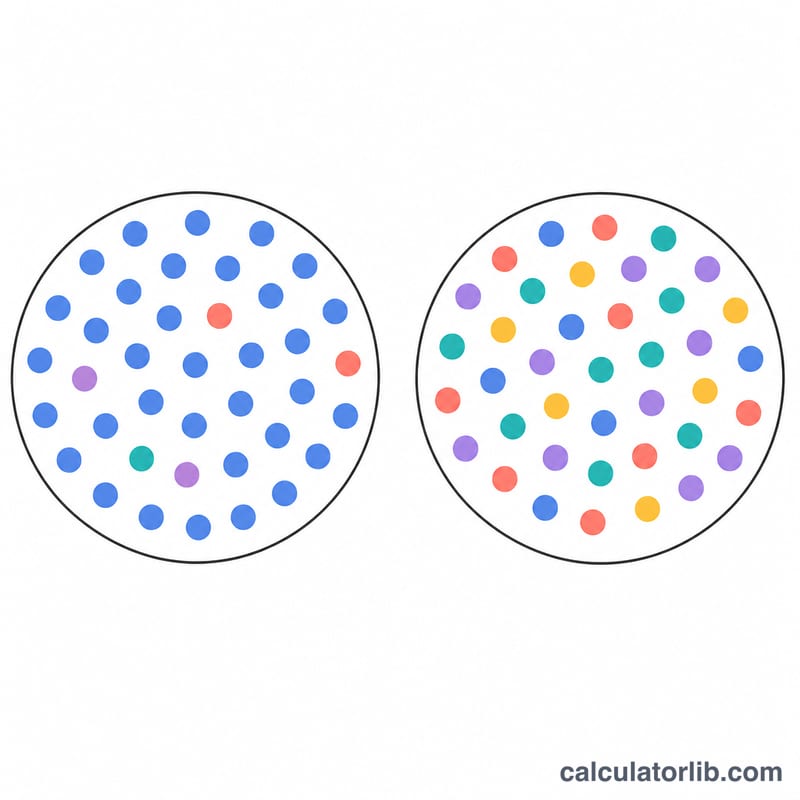
How to use this calculator
Enter the number of individuals counted for each species or category, separated by commas — for example 10, 20, 30, 40. The calculator sums the totals, applies Simpson's formula, and reports the diversity index along with the raw Simpson's Index and the reciprocal (effective species) value, the total count N, and the species richness S.
The formula explained
For each species i with count \(n_i\), compute \(n_i(n_i-1)\). Sum these across all species and divide by \(N(N-1)\), where \(N\) is the total of all individuals. This fraction is Simpson's Index (the probability that two randomly drawn individuals are the same species). Subtracting it from 1 gives Simpson's Diversity Index, which instead represents the probability two random individuals are different species.
$$D = 1 - \frac{\sum n_i\,(n_i - 1)}{N\,(N - 1)} \qquad \text{where } n_i = \text{species counts},\ N = \textstyle\sum n_i$$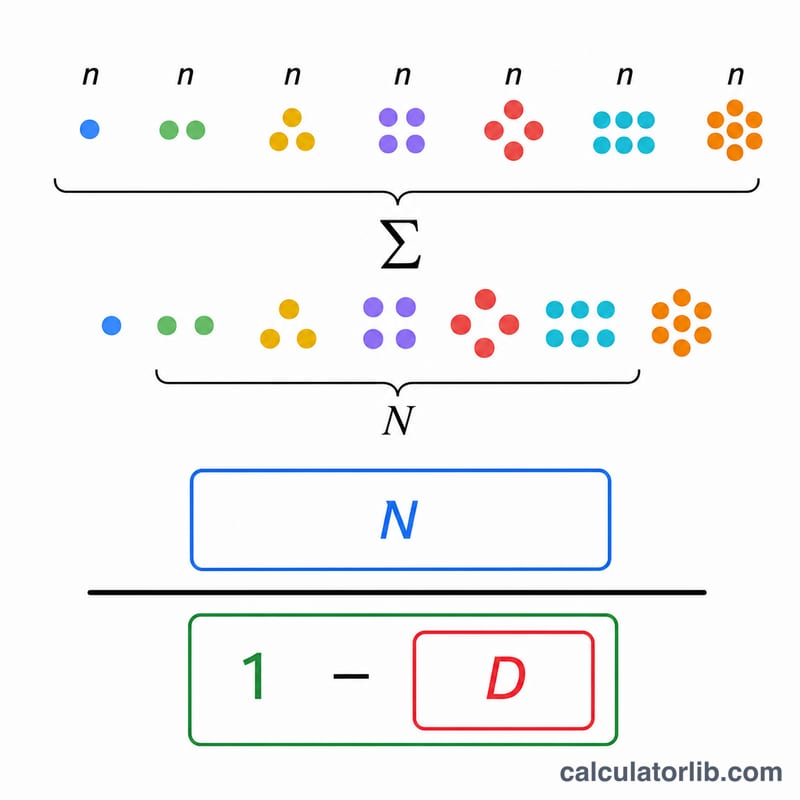
Worked example
Suppose a sample has counts 1, 1, 1 (three species, one individual each). Then \(N = 3\), and \(\sum n_i(n_i-1) = 0+0+0 = 0\) because each \(n_i(n_i-1) = 0\). Simpson's Index $$= \frac{0}{3\times 2} = 0,$$ so \(D = 1 - 0 = 1\), the maximum possible diversity for perfectly even data.
FAQ
Does a higher number mean more diversity? Yes — for the \(D = 1 - \text{Simpson's Index}\) form used here, values near 1 mean high diversity and values near 0 mean a single species dominates.
What is the reciprocal index? \(1/D'\) (where \(D'\) is Simpson's Index) gives the "effective number of species" — the number of equally abundant species that would produce the observed index.
Can I use proportions instead of counts? This calculator uses the count-based formula with \(N(N-1)\), which requires whole-number counts. For proportion data, use the Gini-Simpson form \(1 - \sum p_i^2\).