
What This Calculator Does
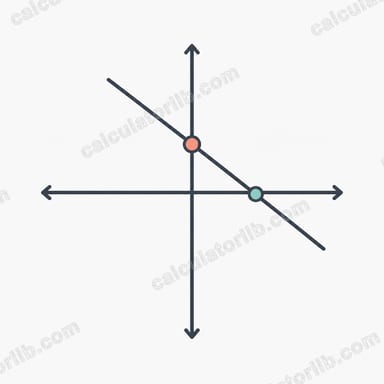
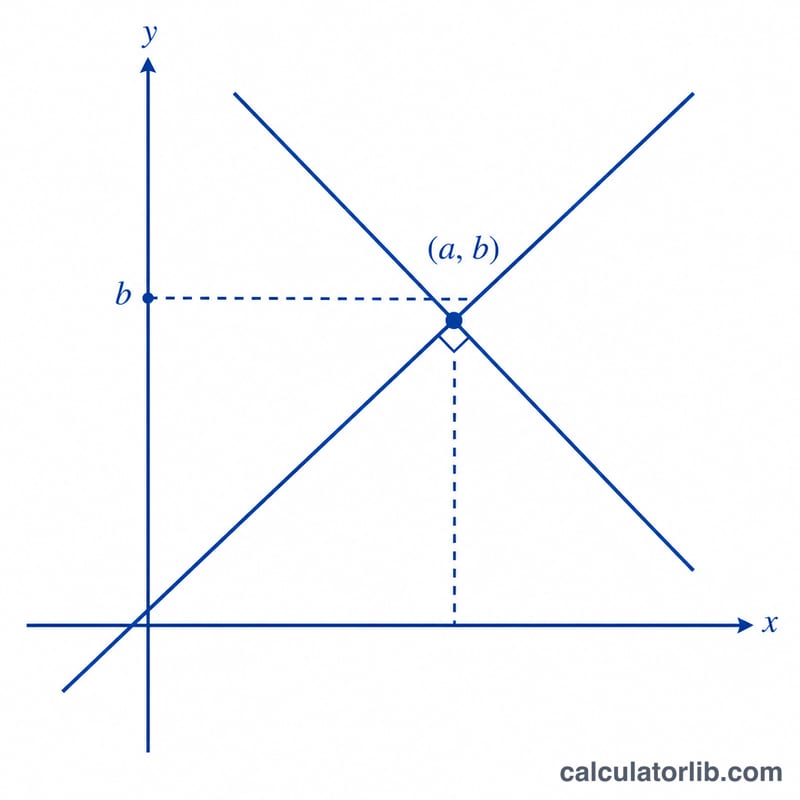
This tool finds the equation of a straight line that is perpendicular to a given line and passes through a specific point. You supply the slope (m) of the original line and the coordinates of a point (x₁, y₁) the new line must pass through. The calculator returns the perpendicular slope and the full equation in slope-intercept form, \(y = mx + b\).
How to Use It
Enter the slope of your original line, then enter the x and y coordinates of the point. Press calculate. If the original slope is zero (a horizontal line), the perpendicular is a vertical line written as \(x = x_1\), since its slope is undefined.
The Formula Explained
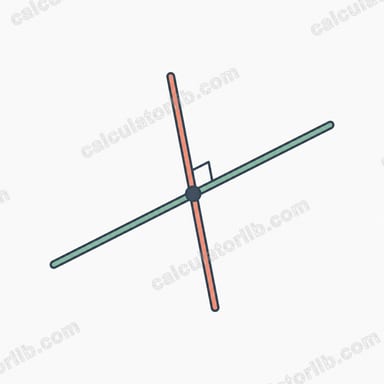
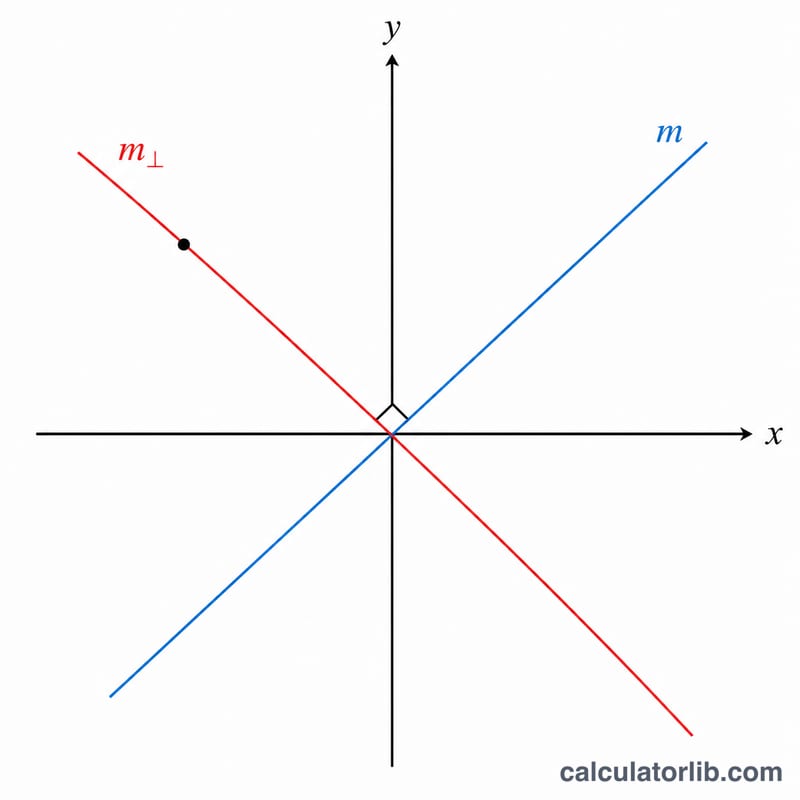
Two lines are perpendicular when the product of their slopes equals −1. So the perpendicular slope is the negative reciprocal: \(m_\perp = -\frac{1}{m}\). To force the new line through the point (x₁, y₁), we use point-slope form: $$y - y_1 = m_\perp\left(x - x_1\right)$$ Rearranging gives slope-intercept form \(y = m_\perp x + b\), where the intercept is \(b = y_1 - m_\perp \cdot x_1\).
Worked Example
Suppose the original line has slope \(m = 2\) and the new line must pass through (1, 3). The perpendicular slope is \(m_\perp = -\frac{1}{2} = -0.5\). The intercept is $$b = 3 - (-0.5)(1) = 3 + 0.5 = 3.5$$ So the perpendicular line is \(y = -0.5x + 3.5\).
FAQ
What if the original slope is 0? A horizontal line (slope 0) has a vertical perpendicular, written \(x = x_1\), because its slope is undefined.
What if the original line is vertical? A vertical line has an undefined slope; its perpendicular is horizontal, \(y = y_1\). This calculator takes a numeric slope, so model a vertical original line as the special case directly.
Why is the slope the negative reciprocal? Rotating a line 90° negates and inverts its rise-over-run, which makes the product of the two slopes equal −1.