
What Is an Equilateral Triangle?
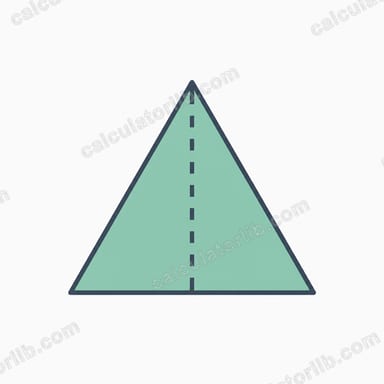
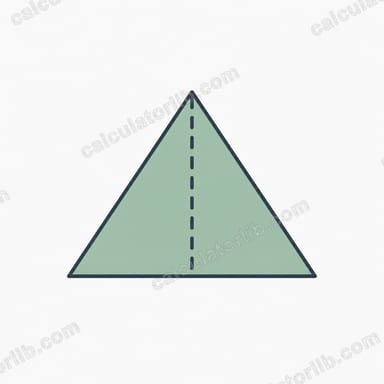
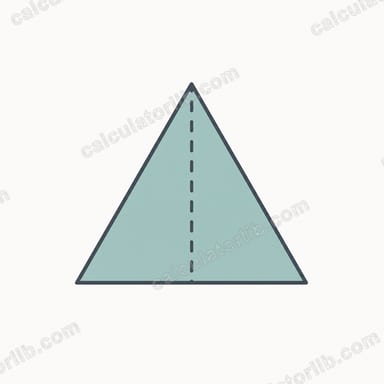
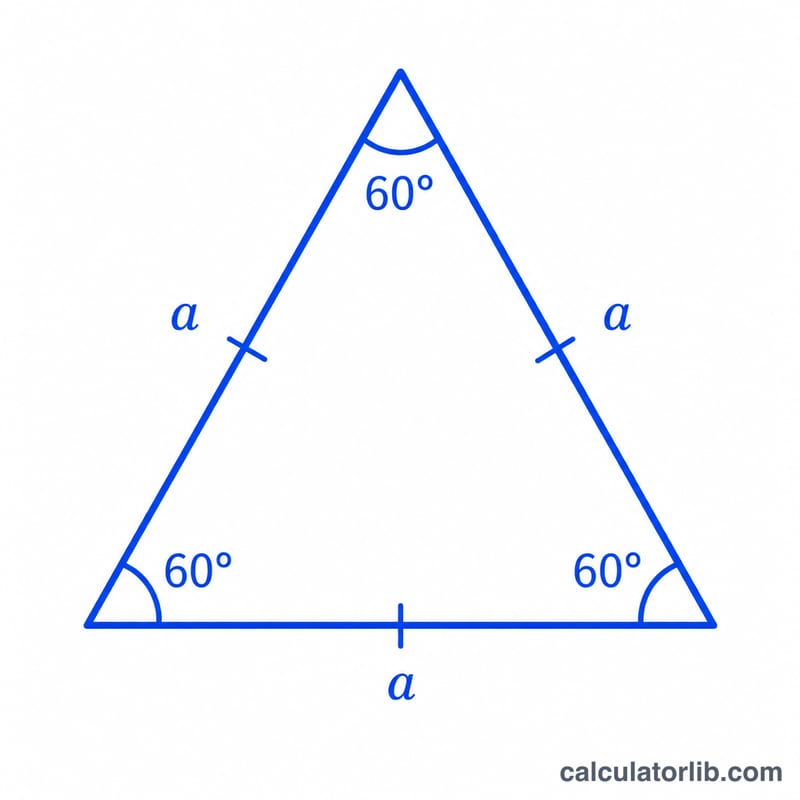
An equilateral triangle is a triangle in which all three sides are equal in length and all three interior angles measure exactly 60°. Because of this perfect symmetry, its area can be found from a single measurement — the side length. This calculator instantly computes the area, perimeter, and height of an equilateral triangle once you enter one side.
How to Use This Calculator
Enter the side length (a) of your equilateral triangle in any unit (cm, m, inches, etc.) and the calculator returns the area in square units of that same unit. It also shows the perimeter (3a) and the height (altitude) for convenience. There is nothing else to configure — the geometry of an equilateral triangle is fully determined by one side.
The Formula Explained
The area of an equilateral triangle is given by:
$$A = \frac{\sqrt{3}}{4} \times a^{2}$$
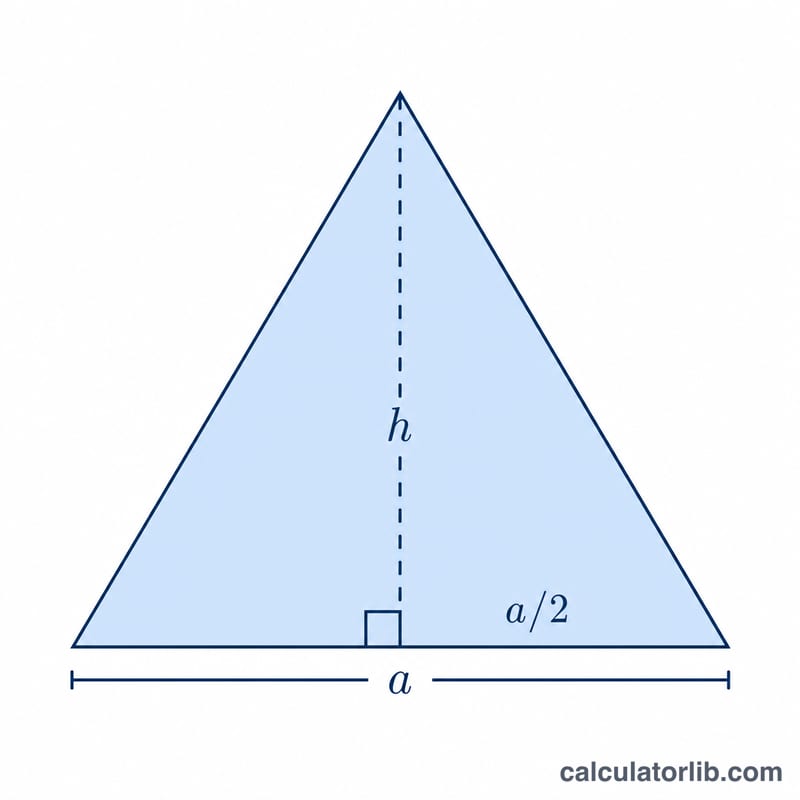
This comes from the general triangle area \(\frac{1}{2} \times \text{base} \times \text{height}\). The base is the side \(a\), and the height of an equilateral triangle is \(\frac{\sqrt{3}}{2}\cdot a\). Multiplying \(\frac{1}{2} \times a \times \frac{\sqrt{3}}{2}\cdot a\) gives \(\frac{\sqrt{3}}{4}\cdot a^{2}\). The constant \(\frac{\sqrt{3}}{4}\) is approximately \(0.4330127\).
Worked Example
Suppose a triangle has a side length of 6 units. Then \(a^{2} = 36\), and $$A = 0.4330127 \times 36 \approx 15.59 \text{ square units}.$$ Its perimeter is \(3 \times 6 = 18\) units, and its height is \(\frac{\sqrt{3}}{2} \times 6 \approx 5.20\) units.
FAQ
Do all sides have to be equal? Yes. This formula only applies to equilateral triangles. For other triangles use Heron's formula or \(\frac{1}{2}\cdot\text{base}\cdot\text{height}\).
What units does the area use? Whatever unit you enter for the side, the area is in that unit squared (e.g. cm → cm²).
Why does √3 appear? It arises from the height of an equilateral triangle, which is derived using the Pythagorean theorem on half the triangle.