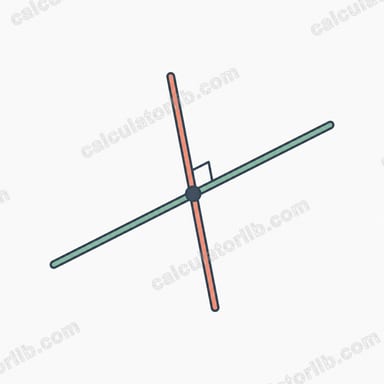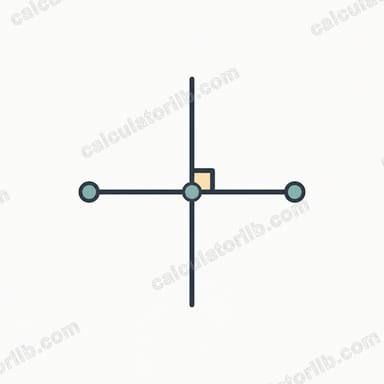

What is a perpendicular bisector?
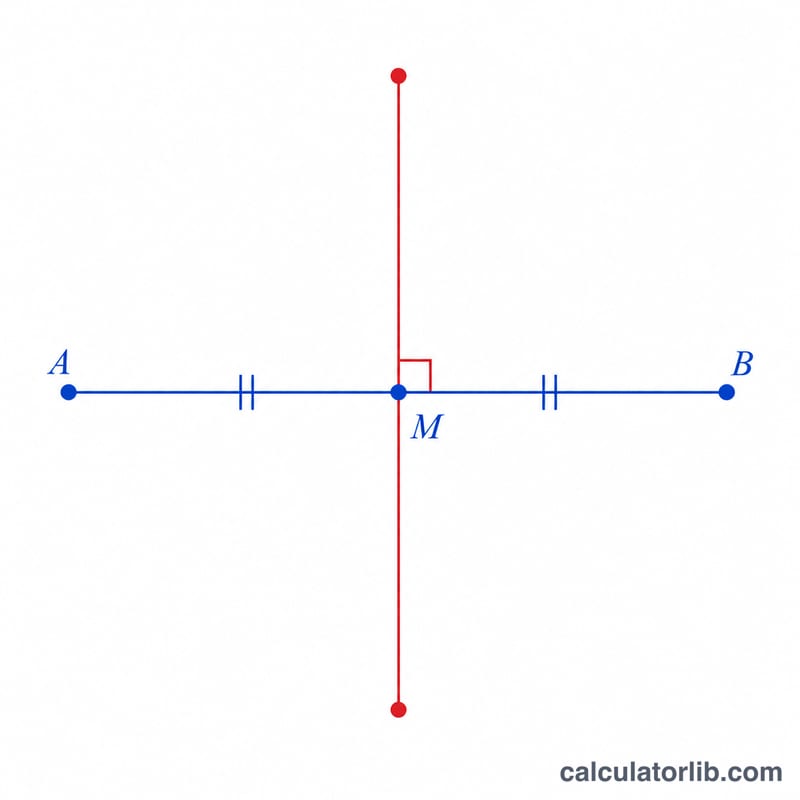
The perpendicular bisector of a line segment is the line that crosses the segment at its exact midpoint and meets it at a 90° angle. Every point on this line is equidistant from the two endpoints, which makes it essential in geometry constructions, finding circumcenters of triangles, and coordinate proofs.
How to use this calculator
Enter the coordinates of the two endpoints of your segment — Point 1 (\(x_1\), \(y_1\)) and Point 2 (\(x_2\), \(y_2\)). The calculator returns the equation of the perpendicular bisector, its slope, the midpoint it passes through, and the y-intercept. It automatically handles special cases such as horizontal segments (giving a vertical bisector) and vertical segments (giving a horizontal bisector).
The formula explained
First find the midpoint \(M = \left(\dfrac{x_1+x_2}{2}, \dfrac{y_1+y_2}{2}\right)\). The segment's slope is \(\dfrac{y_2-y_1}{x_2-x_1}\); the perpendicular bisector uses the negative reciprocal, \(m_\perp = -\dfrac{x_2-x_1}{y_2-y_1}\). Plugging M into point-slope form gives \(y - M_y = m_\perp(x - M_x)\), which rearranges to \(y = m_\perp \cdot x + b\).
$$ y = m\,(x - M_x) + M_y \\[1.5em] \text{where}\quad \left\{ \begin{aligned} m &= -\dfrac{x_2 - x_1}{y_2 - y_1} \\ M_x &= \dfrac{x_1 + x_2}{2} \\ M_y &= \dfrac{y_1 + y_2}{2} \end{aligned} \right. $$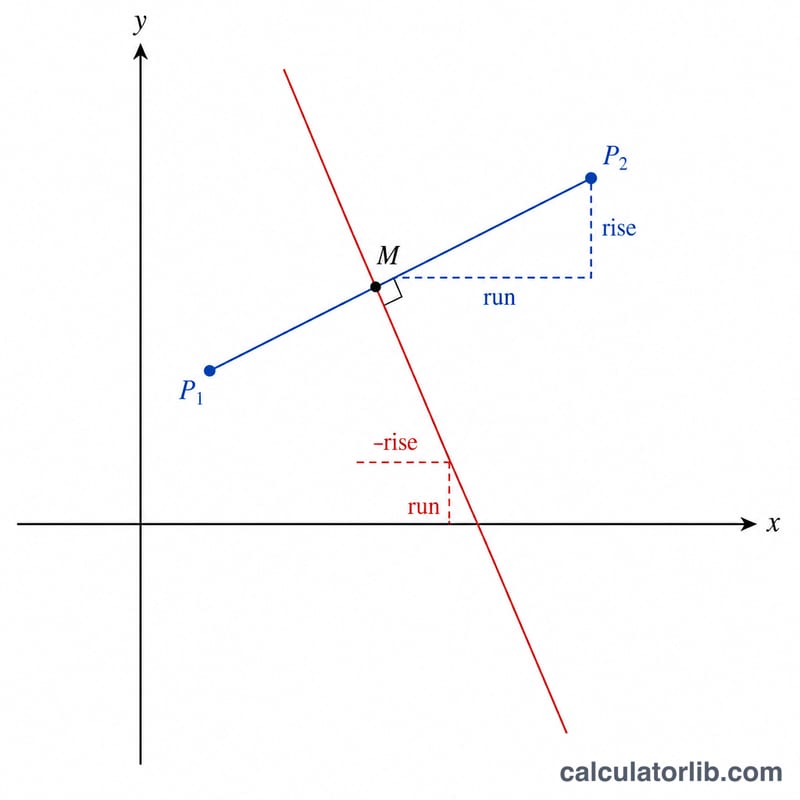
Worked example
For points (1, 2) and (5, 6): midpoint \(M = (3, 4)\). Segment slope \(= \dfrac{6-2}{5-1} = 1\), so \(m_\perp = -1\). Equation:
$$ y - 4 = -1(x - 3), \quad \text{i.e.} \quad y = -x + 7. $$The y-intercept is 7.
FAQ
What if the segment is horizontal? If \(y_1 = y_2\), the segment is horizontal, so its perpendicular bisector is the vertical line \(x = M_x\) with undefined slope.
What if the two points are the same? A single point has no unique perpendicular bisector, so the result is undefined.
Why the negative reciprocal? Perpendicular lines have slopes whose product is \(-1\), so flipping and negating the segment's slope guarantees a 90° intersection.