
What the Sled Ride Calculator Does
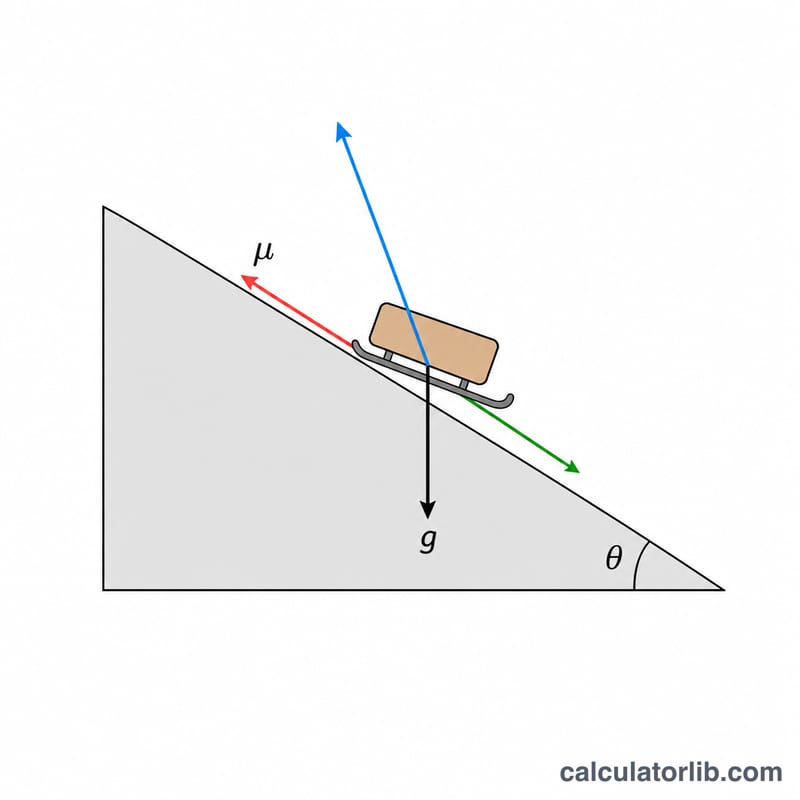
The Sled Ride Calculator is a physics tool that models a sled sitting on a snowy slope and works out the forces and energy acting on it. You enter three values — the sled's mass, the slope angle and the friction coefficient — and it calculates the gravitational force, the components of that force along and into the slope, the friction force, the net force, the resulting acceleration, and related energy figures. It uses a fixed gravitational acceleration of 9.81 m/s² (standard Earth gravity).
The Inputs You Provide
- Sled Mass (kg) — the combined mass of the sled and rider.
- Slope Angle (degrees) — the steepness of the hill, measured from horizontal.
- Friction Coefficient — how slippery the contact is (around 0.02–0.1 for a sled on snow, higher for rougher surfaces).
The Formulas Used
The calculator first finds the weight (gravity force): \(F_g = m \times 9.81\). It then splits this into two parts using the angle \(\theta\):
- Force pulling the sled down the slope: \(F_{\parallel} = F_g \times \sin(\theta)\)
- Force pressing into the slope: \(F_{\perp} = F_g \times \cos(\theta)\)
- Friction force opposing motion: \(F_f = \mu \times F_{\perp}\)
- Net force: \(F_{net} = F_{\parallel} - F_f\)
- Acceleration: \(a = F_{net} / m\)
Combining these gives the acceleration directly:
$$a = \frac{\text{Mass}\,g\sin\theta - \mu\,\text{Mass}\,g\cos\theta}{\text{Mass}}$$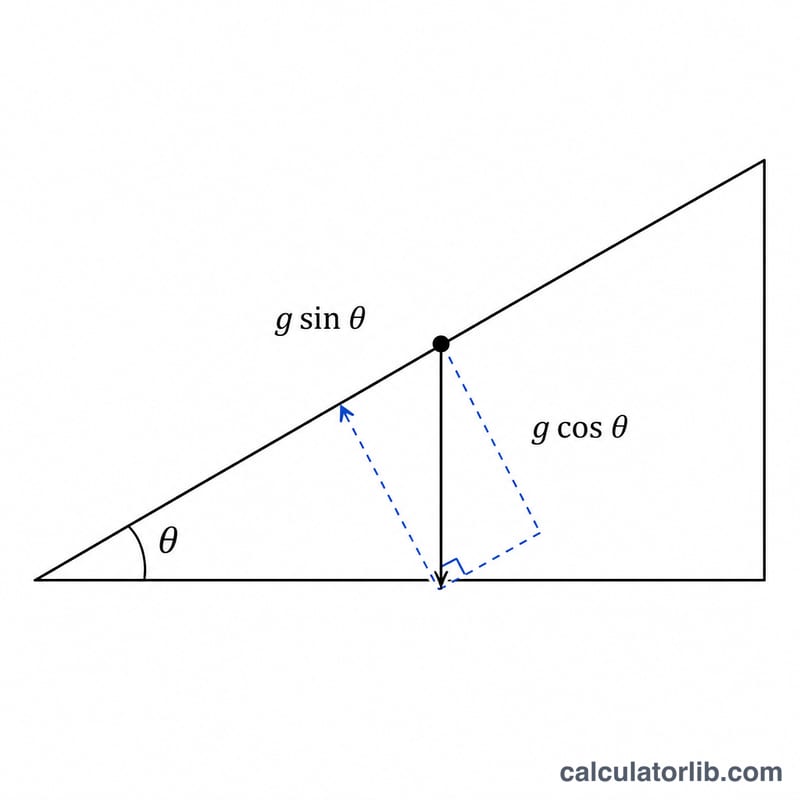
Worked Example
Suppose a sled and rider weigh 60 kg, the slope is 20°, and the friction coefficient is 0.05.
- Gravity force = \(60 \times 9.81 = 588.6\ \text{N}\)
- Parallel force = \(588.6 \times \sin(20°) \approx 201.3\ \text{N}\)
- Perpendicular force = \(588.6 \times \cos(20°) \approx 553.1\ \text{N}\)
- Friction force = \(0.05 \times 553.1 \approx 27.7\ \text{N}\)
- Net force = \(201.3 - 27.7 \approx 173.6\ \text{N}\)
- Acceleration = \(173.6 / 60 \approx 2.89\ \text{m/s}^2\)
So the sled accelerates downhill at about 2.9 metres per second squared.
Frequently Asked Questions
What gravity value does it use? A constant 9.81 m/s², the standard value for Earth's surface.
What if the result is negative? A negative net force or acceleration means friction is strong enough that the sled would not start sliding on its own from rest — it stays put.
Does the angle affect the friction? Yes. As the slope gets steeper, cos(θ) shrinks, so the perpendicular force and therefore the friction force decrease, while the parallel pulling force increases — making the sled accelerate faster.