
What This Calculator Does
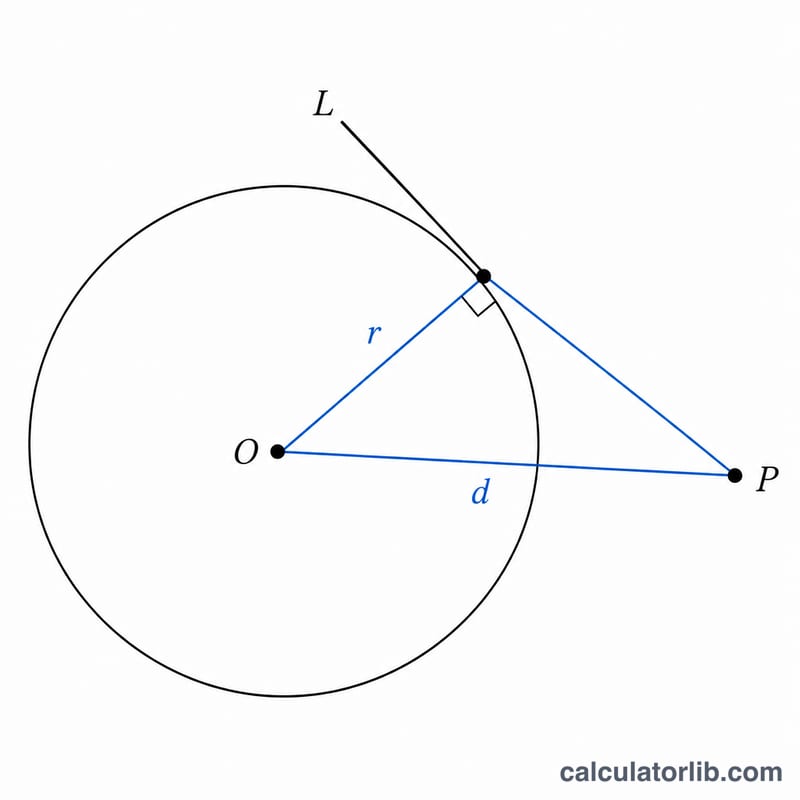
This tool finds the length of a tangent line segment drawn from a point outside a circle to the point where it touches (is tangent to) the circle. Because a tangent line meets a circle at exactly one point and is perpendicular to the radius at that point, the radius, the tangent segment, and the line connecting the external point to the center form a right triangle. The calculator applies the Pythagorean theorem to that triangle.
The Formula
The tangent length is given by $$L = \sqrt{d^{2} - r^{2}}$$ where \(d\) is the straight-line distance from the external point to the circle's center, and \(r\) is the radius of the circle. Here \(d\) is the hypotenuse of the right triangle, \(r\) is one leg (the radius to the tangent point), and \(L\) is the other leg (the tangent segment). For a real tangent to exist, the point must lie outside the circle, so \(d\) must be greater than \(r\).
How to Use It
Enter the distance from your external point to the center of the circle, then enter the circle's radius in the same units. Press calculate to read off the tangent line length. The result is expressed in the same units you used for your inputs.
Worked Example
Suppose a point is 13 units from the center of a circle whose radius is 5 units. Then $$L = \sqrt{13^{2} - 5^{2}} = \sqrt{169 - 25} = \sqrt{144} = 12 \text{ units}.$$ The two tangent lines drawn from that point each have a length of 12 units.
FAQ
Why are the two tangents from a point equal? By symmetry, both tangent segments from an external point to a circle are congruent, so this single length applies to both.
What if \(d\) is less than \(r\)? The point is inside the circle and no tangent line can be drawn; the formula returns no real value, so this calculator shows zero in that case.
What if \(d\) equals \(r\)? The point lies exactly on the circle and the tangent length is zero.