
What Is a Parallel Line Equation?
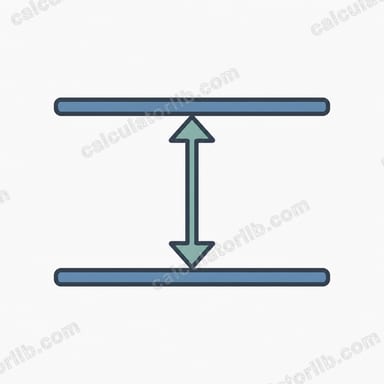
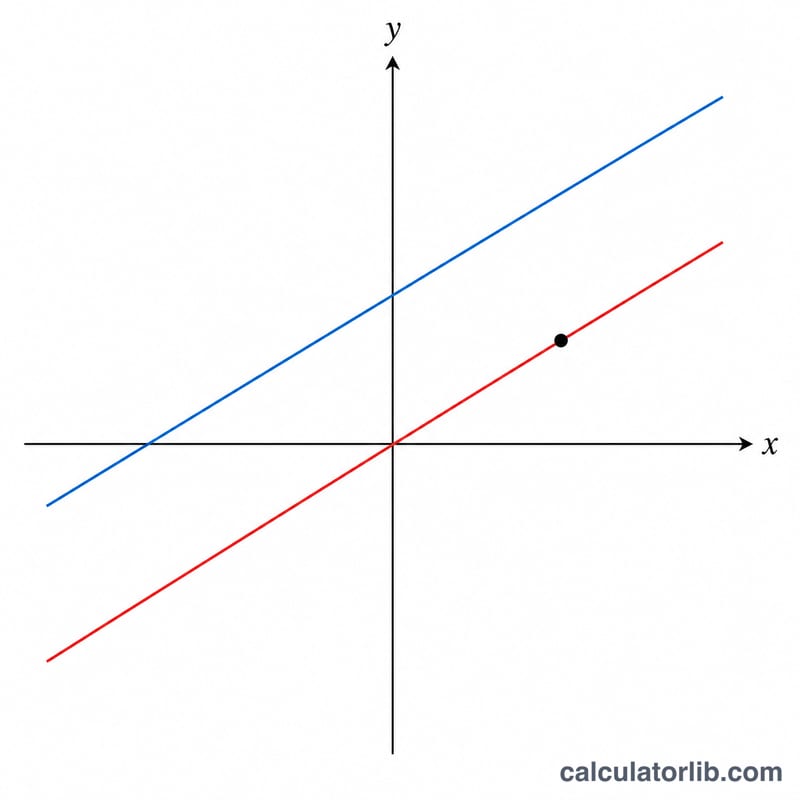
Two lines are parallel when they have exactly the same slope but never intersect. This calculator finds the equation of a line that is parallel to a line of a given slope m and passes through a chosen point (x₁, y₁). Because parallel lines share the same slope, the only thing that changes is the y-intercept. The tool returns the equation in slope-intercept form, \(y = mx + b\).
How to Use It
Enter the slope m of the original line. If you only have the original line's equation, read its slope directly (the coefficient of x in \(y = mx + b\)). Then enter the coordinates of the point the new line must pass through. The calculator computes the y-intercept and displays the full equation.
The Formula Explained
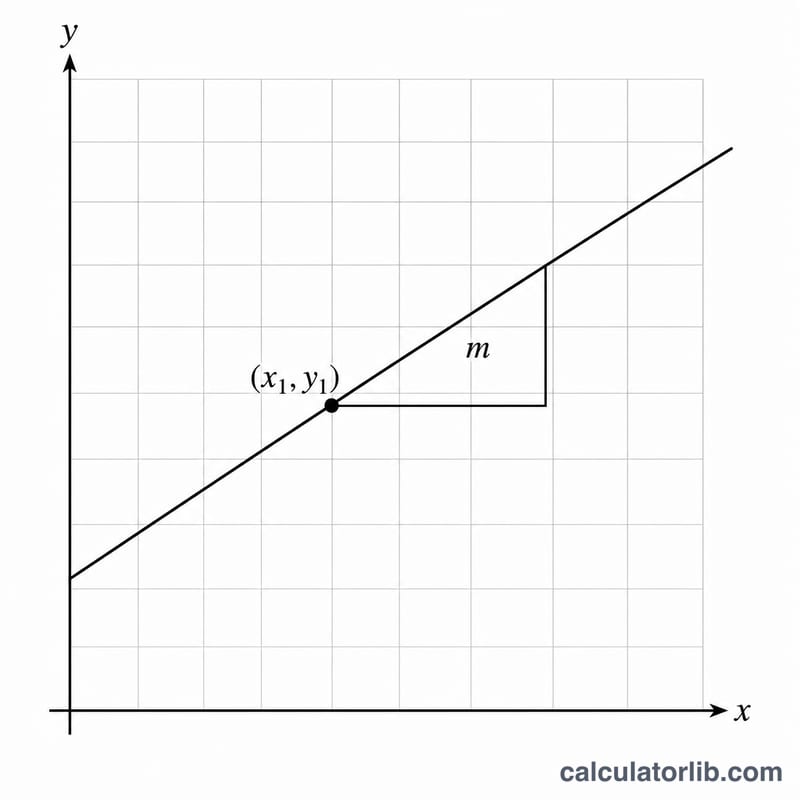
Start from the point-slope form: $$y - y_1 = m(x - x_1)$$ Expanding and solving for y gives $$y = mx + (y_1 - m \cdot x_1)$$ so the new y-intercept is \(b = y_1 - m \cdot x_1\). The slope stays identical to guarantee the lines are parallel.
Worked Example
Find the line parallel to one with slope \(m = 2\) passing through (3, 5). Compute $$b = 5 - 2 \cdot 3 = 5 - 6 = -1$$ The equation is \(y = 2x - 1\). You can verify: at \(x = 3\), \(y = 2(3) - 1 = 5\) ✓.
FAQ
What slope do parallel lines have? Identical slopes. If line A has slope 2, every line parallel to it also has slope 2.
How is this different from a perpendicular line? Perpendicular lines have slopes that are negative reciprocals (\(m\) and \(-1/m\)), while parallel lines keep the same slope.
What if my slope is zero? A slope of 0 is a horizontal line; the parallel line is \(y = y_1\), a constant.