
What Is the Watts to dBm Calculator?
This tool converts electrical or radio-frequency (RF) power expressed in watts (W) into decibel-milliwatts (dBm). The dBm unit is a logarithmic measure of power relative to a fixed reference of one milliwatt (1 mW). It is widely used in telecommunications, antenna engineering, Wi-Fi, and audio because it turns huge ranges of power into manageable, easy-to-add numbers.
How to Use It
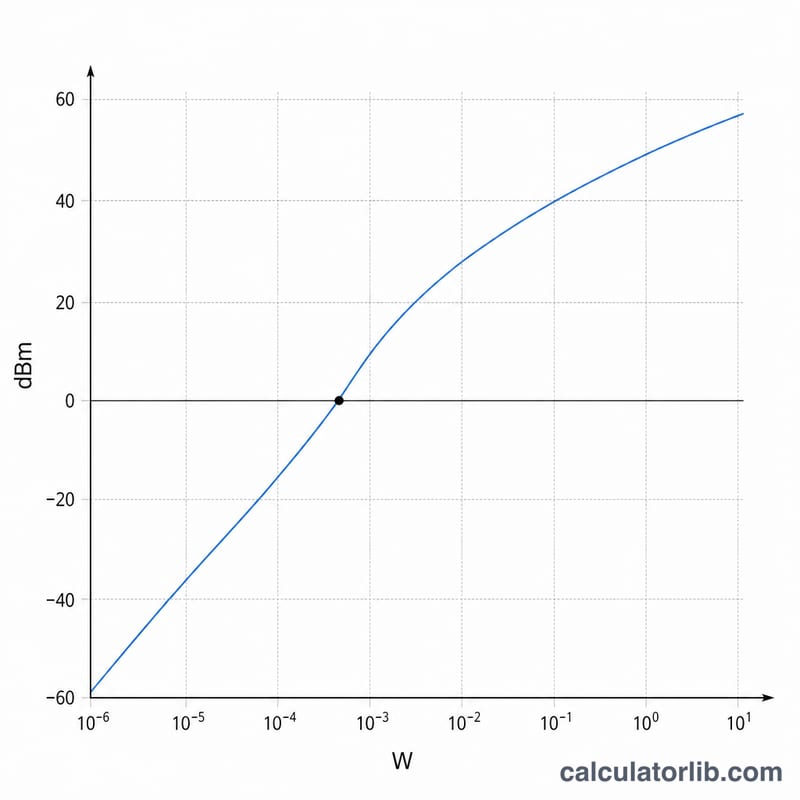
Enter the power value in watts and the calculator instantly returns the equivalent power in dBm, along with the value in milliwatts. Use decimals for fractional values — for example, 0.001 W equals exactly 0 dBm, and 1 W equals about 30 dBm.
The Formula Explained
The conversion uses the logarithmic relationship:
$$P_{\text{dBm}} = 10 \cdot \log_{10}\!\left(\frac{P_W}{0.001}\right)$$Here \(P_W\) is the power in watts, and 0.001 W (= 1 mW) is the reference power. Multiplying the base-10 logarithm by 10 converts the ratio into decibels. Every 10× increase in power adds 10 dB, and every 2× increase adds about 3 dB.
Worked Example
Suppose a transmitter outputs 2 watts. First, \(2 \text{ W} \div 0.001 = 2000\). Then \(\log_{10}(2000) \approx 3.30103\). Multiplying by 10 gives 33.01 dBm. So a 2 W signal equals about 33 dBm.
FAQ
How many dBm is 1 watt? Exactly 30 dBm, because \(\log_{10}(1000) = 3\) and \(3 \times 10 = 30\).
What is 0 dBm in watts? 0 dBm equals 1 milliwatt, or 0.001 watts.
Can I enter very small powers? Yes. For powers below 1 mW the dBm value becomes negative; for example 0.0001 W (0.1 mW) equals −10 dBm. Power must be greater than zero because the logarithm of zero is undefined.