
What Is an RF Link Budget?
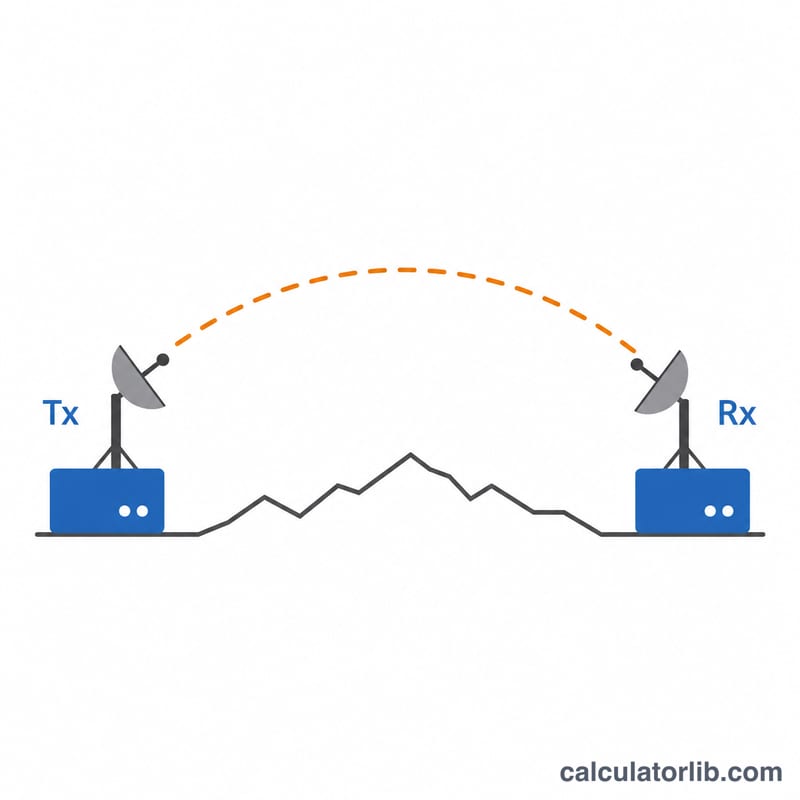
An RF link budget is an accounting of all the gains and losses a signal experiences as it travels from a transmitter to a receiver. By summing transmit power, antenna gains, propagation (path) loss, and miscellaneous system losses, engineers can predict the received signal power at the far end of a wireless link. This calculator works in the logarithmic decibel domain, where all quantities simply add and subtract — making the math fast and intuitive.
How to Use This Calculator
Enter your transmitter output power in dBm, the gain of the transmit antenna in dBi, the total path loss in dB (free-space plus any additional attenuation), the receive antenna gain in dBi, and any other system losses such as cable, connector, or feedline losses in dB. The calculator returns the received signal power in dBm and the EIRP (effective isotropic radiated power) of your transmit chain.
The Formula Explained
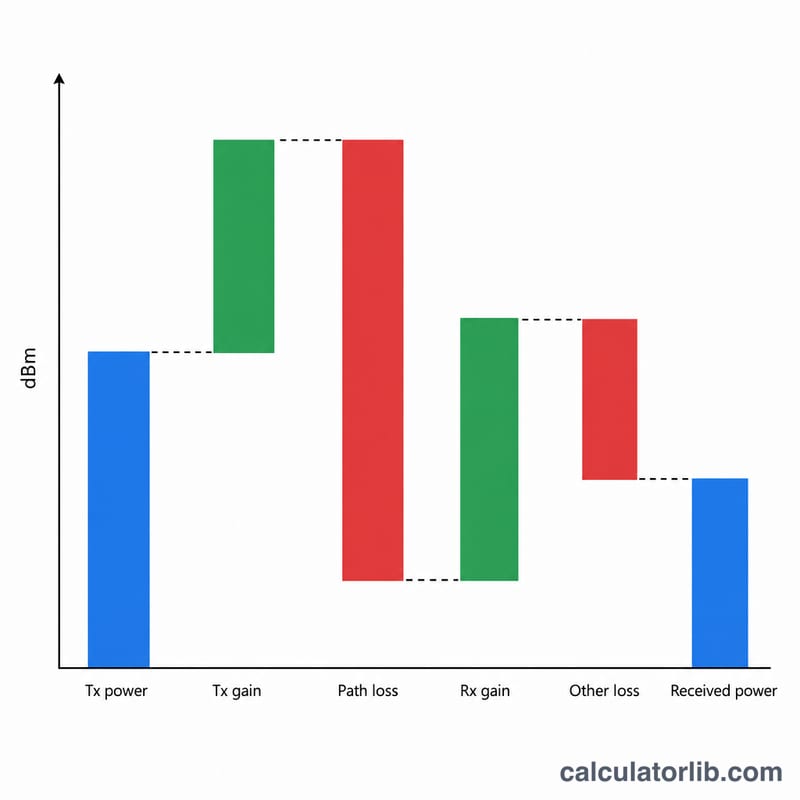
The core equation is: $$P_{rx} = \text{Tx Power} + \text{Tx Gain} - \text{Path Loss} + \text{Rx Gain} - \text{Other Losses}$$ Because decibels are logarithmic, every gain adds and every loss subtracts. The received power can then be compared against the receiver sensitivity to determine your link margin — a positive margin means a workable link.
Worked Example
Suppose a transmitter outputs 30 dBm into a 10 dBi antenna. The path loss is 100 dB, the receive antenna provides 10 dBi, and cable/connector losses total 3 dB. The received power is $$30 + 10 - 100 + 10 - 3 = -53 \text{ dBm}$$ and the EIRP is $$30 + 10 = 40 \text{ dBm}$$ If your receiver sensitivity is −90 dBm, you enjoy a healthy 37 dB link margin.
FAQ
What is the difference between dBm and dBi? dBm is an absolute power level referenced to 1 milliwatt, while dBi is a relative antenna gain referenced to an isotropic radiator. They combine directly in the link budget.
What counts as "other losses"? These include coaxial cable loss, connector loss, polarization mismatch, pointing error, atmospheric absorption, and any fade margin you choose to reserve.
How do I find path loss? Free-space path loss can be computed from distance and frequency, then increased to account for obstacles, multipath, and rain fade depending on your environment.