
What is the PoE Power Budget Calculator?
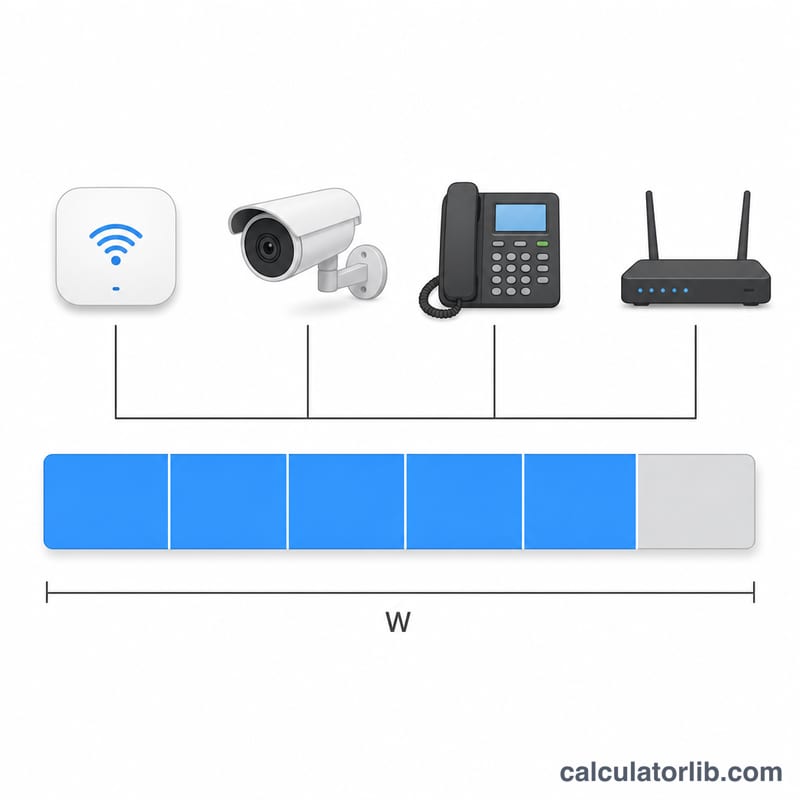
Power over Ethernet (PoE) switches deliver electrical power and data over the same cable. Every switch has a finite PoE power budget — the total wattage it can hand out across all ports at once. This calculator tells you how many powered devices (IP cameras, access points, VoIP phones, etc.) a given budget can support, plus how much headroom remains for your planned deployment.
How to use it
Enter your switch's total PoE power budget in watts (find it on the datasheet, e.g. 370 W). Choose the IEEE PoE class that matches your devices, or type a custom per-device wattage to override the class. Optionally enter how many devices you plan to connect to see the total draw, remaining budget and utilization percentage.
The formula explained
The maximum device count is simply the budget divided by the power each device draws, rounded down because you cannot power a fraction of a device:
$$\text{Max Devices} = \left\lfloor \frac{\text{Switch Budget}}{\text{Device Power}} \right\rfloor$$
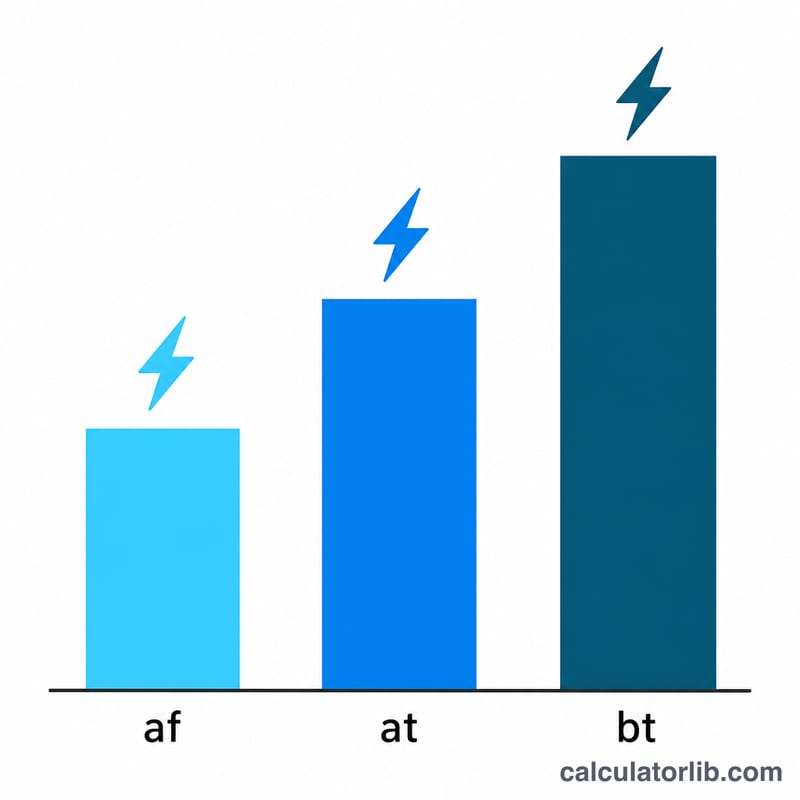
Standard PoE class ceilings (power available at the powered device) are roughly: Class 1 = 3.84 W, Class 2 = 6.49 W, Class 3 = 13 W (802.3af), Class 4 / PoE+ = 25.5 W (802.3at), Class 6 = 51 W and Class 8 = 71.3 W (802.3bt). Using the class maximum gives a conservative, safe estimate.
Worked example
A switch advertises a 370 W PoE budget. You want to power PoE+ access points at 25.5 W each. $$\text{Max devices} = \left\lfloor \frac{370}{25.5} \right\rfloor = \lfloor 14.5 \rfloor = \textbf{14 devices}$$ If you plan 12 devices, total draw \(= 12 \times 25.5 = 306\) W, leaving 64 W of headroom and 82.7% utilization.
FAQ
Should I use class power or measured power? Class power is the worst-case maximum and keeps you safe. If you know the real average draw of your devices, use the custom field for a tighter estimate.
Why round down? A switch can only fully power whole devices; the last partial slot has insufficient budget and may cause ports to be denied power.
Does cable length matter? Yes — long runs lose power as heat, so the device sees less than the port delivers. The class figures here already reflect power at the device end for typical 100 m runs.