
What this calculator does
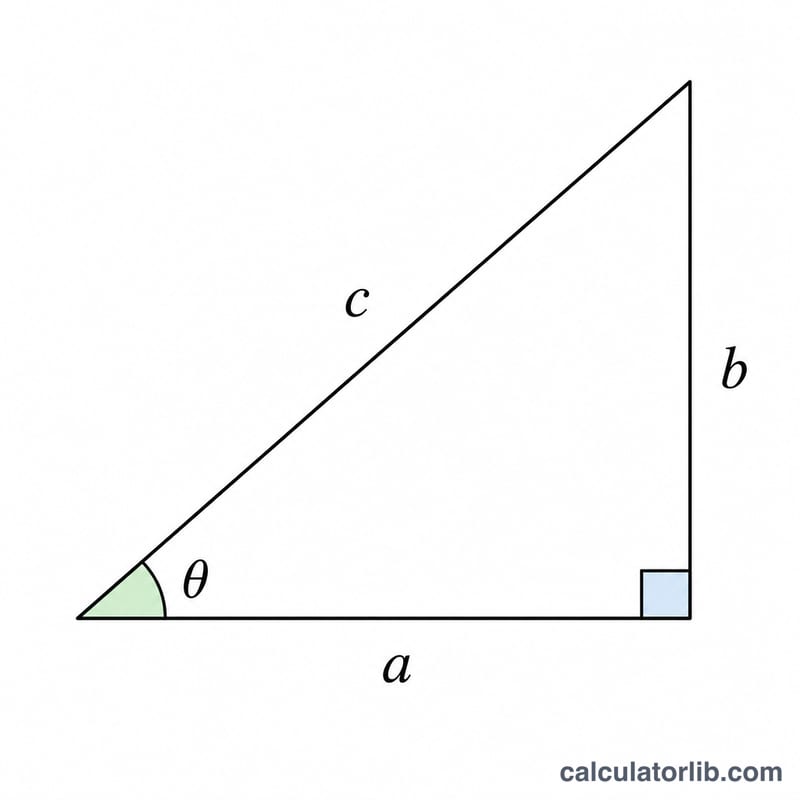
This tool solves a right triangle when you know the base a (the side adjacent to the angle) and the slope angle theta measured between the base and the hypotenuse. It returns the hypotenuse c and the height b (the side opposite the angle). It is pure trigonometry and works in any consistent length unit (mm, cm, m, inches) and in any country.
How to use it
Enter the base length and the angle in decimal degrees, then read off the hypotenuse and height. Common uses include woodworking and DIY layout, road and ramp slope/incline calculations, CNC V-cutting depths, and line-of-sight estimates. If your angle is given in degrees-minutes-seconds, convert it first: \(\text{decimal degrees} = \text{degrees} + \text{minutes}/60 + \text{seconds}/3600\) (for example \(5\deg\ 12\min\ 6\sec = 5 + 12/60 + 6/3600 = 5.2017\) degrees).
The formula explained
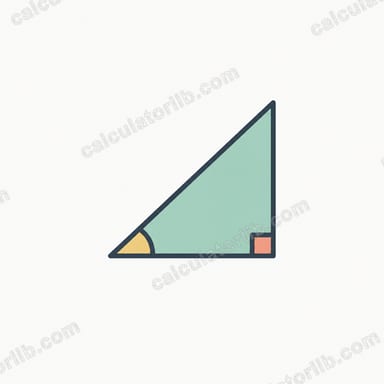
In a right triangle the right angle sits between base a and height b. The angle theta is between a and the hypotenuse c. So a is adjacent to theta and b is opposite it, giving the standard relations \(\cos\theta = a / c\), \(\sin\theta = b / c\), and \(\tan\theta = b / a\). Rearranging gives the working formulas:
$$c = \frac{a}{\cos\theta} \qquad \text{and} \qquad b = a \cdot \tan\theta$$ The angle is converted to radians with \(\theta_{\text{rad}} = \theta \times \frac{\pi}{180}\) before evaluating the trig functions.
Worked example
With \(a = 1\) and \(\theta = 30\) degrees: \(\cos 30\degree = 0.8660254\), so $$c = \frac{1}{0.8660254} = 1.154701.$$ \(\tan 30\degree = 0.5773503\), so $$b = 1 \cdot 0.5773503 = 0.577350.$$ With \(a = 10\) and \(\theta = 45\) degrees: $$c = \frac{10}{\cos 45\degree} = 14.142136 \qquad \text{and} \qquad b = 10 \cdot \tan 45\degree = 10.$$
FAQ
Why must the angle stay below 90 degrees? At exactly 90 degrees \(\cos\theta = 0\), so \(c = a / 0\) is undefined and the triangle is degenerate. Valid input is \(0 \le \theta < 90\).
What unit are the results in? The same unit as the base you enter. The math is unit-agnostic, so a base in millimeters yields a hypotenuse and height in millimeters.
Can the base be zero? A zero base collapses the triangle to a point, giving \(c = 0\) and \(b = 0\); use a positive length for a real triangle.