
What is the Wells Score for DVT?
The Wells Score for deep vein thrombosis (DVT) is a validated clinical prediction rule that estimates the pretest probability that a patient with leg symptoms has a deep vein thrombosis. Developed by Dr. Philip Wells and colleagues, it combines ten readily available clinical findings into a single weighted point total used to guide further testing such as D-dimer assays and compression ultrasonography.
How to use this calculator
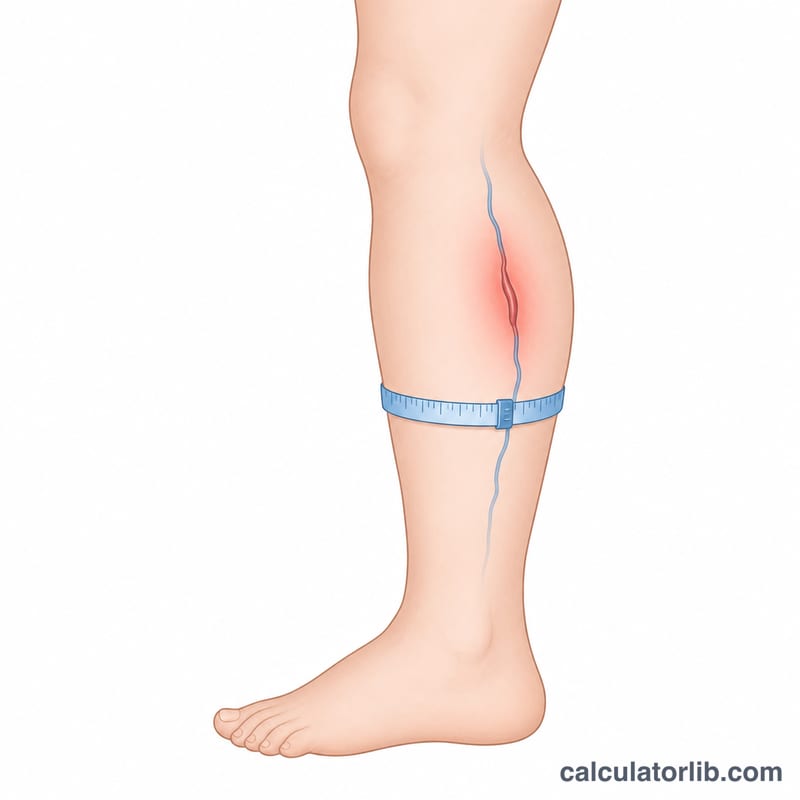
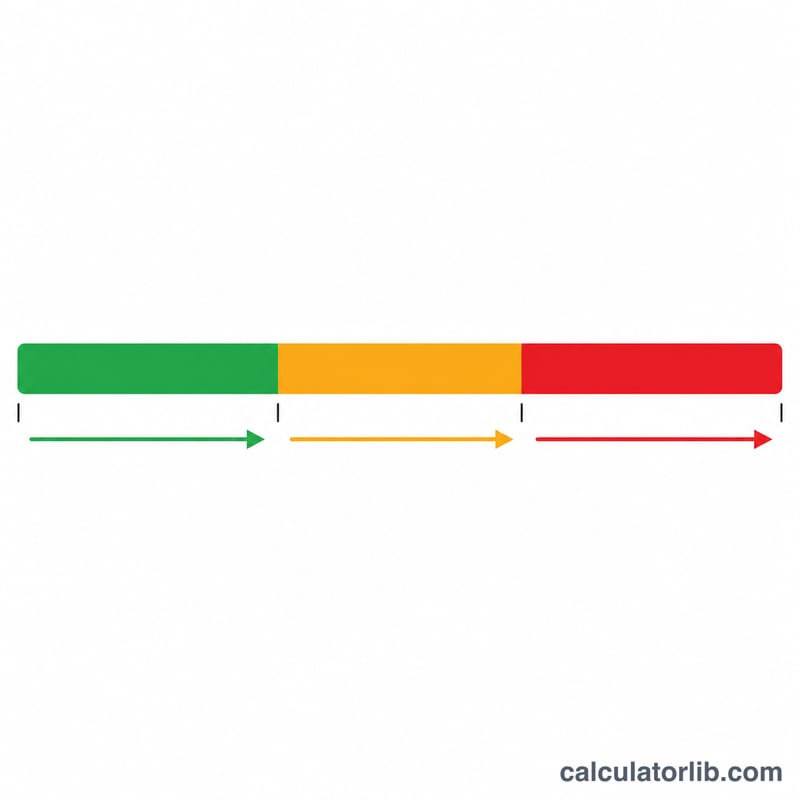
Tick each clinical criterion that applies to your patient. Nine criteria each add +1 point. The final criterion — "an alternative diagnosis is at least as likely as DVT" — subtracts 2 points. The calculator sums the points instantly and returns the total along with a three-tier risk band: low (≤0), moderate (1–2), or high (≥3) probability of DVT.
The formula explained
$$\text{Score} = \text{(active cancer)} + \text{(paralysis/cast)} + \text{(bedridden/recent surgery)} + \text{(deep vein tenderness)} + \text{(entire leg swollen)} + \text{(calf swelling} > 3\text{ cm)} + \text{(pitting edema)} + \text{(collateral superficial veins)} + \text{(previous DVT)} - 2 \times \text{(alternative diagnosis as likely)}$$ Each positive item is worth 1 point except the alternative-diagnosis item, which is −2.
Worked example
A patient has active cancer (+1), localized deep-vein tenderness (+1), an entire swollen leg (+1), and calf swelling greater than 3 cm (+1), with no alternative diagnosis. Total = $$1 + 1 + 1 + 1 = \mathbf{4},$$ placing them in the high-probability category, where proceeding directly to ultrasound is often recommended.
FAQ
Is this a diagnosis? No. The Wells Score estimates probability only and must be combined with D-dimer testing and/or imaging and clinical judgment.
What is the two-tier version? Some protocols use ≥2 = "DVT likely" and <2 = "DVT unlikely." This tool uses the three-tier (low/moderate/high) cutoffs.
Can the score be negative? Yes. If the alternative-diagnosis criterion is selected with few or no other points, the total can be −2, indicating low probability.