

What is the six-month passport rule?
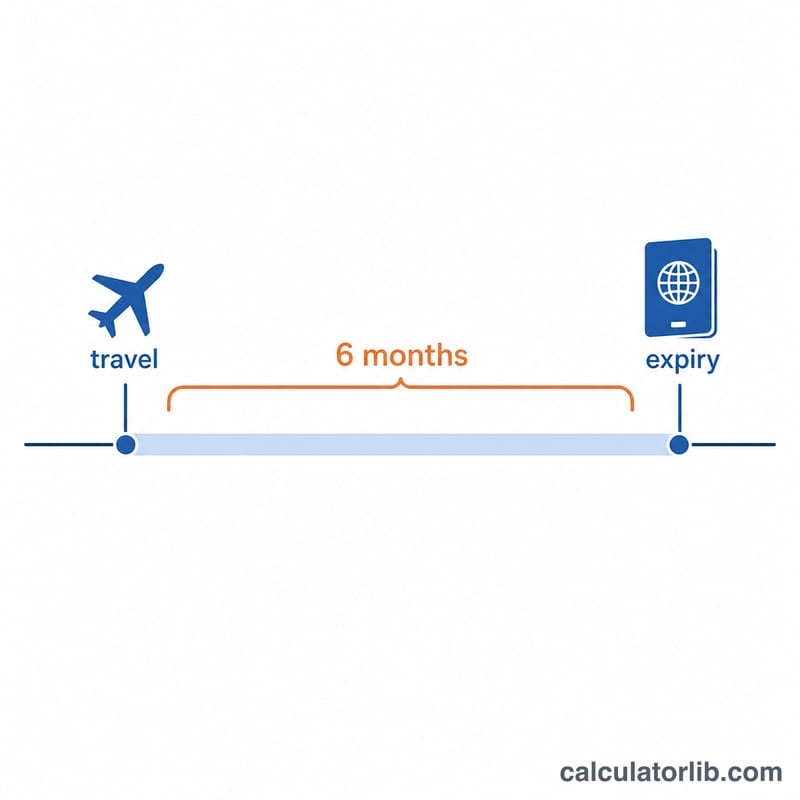
Many countries will not let you enter unless your passport is valid for at least six months beyond your date of arrival (some require three months, others demand validity for the entire stay). This checker compares your passport expiry date against your travel date plus the months of validity required, and tells you whether you are likely clear to travel — and by how large a margin.
How to use it
Enter the date you plan to enter the destination country, your passport's expiry date, and the number of months of validity required (6 is the most common). The tool reports a clear "OK to travel" or "may be denied entry" verdict, the number of days until your passport expires, and your buffer (or shortfall) versus the required cutoff date.
The formula explained
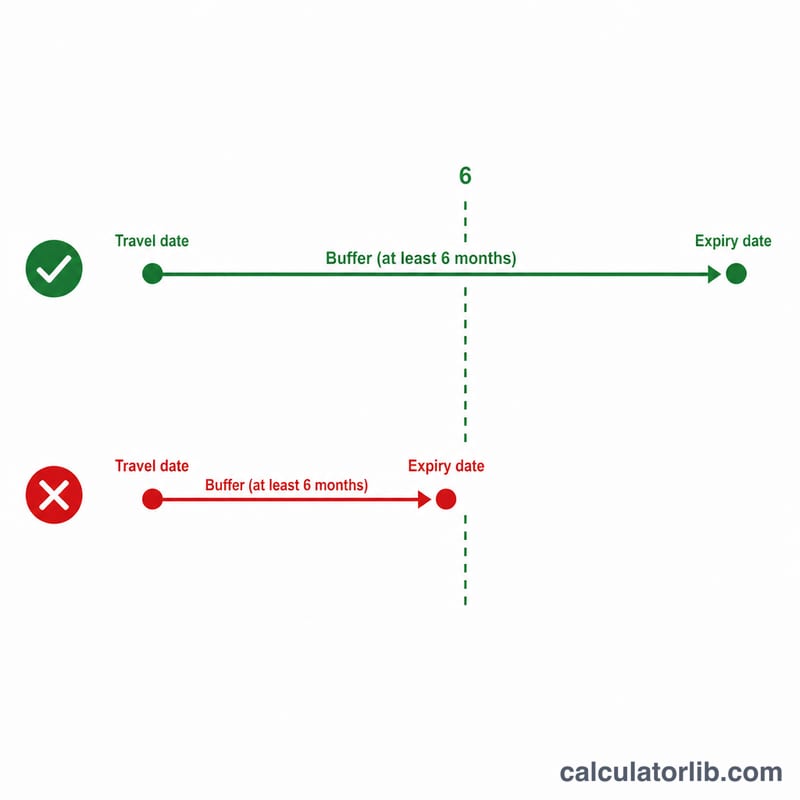
The rule is simple: take your travel date and add the required number of months to get a cutoff date. If your passport expiry is on or after that cutoff, you pass. The buffer is the number of days between the cutoff and your expiry — a positive buffer is spare validity, a negative one is a shortfall you need to fix by renewing.
$$\text{Required Date} = \text{Travel Date} + \text{Months Required}\ \text{months}, \quad \text{Valid} \iff \text{Expiry Date} \geq \text{Required Date}$$
$$\begin{gathered} \text{Required} = \text{Travel Date} + \text{Months Required}\ \text{mo} \\[1.5em] \text{Valid} \iff \text{Expiry Date} \geq \text{Required} \\[1em] \text{Buffer (days)} = \text{Expiry Date} - \text{Required} \end{gathered}$$
Worked example
Suppose you travel on 1 June 2024 and your passport expires on 15 January 2025, with a 6-month requirement. Adding 6 months to 1 June 2024 gives a cutoff of 1 December 2024. Because 15 January 2025 is after 1 December 2024, you pass — with a buffer of \(45\) days. Your passport is also valid for \(228\) days from travel.
$$\text{1 June 2024} + 6\ \text{months} = \text{1 December 2024}$$
$$\text{15 January 2025} \geq \text{1 December 2024} \implies \text{Valid}$$
$$\text{Buffer} = \text{15 January 2025} - \text{1 December 2024} = 45\ \text{days}$$
FAQ
Is six months always the requirement? No. Rules vary by destination and even by airline. Always confirm with the embassy or official government travel advisory for your specific destination.
Is the rule measured from departure or arrival? Usually from your date of arrival/entry, which is why this tool asks for your travel/entry date. Use the latest entry date if you have multiple stops.
Does this guarantee entry? No. This is an informational estimate only; final admission is at the discretion of border authorities. Renew early if your buffer is small.