

What is the Schengen 90/180 rule?
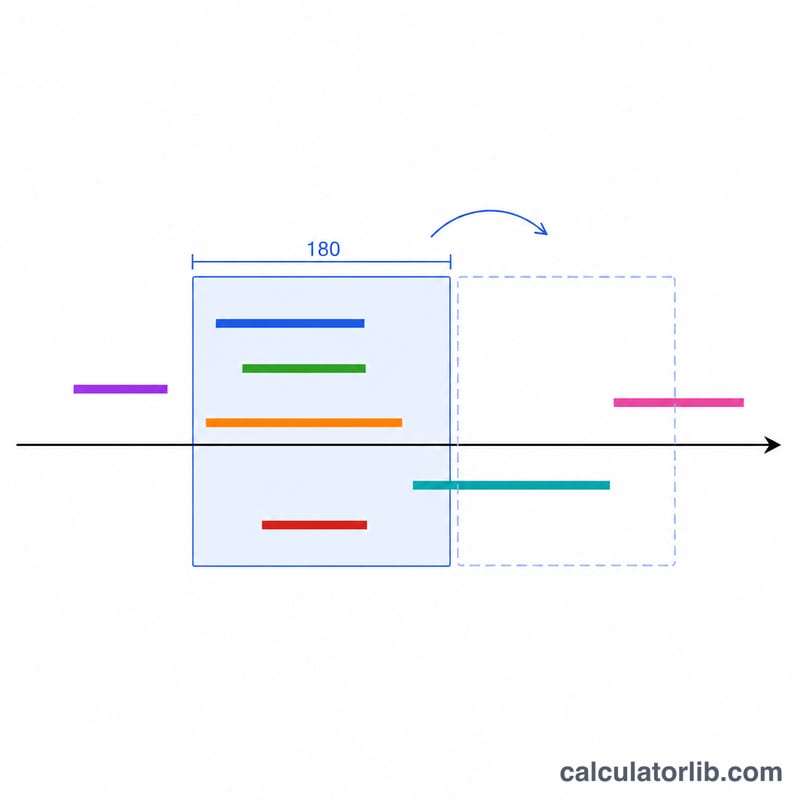
This calculator applies to the Schengen Area in Europe (most EU countries plus Iceland, Norway, Switzerland and Liechtenstein). Under the short-stay rule, non-EU visitors and visa-exempt travellers may spend a maximum of 90 days within any rolling 180-day period. The 180-day window is not fixed to a calendar year — it moves: for any given day you look back at the previous 180 days (the day itself plus the 179 days before it) and count how many of those days you were present.
How to use it
Pick a reference date — usually the day you plan to enter or the day you want to verify. Then enter the entry and exit dates of every Schengen trip in the last six months (and any planned trips). Both the entry day and the exit day count as days of presence. The calculator sums all days that fall inside the trailing 180-day window and subtracts that from 90.
The formula explained
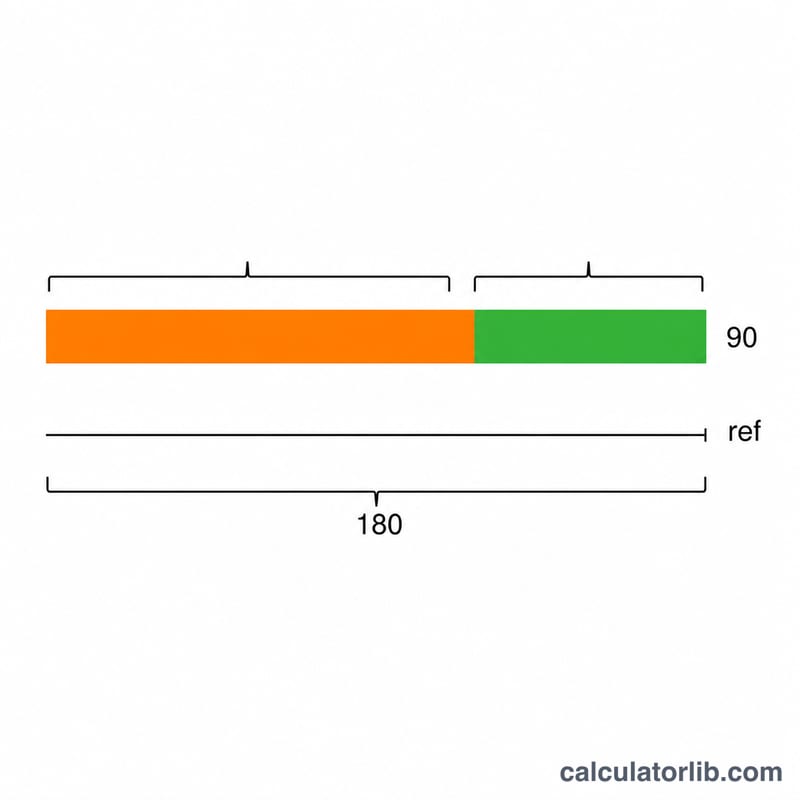
For each trip, the days counted are the overlap between the trip and the window \([ \text{ref} - 179,\ \text{ref} ]\). The number of overlapping days is \(\min(\text{exit}, \text{ref}) - \max(\text{entry}, \text{ref}-179) + 1\) (only when this is positive). Summing across all trips gives \(\text{DaysUsed}\); $$\text{Remaining} = 90 - \text{DaysUsed}.$$ A negative remaining means you would be in overstay.
Worked example
Reference date 1 June 2024. Window is 4 December 2023 to 1 June 2024. Trip A: 1–10 January 2024 = 10 days. Trip B: 1–20 March 2024 = 20 days. Total used = 30 days, so remaining = $$90 - 30 = 60 \text{ days}.$$
FAQ
Do entry and exit days both count? Yes — official EU guidance counts the day of arrival and the day of departure as full days of stay.
Does the 180 days reset? No. It is a continuously moving window, so days "fall off" as they pass out of the trailing 180 days.
Is this legal advice? No. It is an estimate to help you plan; always confirm with the relevant authorities, as some long-stay visas and bilateral agreements have different rules.