What is the Road Trip Time Calculator?
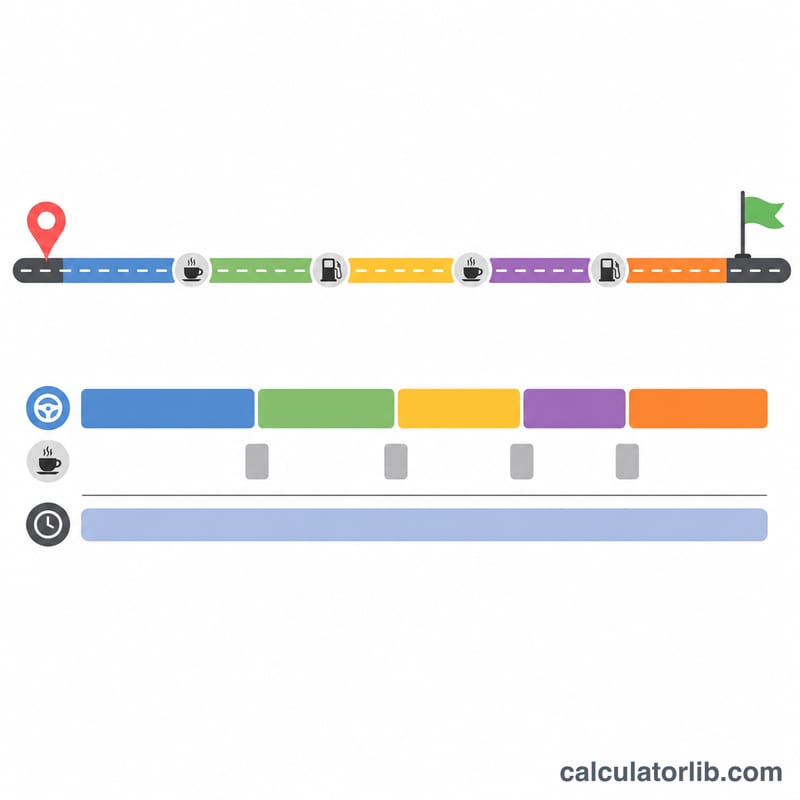
Online maps often show pure driving time, but real road trips include fuel stops, meal breaks, and stretch-your-legs pauses. This calculator gives a more realistic arrival estimate by adding your rest stops to the driving time, so you can plan departure times and overnight stays with confidence.
How to use it
Enter the total distance of your trip, your expected average speed (account for traffic and slower roads, not just the speed limit), the number of stops you plan to make, and the average minutes per stop. The calculator returns your total trip time in hours and minutes, broken down into driving time and break time.
The formula explained
The math is straightforward. Driving time equals distance divided by average speed. Break time equals the number of stops multiplied by minutes per stop, divided by 60 to convert minutes to hours:
$$\text{Total Time} = \frac{\text{Distance}}{\text{Average Speed}} + \frac{\text{Stops} \times \text{Minutes per Stop}}{60}$$
Choosing a realistic average speed is the most important step — highway trips with city sections often average well below the posted limit.
Worked example
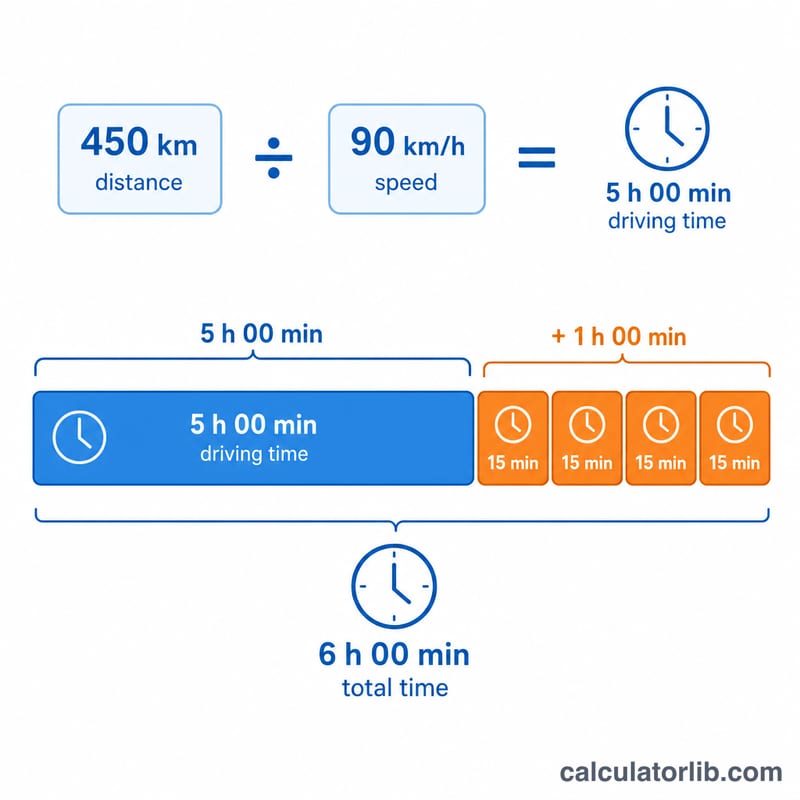
Suppose you drive 300 miles at an average of 60 mph and make 2 stops of 15 minutes each. Driving time is \(300 \div 60 = 5\) hours. Break time is \(2 \times 15 \div 60 = 0.5\) hours. Total trip time \(= 5 + 0.5 = 5.5\) hours, or 5 hours 30 minutes.
Trip Time Comparison: Different Speeds and Stop Plans
The table below uses a fixed 300-mile (about 483 km) trip. Driving time is \(\frac{300}{\text{speed}}\), break time is stops × minutes per stop, and total time is their sum. Results are rounded to the nearest minute.
| Average speed | Stop plan | Driving time | Break time | Total time |
|---|---|---|---|---|
| 50 mph | 0 stops | 6 h 00 min | 0 min | 6 h 00 min |
| 50 mph | 2 × 15 min | 6 h 00 min | 30 min | 6 h 30 min |
| 50 mph | 3 × 20 min | 6 h 00 min | 1 h 00 min | 7 h 00 min |
| 50 mph | 4 × 30 min | 6 h 00 min | 2 h 00 min | 8 h 00 min |
| 55 mph | 0 stops | 5 h 27 min | 0 min | 5 h 27 min |
| 55 mph | 2 × 15 min | 5 h 27 min | 30 min | 5 h 57 min |
| 55 mph | 3 × 20 min | 5 h 27 min | 1 h 00 min | 6 h 27 min |
| 55 mph | 4 × 30 min | 5 h 27 min | 2 h 00 min | 7 h 27 min |
| 60 mph | 0 stops | 5 h 00 min | 0 min | 5 h 00 min |
| 60 mph | 2 × 15 min | 5 h 00 min | 30 min | 5 h 30 min |
| 60 mph | 3 × 20 min | 5 h 00 min | 1 h 00 min | 6 h 00 min |
| 60 mph | 4 × 30 min | 5 h 00 min | 2 h 00 min | 7 h 00 min |
| 65 mph | 0 stops | 4 h 37 min | 0 min | 4 h 37 min |
| 65 mph | 2 × 15 min | 4 h 37 min | 30 min | 5 h 07 min |
| 65 mph | 3 × 20 min | 4 h 37 min | 1 h 00 min | 5 h 37 min |
| 65 mph | 4 × 30 min | 4 h 37 min | 2 h 00 min | 6 h 37 min |
Example: at 60 mph with 3 stops of 20 minutes, \(T = \frac{300}{60} + \frac{3 \times 20}{60} = 5 + 1 = \) 6 hours.
Takeaway: going 5 mph faster saves roughly 25–30 minutes on this trip, while adding one extra 30-minute stop costs the same as that speed gain. Stop planning matters as much as speed.
Typical Average Speeds and Stop Lengths by Road Type
These are general planning ranges, not guarantees. Actual average speed is usually below the posted limit because of traffic, construction, weather, and slowdowns. Speed limits and driving rules differ by country and region, so check local conditions.
| Road type | Typical realistic average (mph) | Typical realistic average (km/h) |
|---|---|---|
| Interstate / motorway | 60–70 mph | 97–113 km/h |
| Rural highway | 50–55 mph | 80–89 km/h |
| Mixed highway and city | 40–50 mph | 64–80 km/h |
| Urban driving | 20–30 mph | 32–48 km/h |
Typical stop durations
| Stop type | Typical duration |
|---|---|
| Fuel | 10–15 min |
| Restroom / stretch | 10–15 min |
| Meal | 30–45 min |
A combined fuel, restroom and snack stop often takes 15–20 minutes in practice.
How often to stop
Road-safety guidance commonly cited by many agencies and driving organizations is to take a break roughly every 2 hours of driving, or sooner if you feel tired. For a 6-hour drive, that suggests about 2–3 stops. Use the calculator to see how those stops change your arrival time.
Converting Decimal Hours to Hours and Minutes
Dividing distance by speed gives time in decimal hours (for example, 4.62 h). To convert it to hours and minutes, keep the whole number as hours and multiply the decimal part by 60:
$$\text{minutes} = (\text{decimal hours} - \text{whole hours}) \times 60$$
Example: 300 mi ÷ 65 mph = 4.6154 h. The decimal part is 0.6154, and \(0.6154 \times 60 = 36.9\), which rounds to 37 minutes. So the driving time is 4 h 37 min.
| Decimal hours | Minutes |
|---|---|
| 0.10 | 6 |
| 0.20 | 12 |
| 0.25 | 15 |
| 0.30 | 18 |
| 0.40 | 24 |
| 0.50 | 30 |
| 0.60 | 36 |
| 0.70 | 42 |
| 0.75 | 45 |
| 0.80 | 48 |
| 0.90 | 54 |
Miles per hour to kilometers per hour
Multiply mph by 1.609 to get km/h (divide km/h by 1.609 to get mph).
| Speed (mph) | Calculation | Speed (km/h) |
|---|---|---|
| 50 | 50 × 1.609 = 80.45 | ≈ 80 |
| 55 | 55 × 1.609 = 88.50 | ≈ 89 |
| 60 | 60 × 1.609 = 96.54 | ≈ 97 |
| 65 | 65 × 1.609 = 104.59 | ≈ 105 |
| 70 | 70 × 1.609 = 112.63 | ≈ 113 |
For example, 100 km/h ÷ 1.609 ≈ 62.1 mph.
FAQ
Should I use the speed limit as my average speed? No. Real averages are lower because of traffic, lights, merging, and slowdowns. For mixed highway/city trips, 50–60 mph is often realistic even on 70 mph roads.
Does it work in kilometers? Yes — just enter distance in km and speed in km/h. The result stays in hours and minutes.
How long should stops be? Quick fuel stops take 10–15 minutes; meal breaks 30–45. Many drivers plan a short break every 2 hours for safety.