
What This Calculator Does
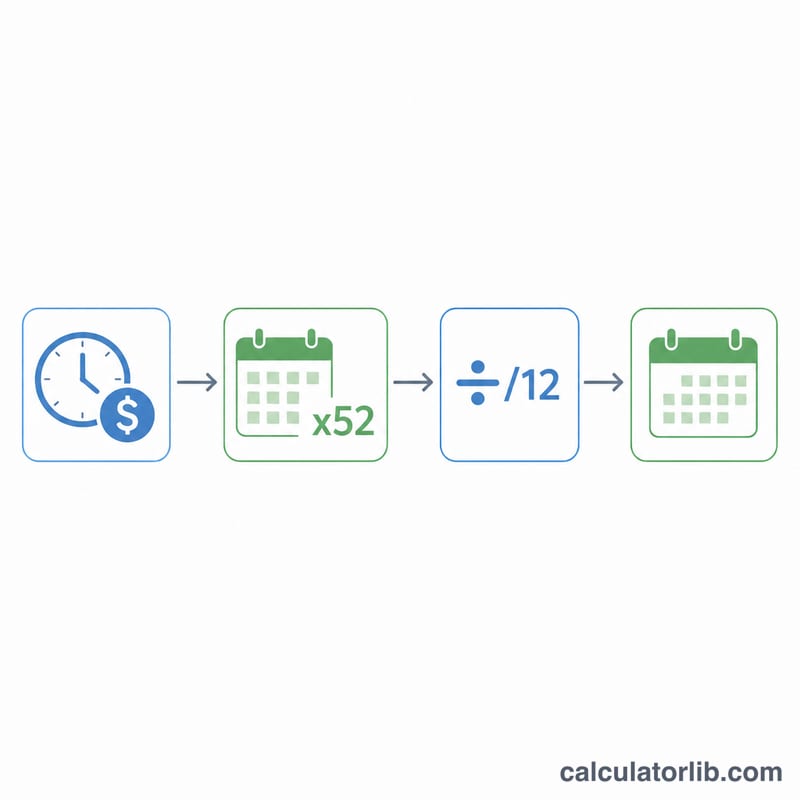
The Hourly to Monthly Budget Calculator converts an hourly wage into a steady monthly figure you can actually budget around. Because months are uneven (some have four pay weeks, some five), the most reliable way to find a "monthly" amount is to annualize your weekly earnings across all 52 weeks of the year and then divide by 12. This calculator does that automatically and also estimates your take-home pay after taxes and deductions.
How to Use It
Enter your hourly rate, the number of hours you typically work each week, and an estimated percentage for taxes and other deductions (income tax, social contributions, retirement, insurance). Leave the tax field at 0 if you only want gross numbers. The result shows your monthly take-home pay as the headline figure, plus gross monthly, net weekly, and annual breakdowns.
The Formula Explained
Gross monthly pay = hourly rate × hours per week × 52 ÷ 12. The 52 represents weeks in a year and 12 the months, so the result is a smooth average month rather than a single calendar month. Net pay simply multiplies the gross by \(\left(1 - \frac{\text{tax\%}}{100}\right)\).
$$\text{Net Monthly} = \frac{\text{Hourly Rate} \times \text{Hours/Week} \times 52}{12} \times \left(1 - \frac{\text{Tax \%}}{100}\right)$$
Worked Example
Suppose you earn $25/hour and work 40 hours a week with a 20% effective deduction rate. Gross monthly = $$25 \times 40 \times 52 \div 12 = \$4{,}333.33.$$ Take-home = $$\$4{,}333.33 \times 0.80 = \$3{,}466.67 \text{ per month.}$$ That is the number to plan rent, groceries, and savings against.

Take-Home Pay Across Common Hourly Rates and Hours
Each row uses the calculator's formula: gross monthly = hourly rate × hours per week × 52 ÷ 12, and net monthly = gross monthly × (1 − deduction rate ÷ 100). Net weekly = hourly rate × hours × (1 − deduction rate ÷ 100). The deduction rate is a single flat percentage you choose, covering all deductions. It is not tied to any country's tax system. Figures are rounded to cents.
| Hourly rate | Hours/week | Deduction rate | Gross monthly | Net monthly | Net weekly |
|---|---|---|---|---|---|
| $15 | 30 | 15% | $1,950.00 | $1,657.50 | $382.50 |
| $15 | 40 | 25% | $2,600.00 | $1,950.00 | $450.00 |
| $20 | 40 | 20% | $3,466.67 | $2,773.33 | $640.00 |
| $25 | 30 | 15% | $3,250.00 | $2,762.50 | $637.50 |
| $25 | 40 | 20% | $4,333.33 | $3,466.67 | $800.00 |
| $35 | 40 | 25% | $6,066.67 | $4,550.00 | $1,050.00 |
Example of the arithmetic for $20/hr, 40 hours, 20%: \(\frac{20 \times 40 \times 52}{12} = \frac{41{,}600}{12} \approx 3{,}466.67\), then \(3{,}466.67 \times (1 - 0.20) \approx 2{,}773.33\).
Key Terms: Gross, Net, and Deductions
- Gross pay: Total earnings before anything is withheld. For hourly work, it is the hourly rate × hours worked.
- Net (take-home) pay: The amount that reaches you after deductions. This is the number to use for budgeting rent, bills, and savings.
- Deductions: Amounts withheld from gross pay. Common types are income tax, social contributions (such as payroll or social security charges, which differ by country), retirement contributions, and health or other insurance premiums. Which ones apply, and their size, depend on your country and employer.
- Effective tax rate: Total tax divided by total income, i.e. the overall share you actually pay. This is the kind of single percentage the calculator expects.
- Marginal tax rate: The rate applied to your next unit of income in a progressive system. It is usually higher than the effective rate, so it is not a good single input for estimating net pay.
- Annualizing: Converting a pay rate to a yearly figure, here hourly rate × weekly hours × 52 weeks. Unpaid weeks or irregular hours make the real figure lower.
- 52/12 average month: A year has 52 weeks, so an average month has \(\frac{52}{12} \approx 4.33\) weeks. Multiplying weekly pay by 4.33 gives a monthly figure that smooths over months with four or five paychecks.
This is general information, not tax or financial advice. Check your pay stub for your actual deductions.
FAQ
Why divide by 12 instead of using 4 weeks? Using 4 weeks undercounts your pay — there are about 4.33 weeks per month. The 52/12 method captures every week of the year.
Is this accurate for taxes? The tax field is a simple flat estimate. Real payroll taxes are tiered and vary by location, so treat the net figure as a planning approximation.
What about overtime or irregular hours? Enter your average weekly hours. If your schedule varies a lot, run the calculator with a conservative low estimate for safer budgeting.