

What This Calculator Does
The Monthly Income from Hourly Calculator turns an hourly wage into an estimated monthly paycheck. By accounting for how many hours you work each week and spreading earnings evenly across the 52 weeks in a year, it gives you a realistic monthly figure rather than a rough "weeks times four" guess. The result is gross income — before taxes, deductions, or benefits.
How to Use It
Enter your hourly rate (for example, 25 for $25/hour) and the number of hours you typically work per week (for example, 40 for full-time). The calculator instantly shows your estimated monthly income, along with weekly and annual totals so you can sanity-check the numbers.
The Formula Explained
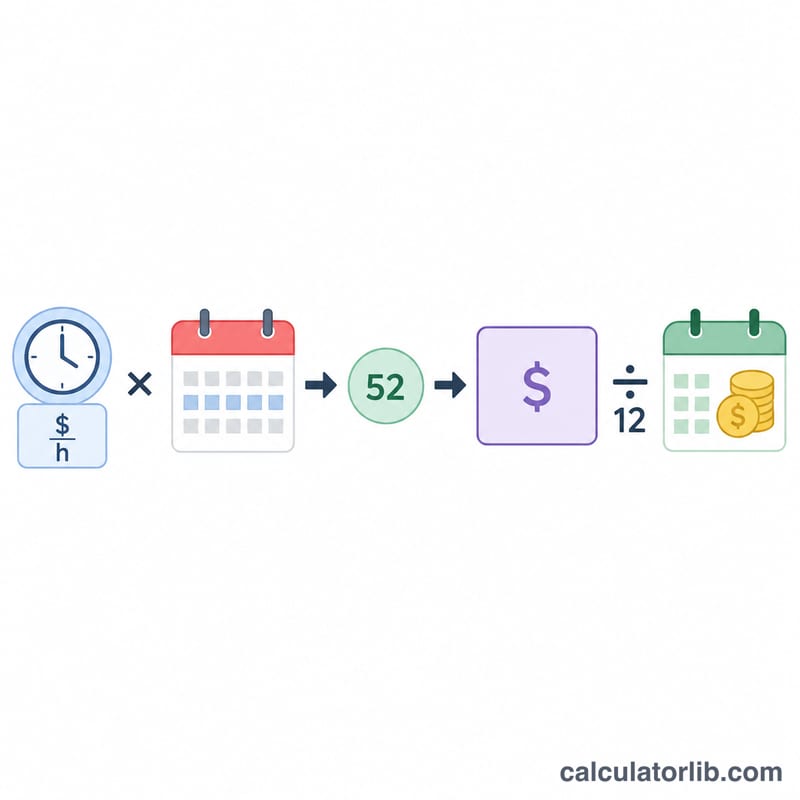
The core formula is $$\text{monthly income} = \frac{\text{hourly rate} \times \text{hours per week} \times 52}{12}$$. Multiplying by 52 captures every week in a year (not just 48 or 50), and dividing by 12 distributes that annual amount evenly across all months. This avoids the common error of multiplying weekly pay by exactly four weeks, which understates true monthly earnings because most months contain more than four weeks.
Worked Example
Suppose you earn $20 per hour and work 40 hours per week. Weekly income is \(\$20 \times 40 = \$800\). Annual income is \(\$800 \times 52 = \$41{,}600\). Monthly income is $$\$41{,}600 \div 12 \approx \mathbf{\$3{,}466.67}$$ Notice this is higher than \(\$800 \times 4 = \$3{,}200\), which is why the 52/12 method is more accurate.
FAQ
Is this gross or net income? It is gross income before taxes and deductions. Your take-home pay will be lower.
Why divide by 12 instead of multiplying by 4? A month averages about 4.33 weeks. Using 52/12 spreads a full year's earnings evenly and is more accurate than assuming four weeks per month.
What about overtime or unpaid leave? This tool assumes consistent weekly hours at one rate. For variable schedules, use your average weekly hours.