

What This Calculator Does
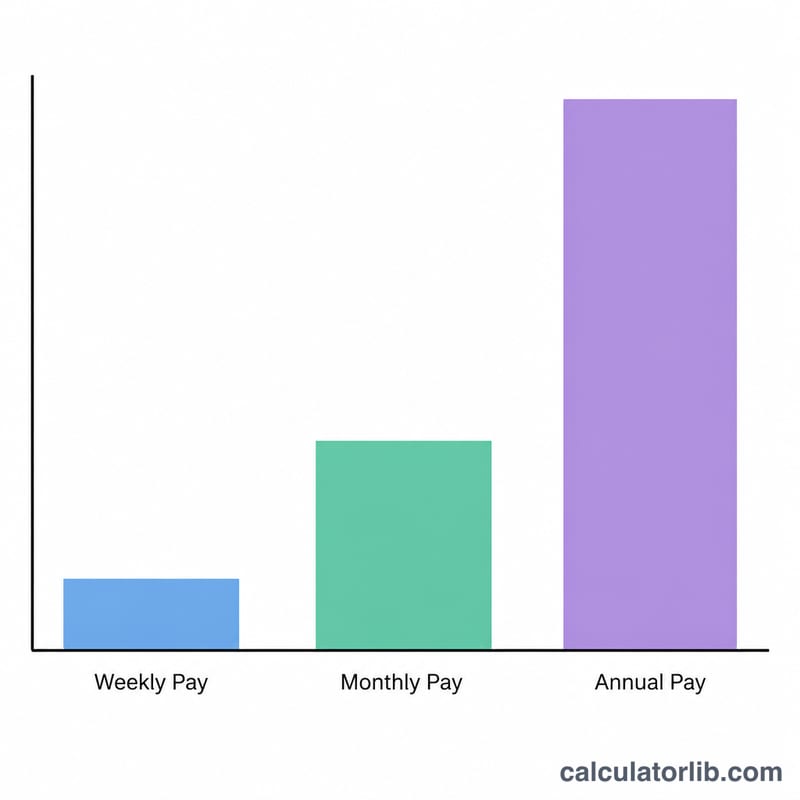
The Hourly to Monthly Salary Calculator converts your hourly pay rate into an estimated monthly salary. It is useful when comparing job offers, budgeting, or understanding what an hourly position is worth on a monthly basis. The tool also shows your weekly and annual pay so you have the full picture. Figures are gross (before taxes and deductions) and the method applies universally to any currency.
How to Use It
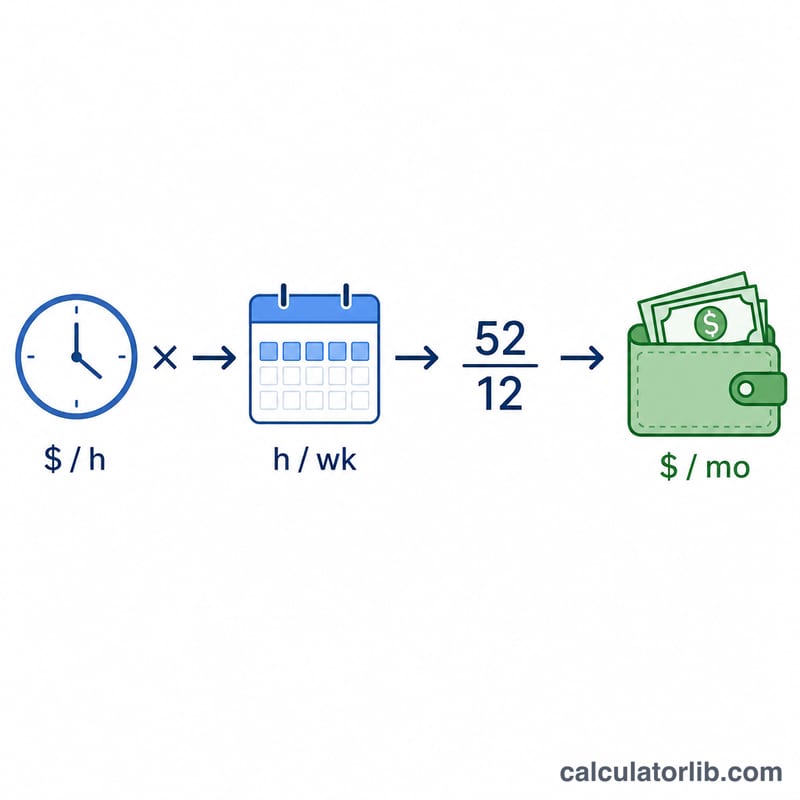
Enter your hourly wage and the number of hours you typically work each week. The calculator multiplies those numbers to get weekly pay, scales it across 52 weeks for the year, and divides by 12 to give an average month. Adjust the hours per week to model part-time or overtime scenarios.
The Formula Explained
The core formula is $$\text{Monthly} = \frac{\text{Hourly} \times \text{Hours per Week} \times 52}{12}$$ There are 52 weeks in a year and 12 months, so dividing annual pay by 12 gives a consistent average monthly amount. This is more accurate than simply multiplying weekly pay by 4, because a month averages about \(4.33\) weeks.
Worked Example
Suppose you earn $25 per hour and work 40 hours per week. Weekly pay is \(25 \times 40 = \$1{,}000\). Annual pay is \(1{,}000 \times 52 = \$52{,}000\). Monthly pay is $$52{,}000 \div 12 \approx \$4{,}333.33$$
FAQ
Why divide by 12 instead of multiplying weekly pay by 4? Multiplying by 4 ignores the extra days in most months. Using \(52 \div 12 = 4.333\) weeks per month gives a true yearly average.
Does this include taxes? No. The result is gross pay before income tax, insurance, and other deductions. Your take-home pay will be lower.
What if my hours vary? Use your average weekly hours. You can run the calculator a few times to see a low, typical, and high estimate.