
What Is the Future Value of Recurring Payments?
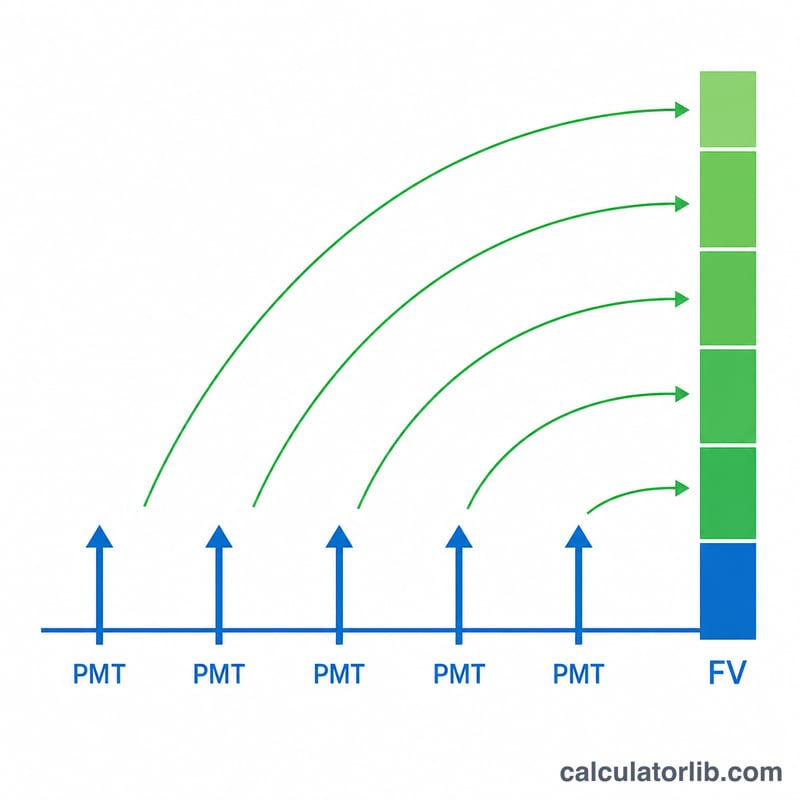
The future value of recurring payments tells you how much a stream of equal, regularly spaced deposits will grow to by a given point in time, once compound interest is applied. This is the math behind savings plans, retirement contributions, sinking funds, and any goal where you set aside the same amount each period. The formula models an ordinary annuity, meaning each payment is made at the end of its period.
How to Use the Calculator
Enter three values: the payment made each period (PMT), the interest rate earned per period as a percentage, and the total number of periods (n). Make sure the rate and the number of periods use the same time unit — if you contribute monthly, use a monthly rate and a count of months. The calculator returns the projected future value plus a breakdown of your total contributions and the interest earned.
The Formula Explained
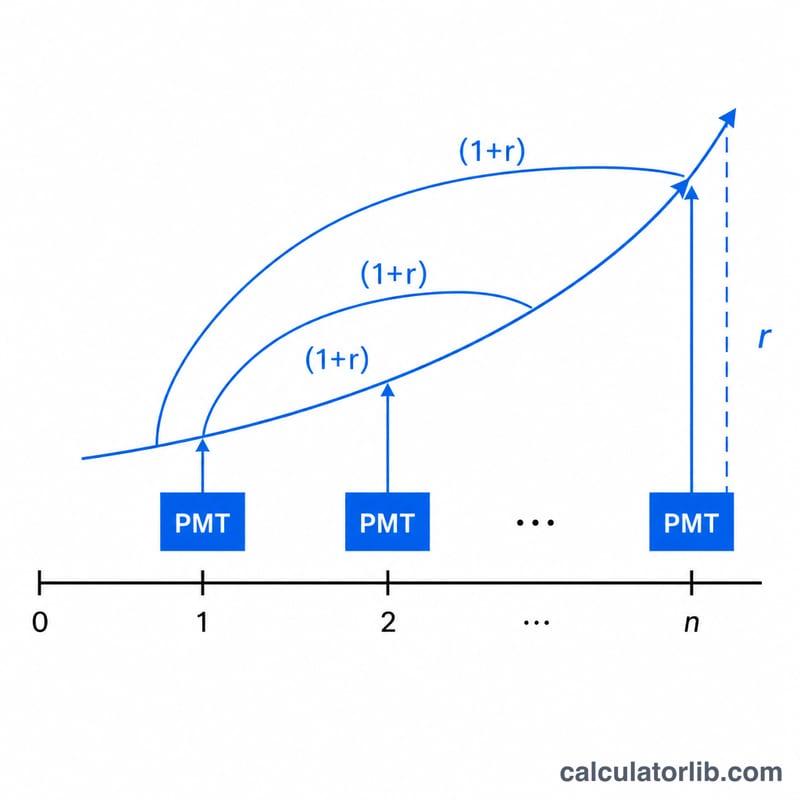
The core equation is $$FV = \text{PMT} \cdot \frac{(1+r)^{\text{n}} - 1}{r}$$ where r is the rate per period written as a decimal (5% becomes 0.05). The term \((1 + r)^n - 1\) captures how each payment compounds for the periods remaining after it is deposited; dividing by \(r\) sums that geometric growth across all payments. When \(r\) is 0, the formula simplifies to \(\text{PMT} \times n\) because no interest accrues.
Worked Example
Suppose you deposit $100 at the end of every year, earning 5% annually, for 10 years. Then \(r = 0.05\) and \(n = 10\). \((1.05)^{10} \approx 1.628895\), so $$\frac{1.628895 - 1}{0.05} \approx 12.57789$$ Multiplying by $100 gives a future value of about $1,257.79. You contributed $1,000 in total, so roughly $257.79 came from compound interest.
FAQ
Does this assume payments at the start or end of the period? It uses the ordinary annuity convention (end of period). For payments at the beginning (an annuity due), multiply the result by \((1 + r)\).
What if my interest rate is annual but I pay monthly? Convert to a per-period rate first — divide the annual rate by 12 and set n to the number of months.
Can the rate be zero? Yes. With a 0% rate the calculator returns \(\text{PMT} \times n\), your simple total of all deposits.