
What is the Compression Ratio Calculator?
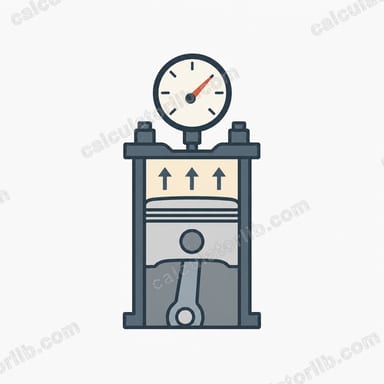
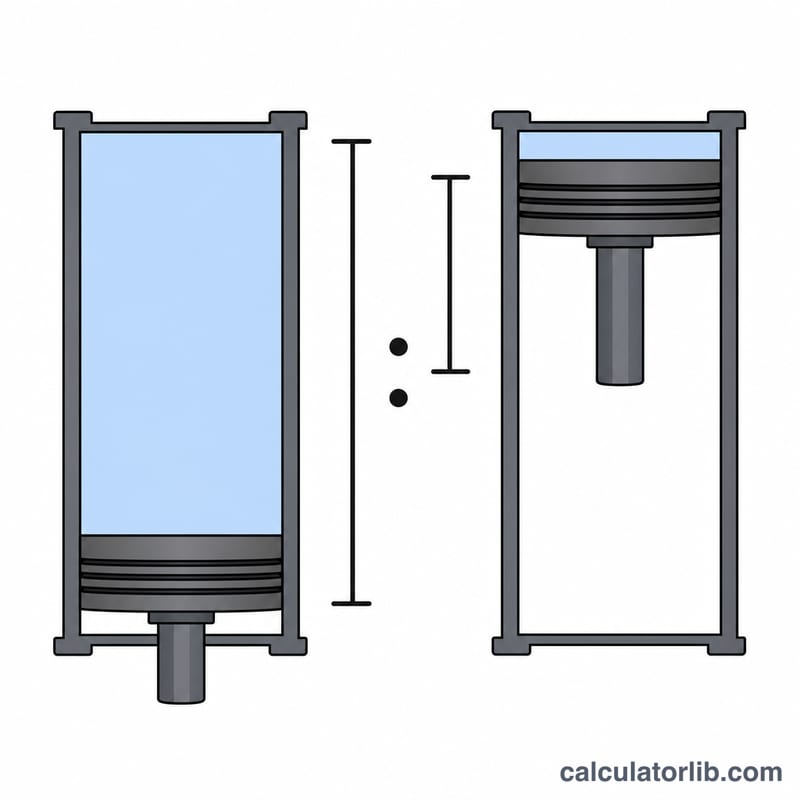
An engine's compression ratio (CR) describes how much the air-fuel mixture is squeezed inside a cylinder before ignition. It is the ratio between the total cylinder volume (when the piston is at the bottom of its stroke) and the clearance volume (when the piston is at the top). A higher compression ratio generally means more thermal efficiency and power, but it also raises the octane requirement to avoid knock. This calculator computes CR from three values you can measure directly: bore, stroke, and clearance volume.
How to use it
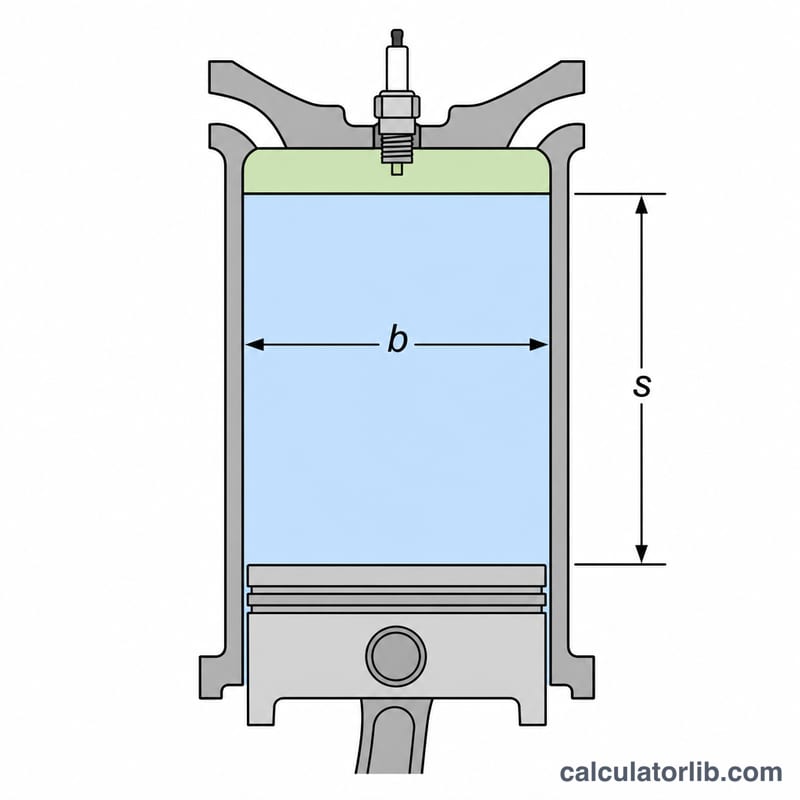
Enter the cylinder bore (the diameter of the cylinder) and the stroke (the distance the piston travels), both in millimetres. Then enter the clearance volume in cubic centimetres (cc) — this is the combustion chamber volume remaining above the piston at top dead centre, including head gasket, deck and chamber. The calculator returns the swept (displacement) volume per cylinder and the resulting compression ratio.
The formula explained
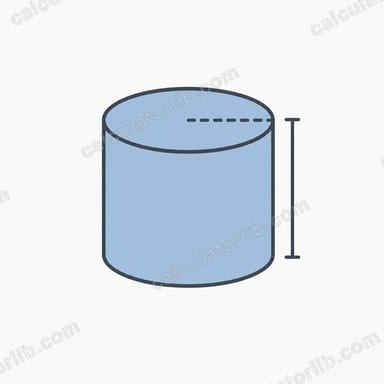
The swept volume is the volume of a cylinder: \(V_{disp} = \frac{\pi}{4} \times \text{bore}^2 \times \text{stroke}\). With bore and stroke in mm the result is in mm³, so we divide by 1000 to convert to cc. The compression ratio is then $$\text{CR} = \frac{V_{disp} + V_{clear}}{V_{clear}}$$
Worked example
For an 86 mm bore, 86 mm stroke and 55 cc clearance: $$V_{disp} = 0.7853982 \times 86^2 \times 86 = 499{,}481 \text{ mm}^3 \approx 499.48 \text{ cc}$$ Then $$\text{CR} = \frac{499.48 + 55}{55} \approx 10.08 : 1$$
FAQ
Does this account for all cylinders? No — it computes per-cylinder swept volume and CR. CR is the same for every cylinder, so multiply swept volume by the cylinder count for total displacement.
What raises compression ratio? A smaller clearance volume (thinner gasket, milled head, domed piston) or a larger swept volume raises CR.
Why convert mm³ to cc? Clearance volume is usually quoted in cc, so the swept volume must use the same units before adding them.