What is the English Learning Time Calculator?
This tool estimates how long it will take to learn English by converting the study-hour gap between your current and target level into weeks and months. It uses the widely cited CEFR guided-learning-hour benchmarks (roughly 200 cumulative hours per level), so it works for learners worldwide regardless of their first language. The estimate is a planning guide, not a guarantee — real progress depends on study quality, immersion, and motivation.
How to use it
Select your current level (from Beginner A1 to Advanced C1) and your target level (up to Proficient C2). Then enter how many hours you can realistically study each week. The calculator subtracts the cumulative hours of your current level from your target to find the required study hours, then divides by your weekly pace to give the number of weeks and months.
The formula explained
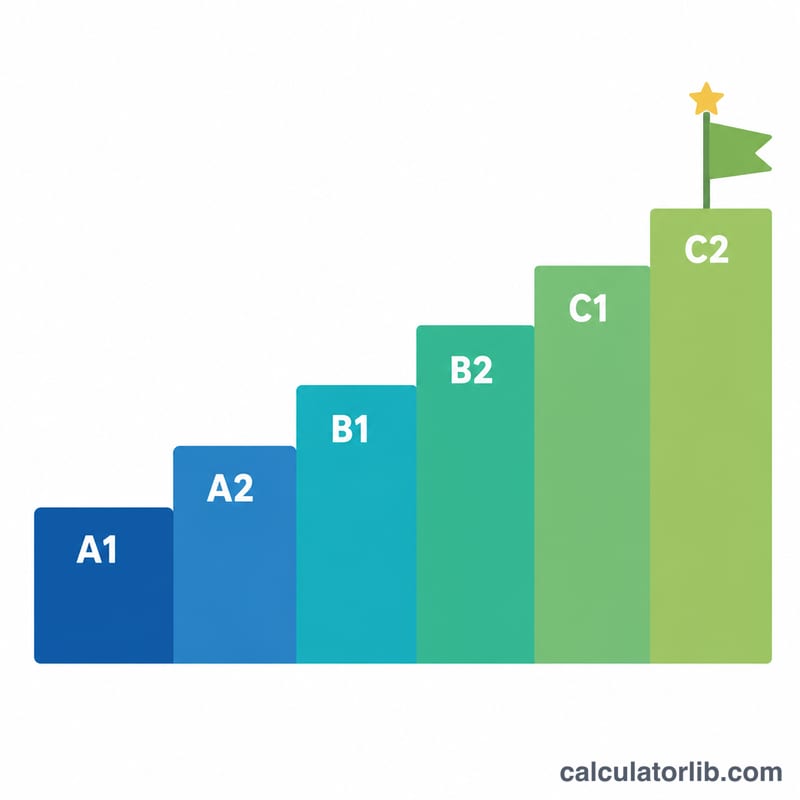
The core equation is \( \text{Weeks} = \text{Required Hours} \div \text{Weekly Hours} \). Required hours come from the level gap: each CEFR step is mapped to a cumulative hour figure (A2 ≈ 200, B1 ≈ 400, B2 ≈ 600, C1 ≈ 800, C2 ≈ 1000). Months are approximated by dividing weeks by \(4.345\) (the average weeks per month).
$$ \begin{gathered} \text{Weeks} = \frac{\text{Required Hours}}{\text{Weekly Hours}} \\[1.5em] \text{where}\quad \left\{ \begin{aligned} \text{Required Hours} &= \text{Target Level} - \text{Current Level} \\ \text{Months} &= \frac{\text{Weeks}}{4.345} \\ \text{Daily Hours} &= \frac{\text{Weekly Hours}}{7} \end{aligned} \right. \end{gathered} $$Worked example
Suppose you are at Elementary (A2 ≈ 200 hours) and want to reach Upper-Intermediate (B2 ≈ 600 hours), studying 10 hours per week. Required hours = \( 600 - 200 = 400 \). Weeks:
$$ \text{Weeks} = \frac{400}{10} = 40 \text{ weeks} \approx 9.2 \text{ months} $$That's an average of about 1.43 hours of study per day.
CEFR Levels and Guided Learning Hours
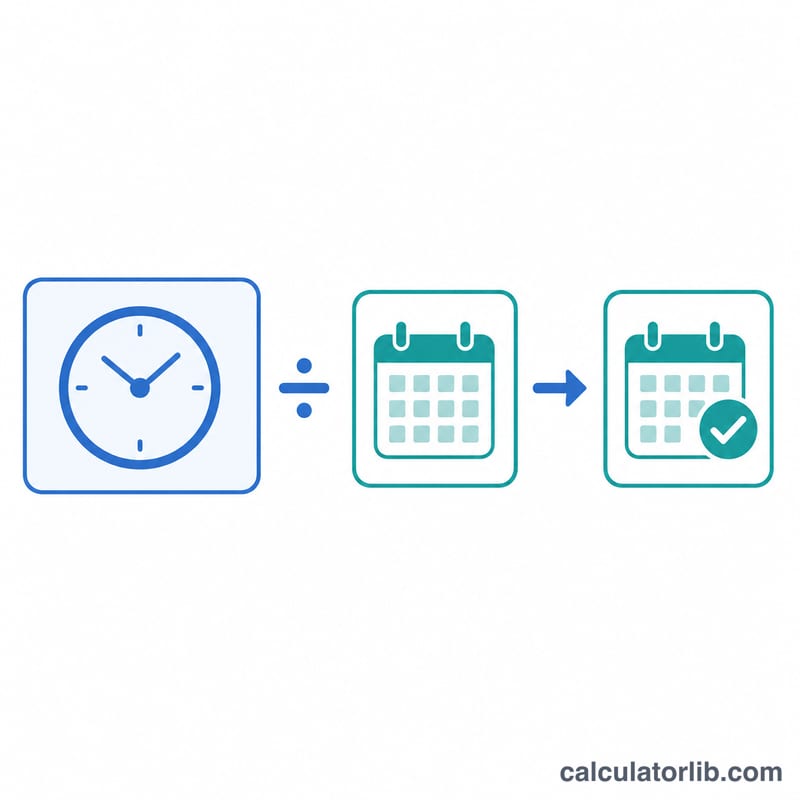
The Common European Framework of Reference for Languages (CEFR), published by the Council of Europe, describes six levels of ability from A1 to C2. The CEFR itself does not prescribe study times; the hour figures below are the widely cited guided learning hour estimates published by Cambridge English (and used in similar form by Eaquals and other European language-teaching bodies) for English. "Guided" means timetabled, teacher-led or structured study — homework, reading and informal practice sit on top of it.
| CEFR level | Common label | Cumulative guided hours from zero | Incremental hours for this step | Typical "can-do" summary (CEFR global scale) |
|---|---|---|---|---|
| A1 | Beginner | ≈ 90–100 | ≈ 90–100 (from zero) | Can introduce themselves, ask and answer simple questions about personal details, and understand very basic everyday phrases. |
| A2 | Elementary | ≈ 180–200 | ≈ 90–100 (A1 → A2) | Can handle short routine exchanges — shopping, directions, family, work — using simple, memorised language. |
| B1 | Intermediate | ≈ 350–400 | ≈ 150–200 (A2 → B1) | Can cope with most travel and work situations, describe experiences and give brief reasons or explanations. |
| B2 | Upper-Intermediate | ≈ 500–600 | ≈ 150–200 (B1 → B2) | Can understand the main ideas of complex text, interact with fluent speakers without strain, and argue a viewpoint in detail. |
| C1 | Advanced | ≈ 700–800 | ≈ 200 (B2 → C1) | Can use language flexibly for social, academic and professional purposes, and produce clear, well-structured extended text. |
| C2 | Proficient | ≈ 1000–1200+ | ≈ 200–400 (C1 → C2) | Can understand virtually everything heard or read and express themselves spontaneously, precisely and with fine shades of meaning. |
Two cautions. First, these are ranges, not fixed values: published estimates for B2, for example, run from about 500 to 600 cumulative hours. Second, the real figure for an individual depends on the distance between English and their first language, the quality and intensity of instruction, how much unguided exposure they get, and age and prior language-learning experience. A speaker of a closely related Germanic language typically needs fewer hours than the table suggests; a learner from a linguistically distant background may need considerably more.
For simplicity, this calculator anchors the levels at the rounded values \(0\) (absolute beginner), \(200\) (A2), \(400\) (B1), \(600\) (B2), \(800\) (C1) and \(1000\) (C2) hours, and takes the required hours as the difference between your target and current anchor:
$$\text{Required Hours} = \text{Target Level} - \text{Current Level}$$How Weekly Study Hours Change Your Timeline
Only two things drive the estimate: how many hours the level gap requires, and how many of those hours you actually do each week. The table below holds the goal constant at A2 → B2, a gap of \(600 - 200 = 400\) hours, and varies the weekly commitment. Weeks, months and daily hours follow the article's formulas:
$$\text{Weeks} = \frac{\text{Required Hours}}{\text{Weekly Hours}}, \qquad \text{Months} = \frac{\text{Weeks}}{4.345}, \qquad \text{Daily Hours} = \frac{\text{Weekly Hours}}{7}$$| Weekly hours | Weeks | Months | Average daily hours |
|---|---|---|---|
| 2 | 200.0 | 46.0 | 0.29 |
| 5 | 80.0 | 18.4 | 0.71 |
| 10 | 40.0 | 9.2 | 1.43 |
| 15 | 26.7 | 6.1 | 2.14 |
| 20 | 20.0 | 4.6 | 2.86 |
Worked check on the 10 h/week row:
$$\text{Weeks} = \frac{400\ \text{h}}{10\ \text{h/week}} = 40.0 \quad\Rightarrow\quad \text{Months} = \frac{40.0}{4.345} = 9.2, \quad \text{Daily Hours} = \frac{10}{7} = 1.43$$Notice the shape of the curve: going from 2 to 5 hours a week cuts the timeline by about 120 weeks, while going from 15 to 20 hours saves fewer than 7. Early increases in weekly hours buy far more time than late ones.
Now hold the weekly commitment at 10 hours and vary the level gap instead:
| Level goal | Required hours | Weeks | Months | Average daily hours |
|---|---|---|---|---|
| A1 → A2 | ≈ 100 | 10.0 | 2.3 | 1.43 |
| B1 → B2 | 200 | 20.0 | 4.6 | 1.43 |
| B2 → C1 | 200 | 20.0 | 4.6 | 1.43 |
| A2 → C2 | 800 | 80.0 | 18.4 | 1.43 |
The A1 → A2 row uses the narrower ≈ 100-hour step from the Cambridge English estimates; the calculator's own level anchors move in 200-hour increments, so its smallest selectable step (absolute beginner → A2) returns \(200 \div 10 = 20.0\) weeks rather than 10. Note also that the 4.345 divisor converts weeks to average calendar months (\(365.25 \div 7 \div 12 = 4.345\)), so "4.6 months" means 4.6 average months, not 4 months and 6 days. Finally, these are study-hour projections, not guarantees: a plateau, a long break, or a switch from passive review to active speaking practice can move the real date in either direction.
FAQ
Are these hours exact? No. The CEFR hour figures are averages; some learners need fewer, others more. Treat the result as a realistic ballpark.
Does immersion count? Yes — living in an English-speaking environment, watching media, and conversation all count as study hours and speed things up.
What if my target is below my current level? The required hours are floored at zero, so the result will be zero weeks.