
What Is Interval Notation?
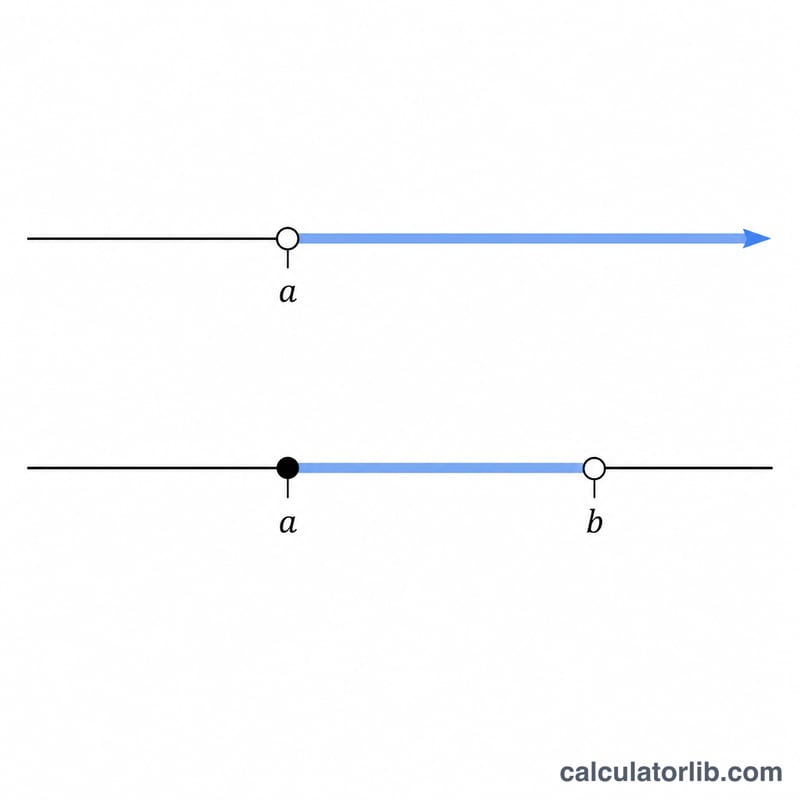
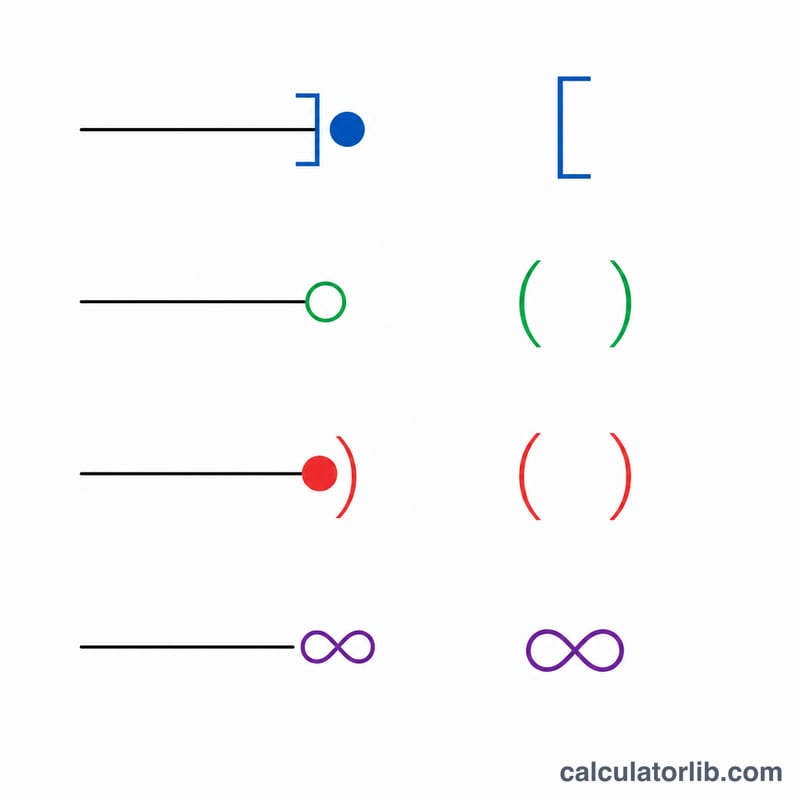
Interval notation is a compact way to write the set of all real numbers between two bounds. A square bracket [ ] means the endpoint is included (closed), while a parenthesis ( ) means it is excluded (open). Infinity (\(\infty\)) and negative infinity (\(-\infty\)) always use parentheses because they are not real numbers and can never be reached.
How to Use This Calculator
Enter a lower bound and choose whether it is open (\(>\), exclusive) or closed (\(\ge\), inclusive). Do the same for the upper bound. To represent an unbounded side, leave the bound field blank — the calculator will use \(-\infty\) or \(+\infty\) automatically. It instantly returns the interval, the equivalent inequality, and set-builder notation.
The Conversion Rules
The endpoint type controls the symbol used: closed lower → [ and \(\ge\); open lower → ( and \(>\); closed upper → ] and \(\le\); open upper → ) and \(<\). For example, the inequality \(2 \le x < 7\) becomes the interval \([2, 7)\), and \(x > 5\) becomes \((5, \infty)\).
Worked Example
Suppose you want all numbers from 2 (included) up to but not including 7. Lower bound 2 is closed, upper bound 7 is open. The result is the interval \([2, 7)\), the inequality \(2 \le x < 7\), and the set \(\{\, x \mid 2 \le x < 7 \,\}\).
FAQ
Why does infinity always use a parenthesis? Because infinity is a concept, not an actual number, it can never be "included," so it always takes an open parenthesis.
What if the lower bound is larger than the upper bound? The interval is empty — there are no real numbers that satisfy both conditions.
What does a single point like \(\{3\}\) mean? When both bounds equal the same value and both are closed (\(3 \le x \le 3\)), the only solution is \(x = 3\), written as the single-point set \(\{3\}\).