透過 MCP 連接 →

輸入計算

數學公式

廣告

結果

區間表示法
(-∞, ∞)
Valid interval
不等式 all real numbers
集合表示法 { x | all real numbers }

什麼是區間表示法?

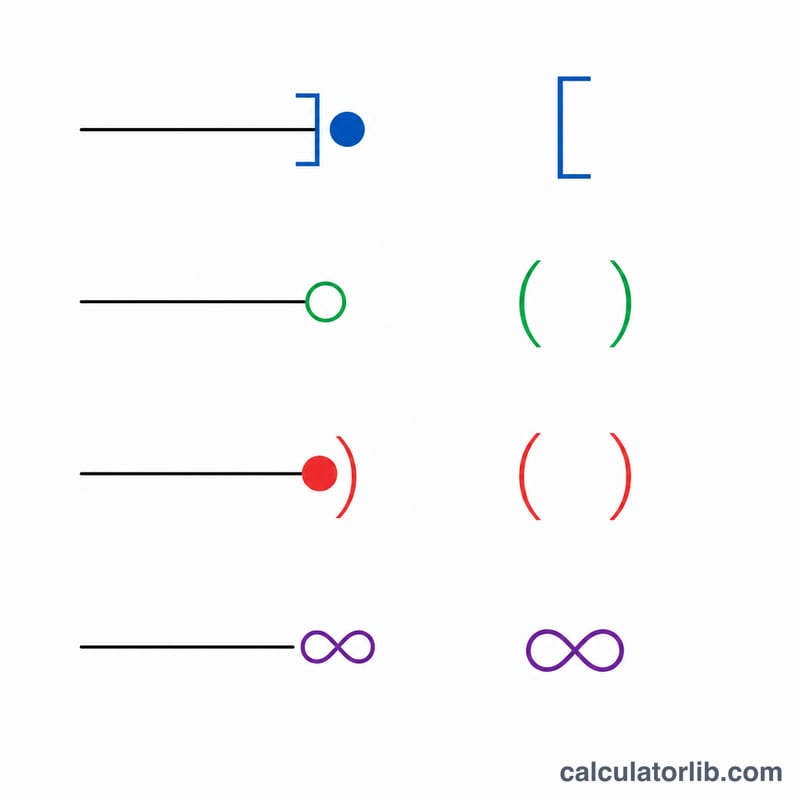
區間表示法是一種簡潔的寫法,用來表示介於兩個界限之間所有實數所構成的集合。中括號 [ ] 代表端點包含在內(閉區間),而小括號 ( ) 則代表端點不包含在內(開區間)。正無限大(∞)與負無限大(−∞)一律使用小括號,因為它們並非實數,永遠無法被「達到」。
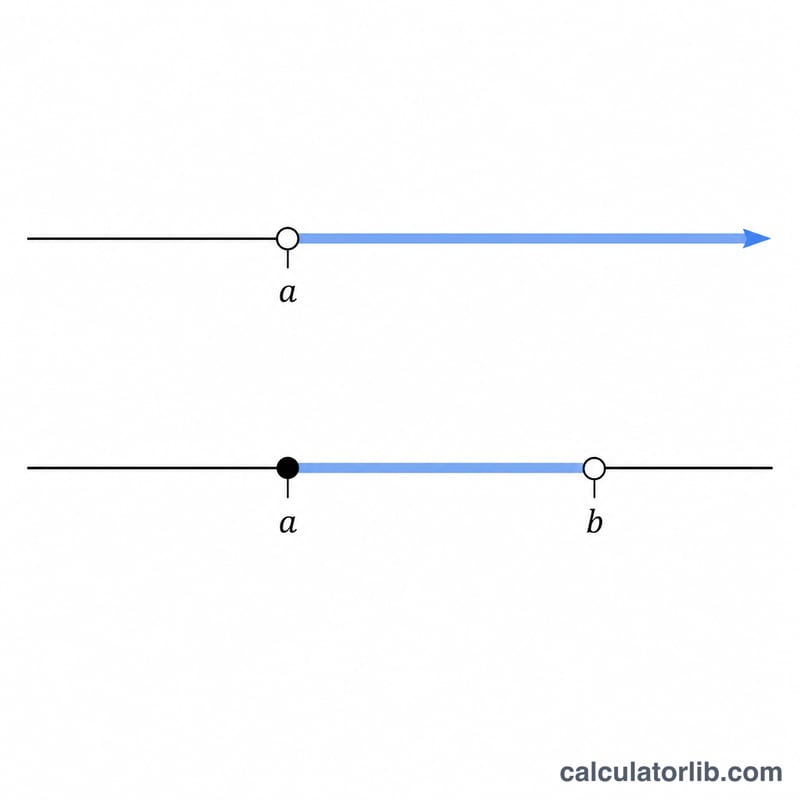
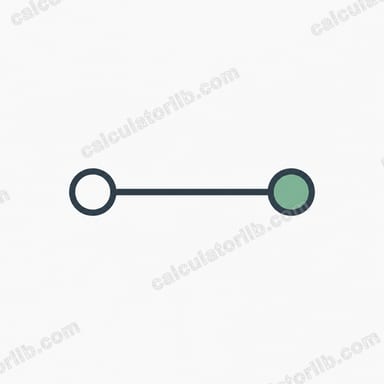
Number line showing an open endpoint as a hollow circle and a closed endpoint as a filled dot with shaded intervals
On a number line, a hollow circle means an open endpoint (exclusive) and a filled dot means a closed endpoint (inclusive).

如何使用這個計算機

先輸入下界,並選擇它是開(>,不含)還是閉(≥,含)。上界也以相同方式設定。若某一側沒有界限(無限延伸),只要把該欄位留空即可——計算機會自動套用 −∞ 或 +∞。它會立即回傳區間、對應的不等式,以及集合建構式(set-builder)表示法。

轉換規則

端點的類型決定所使用的符號:閉下界 → [ 與 ≥;開下界 → ( 與 >;閉上界 → ] 與 ≤;開上界 → ) 與 <。舉例來說,不等式 \(2 \le x < 7\) 寫成區間是 \([2, 7)\),而 \(x > 5\) 則寫成 \((5, \infty)\)。

$$\langle\,\text{a}\,,\; \text{b}\,\rangle \;\Longleftrightarrow\; \text{a}\;\lessgtr\;x\;\lessgtr\;\text{b}$$$$\begin{gathered} \big[\ \text{a}\,,\ \text{b}\ \big] \;\Longleftrightarrow\; \text{a} \le x \le \text{b} \\[1.5em] \text{where}\quad \left\{ \begin{aligned} [\ \text{or}\ ( &\;\text{from}\; \text{Lower type}\ (\text{closed}\Rightarrow\le,\ \text{open}\Rightarrow<) \\ ]\ \text{or}\ ) &\;\text{from}\; \text{Upper type}\ (\text{closed}\Rightarrow\le,\ \text{open}\Rightarrow<) \end{aligned} \right. \end{gathered}$$
Advertisement
Chart pairing bracket and parenthesis symbols with open and closed endpoints and infinity
Use brackets [ ] for included endpoints and parentheses ( ) for excluded endpoints; infinity always takes a parenthesis.

實際範例

假設你想表示從 2(含)開始,一直到 7(但不含 7)的所有數。下界 2 為閉,上界 7 為開。結果的區間為 \([2, 7)\),不等式為 \(2 \le x < 7\),集合則寫成 \(\{\, x \mid 2 \le x < 7 \,\}\)

常見問題

為什麼無限大永遠用小括號?因為無限大只是一個概念,並不是一個真正的數,永遠無法被「包含」,所以它一律使用開的小括號。

如果下界比上界還大會怎樣?這個區間是空集合——沒有任何實數能同時滿足這兩個條件。

像 \(\{3\}\) 這樣的單點代表什麼?當兩個界限相等且都是閉端點時(\(3 \le x \le 3\)),唯一的解就是 \(x = 3\),寫成單點集合 \(\{3\}\)。
最後更新: