
什么是区间表示法?
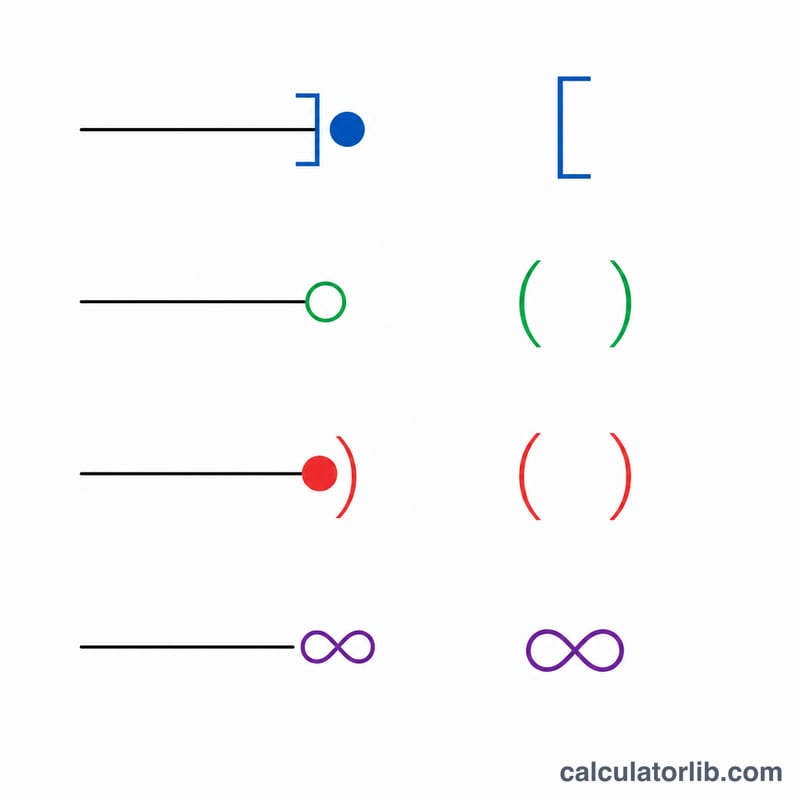
区间表示法是一种简洁的写法,用来表示介于两个边界之间的所有实数。方括号 [ ] 表示端点包含在内(闭区间),而圆括号 ( ) 表示端点不包含在内(开区间)。正无穷(∞)和负无穷(−∞)永远使用圆括号,因为它们并不是真正的实数,无法被"取到"。
如何使用本计算器
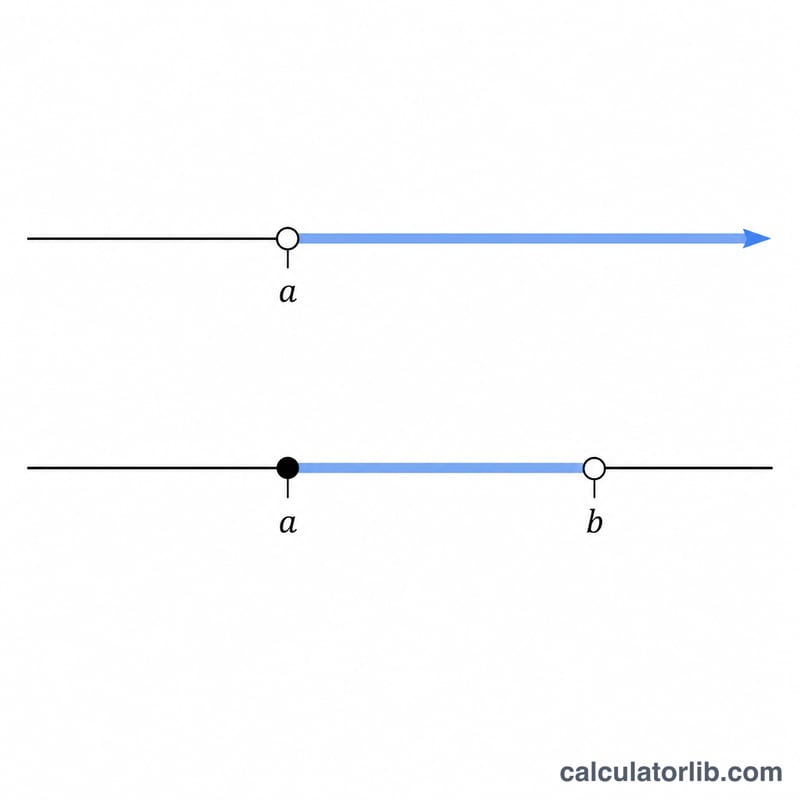
先输入下界,并选择它是开区间(>,不含)还是闭区间(≥,含)。再对上界做同样的设置。如果某一侧没有边界(趋向无穷),把对应的边界输入框留空即可——计算器会自动使用 \(-\infty\) 或 \(+\infty\)。它会立即给出区间表示、等价的不等式以及集合构造式三种结果。
转换规则
端点类型决定使用哪种符号:闭下界 → [ 与 ≥;开下界 → ( 与 >;闭上界 → ] 与 ≤;开上界 → ) 与 <。 $$\big[\ \text{a}\,,\ \text{b}\ \big] \;\Longleftrightarrow\; \text{a} \le x \le \text{b}$$ $$\langle\,\text{a}\,,\; \text{b}\,\rangle \;\Longleftrightarrow\; \text{a}\;\lessgtr\;x\;\lessgtr\;\text{b}$$ 例如,不等式 \(2 \le x < 7\) 对应区间 \([2, 7)\),而 \(x > 5\) 对应 \((5, \infty)\)。
实例演示
假设你想表示从 2(含)到 7(不含)之间的所有数。下界 2 为闭区间,上界 7 为开区间。结果就是区间 \([2, 7)\)、不等式 \(2 \le x < 7\),以及集合 \(\{\, x \mid 2 \le x < 7 \,\}\)。
常见问题
为什么无穷大总是用圆括号? 因为无穷大只是一个概念,而不是一个具体的数,永远无法被"包含"在内,所以它始终使用开圆括号。
如果下界比上界还大怎么办? 此时区间为空集——不存在任何同时满足两个条件的实数。
像 \(\{3\}\) 这样的单点是什么意思? 当上下界相等且都是闭区间时(\(3 \le x \le 3\)),唯一的解就是 \(x = 3\),写作单点集合 \(\{3\}\)。