
What this calculator does
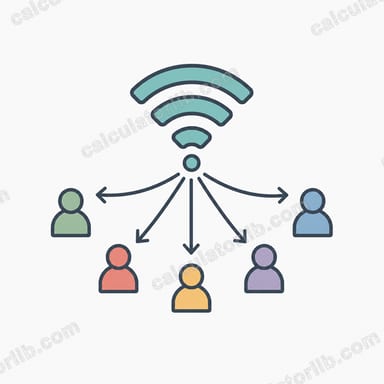
The Concurrent Users Bandwidth Calculator estimates how much internet speed each person can expect when a single connection is shared by several simultaneous users. It assumes the total bandwidth is divided evenly, giving you a quick worst-case "fair share" figure for planning a Wi-Fi network, office connection, café, classroom, or streaming setup.
How to use it
Enter your total connection speed in Mbps (for example, the download speed from your internet plan or speed test) and the number of users you expect to be online at the same time. The calculator returns the bandwidth available per user in both Mbps and Kbps. Compare the result against the requirements of your activities — roughly 5 Mbps for HD video, 25 Mbps for 4K, and under 1 Mbps for browsing or chat.
The formula explained
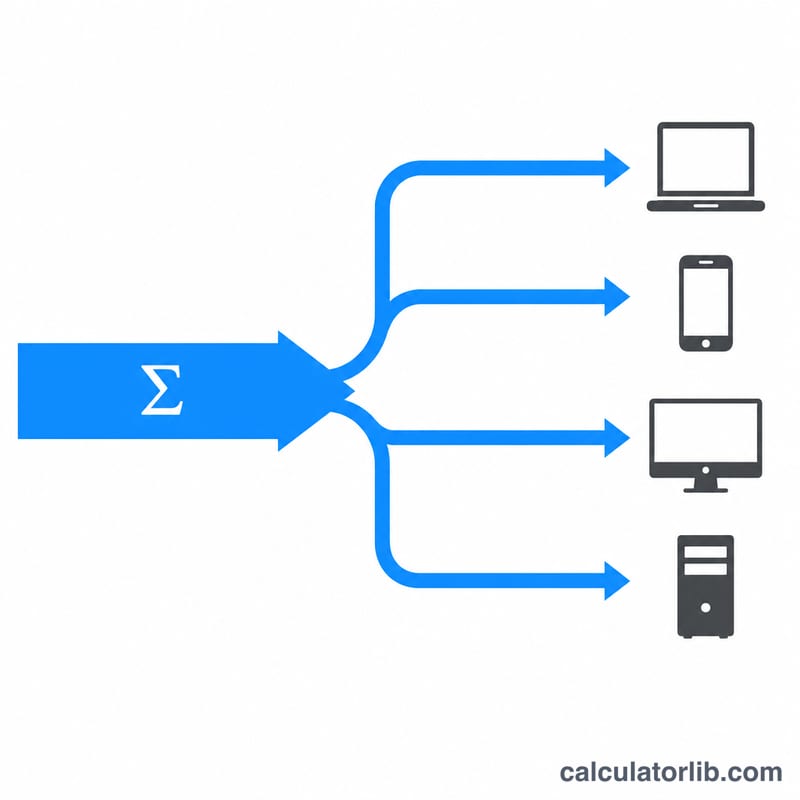
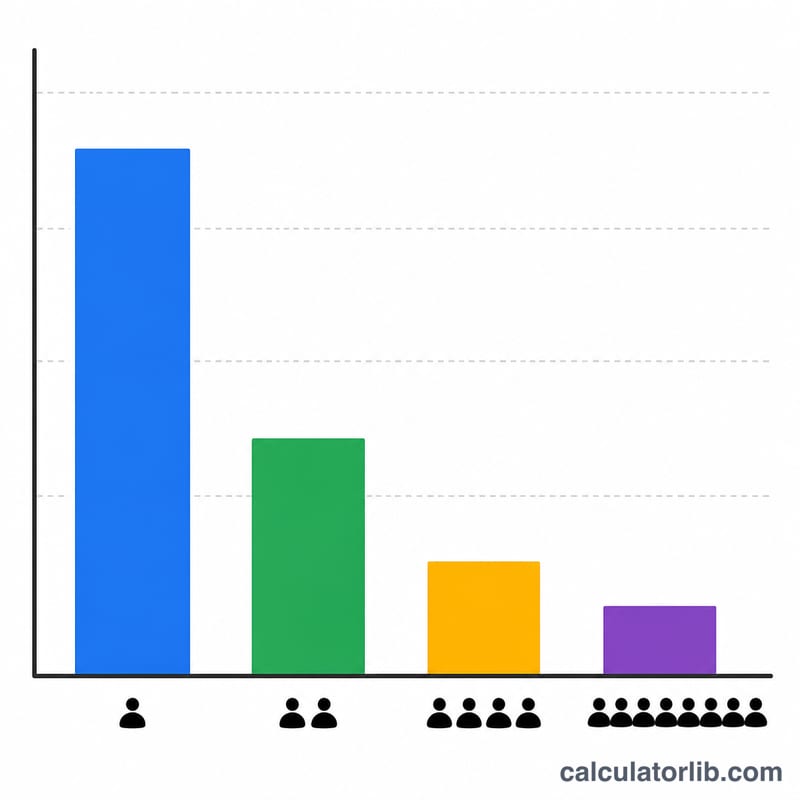
The core equation is simply $$\text{Per-User Mbps} = \frac{\text{Total Mbps}}{\text{Number of Users}}$$ This models the simplest case where each connected device receives an equal slice of capacity. Real networks share bandwidth dynamically — idle users free up capacity for active ones — so this even-split figure is a conservative baseline rather than an exact prediction.
Worked example
Suppose you have a 100 Mbps connection and 10 people streaming at once. $$\text{Per-User} = \frac{100}{10} = 10 \text{ Mbps}$$ each (10,000 Kbps). That is comfortably enough for HD streaming per person but not for everyone in 4K simultaneously.
FAQ
Does each user really get an equal share? Not exactly. Most routers allocate bandwidth on demand, so light users use less and leave more for heavy users. This calculator gives the even-split worst case.
What is a good per-user speed? Aim for at least 5–10 Mbps per active user for smooth HD video and video calls; less is fine for browsing and email.
Should I use download or upload speed? Use whichever matters for your use case — download for streaming, upload for video calls or hosting — since they are usually different on most plans.