
What is the Candela to Lux Calculator?
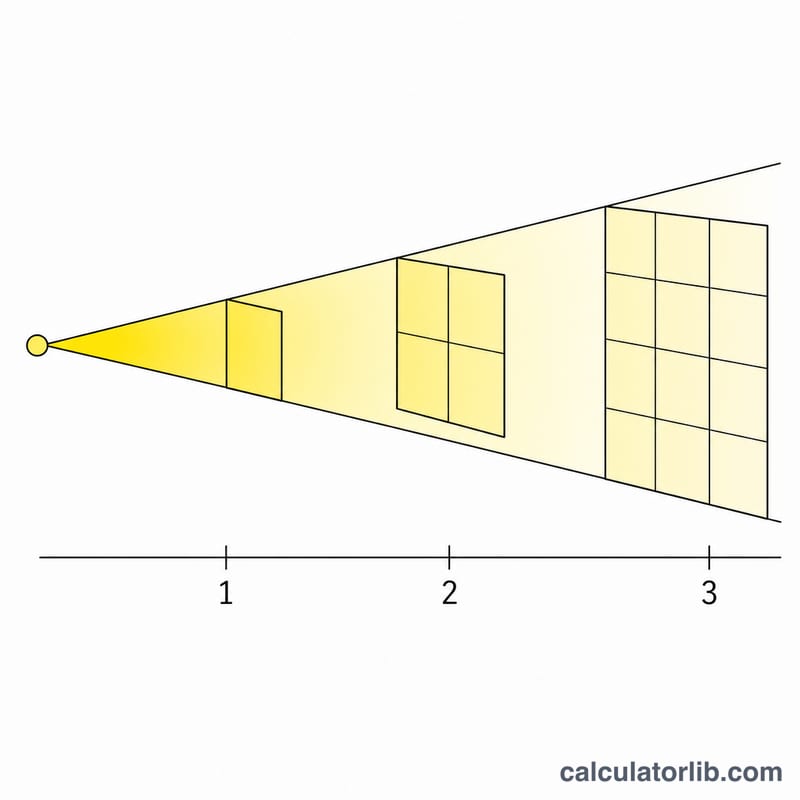
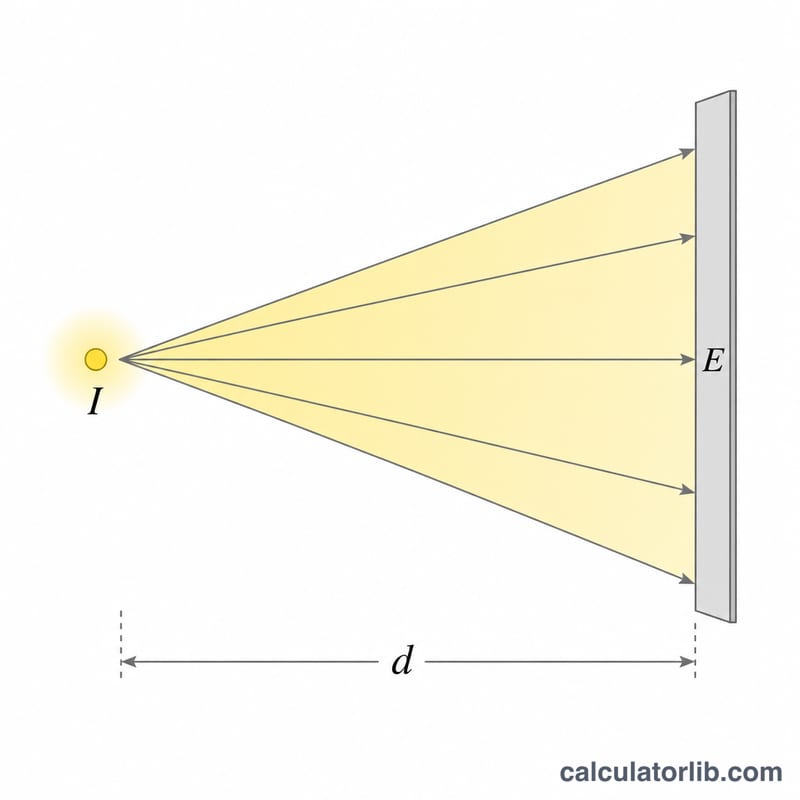
This tool converts luminous intensity (measured in candela, cd) into illuminance (measured in lux, lx) at a specific distance from the light source. Candela describes how much light is emitted in a particular direction, while lux describes how much of that light actually lands on a surface. Because light spreads out as it travels, the same source produces less lux the farther away you measure it.
How to use it
Enter the luminous intensity of your light source in candela and the distance from the source to the surface in meters. The calculator instantly returns the illuminance in lux. This is useful for lighting design, photography, stage lighting, and choosing flashlights or projectors.
The formula explained
The conversion follows the inverse-square law:
$$\text{Lux} = \frac{\text{Intensity (cd)}}{\left(\text{Distance (m)}\right)^2}$$Here I is the luminous intensity in candela and d is the distance in meters. Because distance is squared, doubling the distance reduces the illuminance to one-quarter. To go the other way, multiply the desired lux by the distance squared: \(I = E_v \times d^2\).
Worked example
Suppose a spotlight has an intensity of 1,000 cd and you measure illuminance 2 meters away. Then $$E_v = \frac{1{,}000}{2^2} = \frac{1{,}000}{4} = 250 \text{ lux}.$$ Move to 5 meters and you get \(1{,}000 / 25 = 40\) lux.
FAQ
Is candela the same as lux? No. Candela measures intensity in a direction; lux measures light received per square meter on a surface. They are related only when you also know the distance.
Does the calculator account for beam angle? No. It uses point-source intensity in the measured direction, which is the standard cd-to-lux relationship.
What if distance is zero? The formula divides by distance squared, so distance must be greater than zero; the calculator returns 0 if it is not.