What Is the Lux to Foot-Candles Calculator?
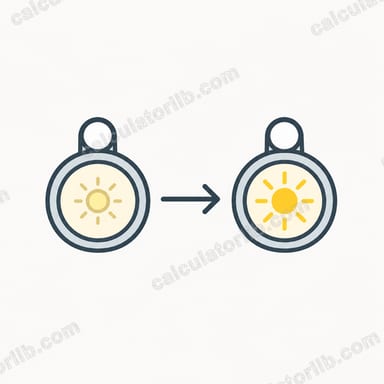
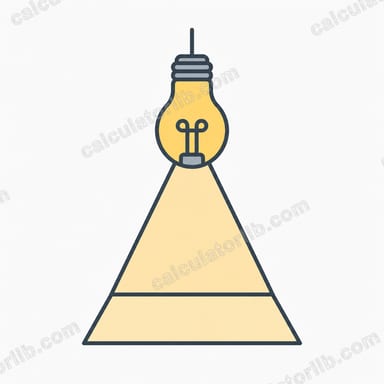
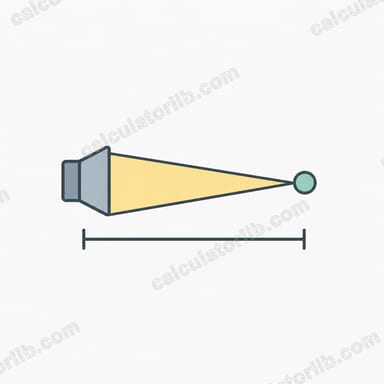
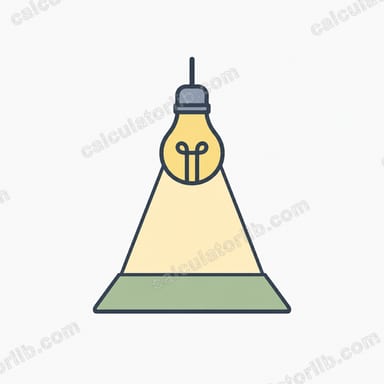
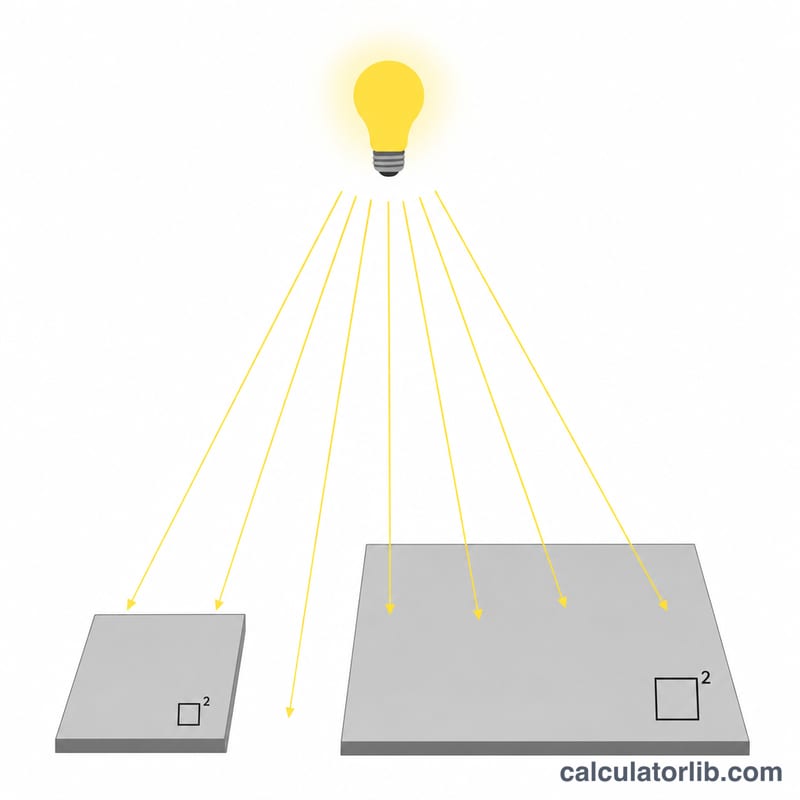
This tool converts illuminance measured in lux (the SI unit, lumens per square meter) into foot-candles (fc), the imperial unit equal to lumens per square foot. Both units describe how much light falls on a surface, but they use different area references, so a simple conversion factor links them.
How to Use It
Enter the illuminance value in lux and the calculator instantly returns the equivalent in foot-candles. This is handy for lighting designers, photographers, and engineers who work with mixed-unit specifications, since many international standards quote lux while US documentation often uses foot-candles.
The Formula Explained
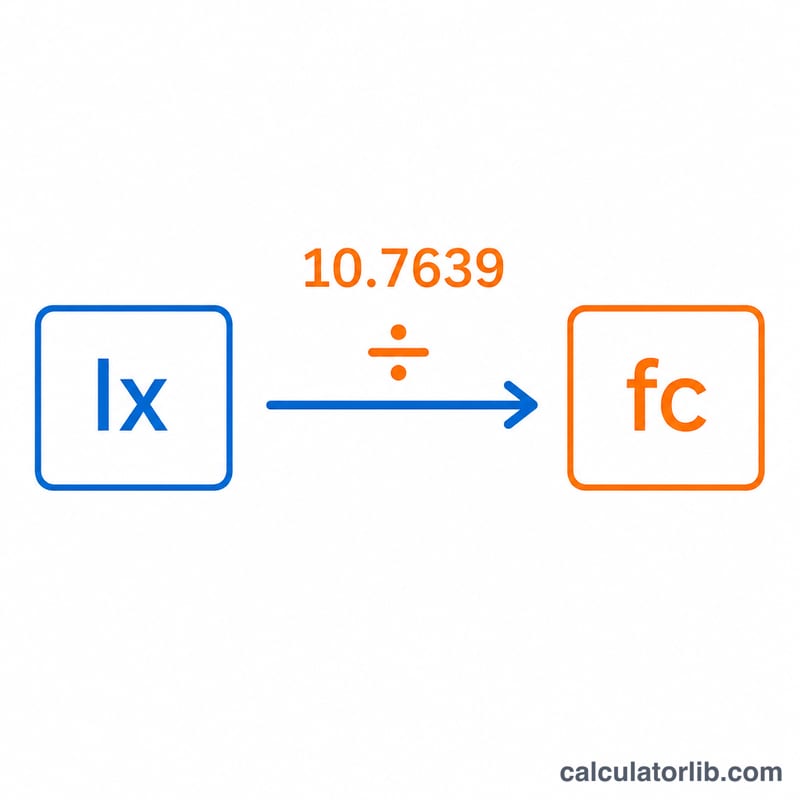
Because 1 square meter equals 10.7639 square feet, one foot-candle equals 10.7639 lux. To convert in the other direction:
$$\text{fc} = \frac{\text{lux}}{10.7639}$$
The constant 10.7639 is simply the number of square feet in a square meter, which is where the area-based unit difference comes from.
Worked Example
Suppose an office is lit to 500 lux, a common target for general office work. Dividing by 10.7639 gives $$500 \div 10.7639 \approx 46.45 \text{ foot-candles}.$$ So 500 lux is roughly 46 fc.
Typical Illuminance Levels by Environment
The table lists approximate illuminance for common settings in lux and foot-candles (fc), converted with \(\text{fc} = \text{lux} / 10.7639\). Values are rounded and are typical figures, not fixed requirements. Recommended levels vary by standard, country, age of the occupants and the visual task. Workplace lighting guidance is published in the European standard EN 12464-1 and by the Illuminating Engineering Society (IES, North America). Always check the edition and rules that apply to your location and project.
| Setting / Task | Approx. illuminance (lux) | Approx. illuminance (fc) |
|---|---|---|
| Moonlight (clear night) | 0.1 – 1 | 0.009 – 0.09 |
| Corridors and circulation areas | 100 | ≈ 9.29 |
| General office work | 300 – 500 | ≈ 28 – 46 |
| Detailed drawing / precision work | 750 – 1,000 | ≈ 70 – 93 |
| Overcast day (outdoors) | ≈ 1,000 and up | ≈ 93 and up |
| Direct sunlight | ≈ 100,000 | ≈ 9,290 |
How to read this:
- EN 12464-1 specifies maintained illuminance for indoor workplaces. For example, it commonly cites about 100 lux for corridors and 500 lux for typical office tasks such as writing and reading.
- IES recommendations are usually given in foot-candles in the US and vary with task difficulty and user age, so they do not always match EN values exactly.
- Outdoor levels change a lot with weather, season, time of day and latitude. Overcast skies can range well above 1,000 lux, and direct sun can exceed 100,000 lux.
- Measured values depend on where the meter is placed, such as on the work plane or on the floor, and on the light source. Treat the table as a rough guide.
FAQ
Is lux brighter than a foot-candle? No — they measure the same physical quantity (illuminance). One foot-candle is about 10.76 lux, so the same lighting level has a larger lux number and a smaller foot-candle number.
Why 10.7639? It is the exact number of square feet in one square meter (one meter = 3.28084 feet, squared ≈ 10.7639).
How do I convert back? Multiply foot-candles by 10.7639 to get lux.