What is the Grow Light Coverage Area Calculator?
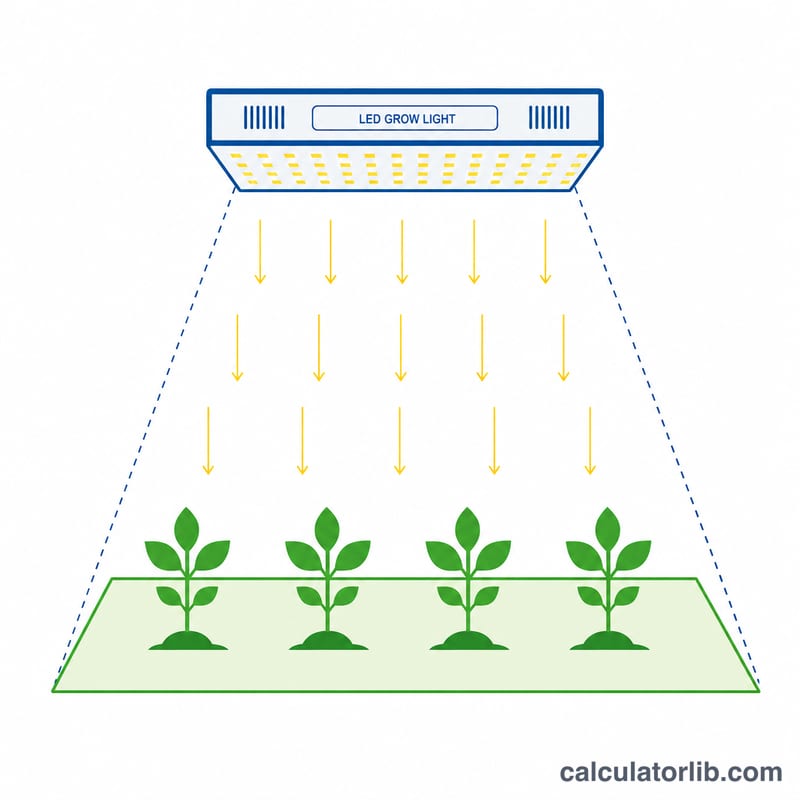
This calculator tells you how large an area (in square feet) a grow light can cover while still delivering your desired light intensity at the canopy. It uses the light's PPF (Photosynthetic Photon Flux, the total micromoles of usable light per second a fixture emits) and your target PPFD (Photosynthetic Photon Flux Density, the intensity reaching the plants in µmol/m²/s).
How to use it
Enter the PPF rating of your light from the manufacturer's spec sheet, then enter the PPFD you want at canopy level for your crop stage. Common targets: seedlings/clones 100–300, vegetative growth 300–600, and flowering 600–1000 µmol/m²/s. The result shows the maximum footprint that receives at least that intensity.
The formula explained
PPF is spread evenly over an area: \(\text{PPFD} = \text{PPF} \div \text{Area(m}^2\text{)}\). Rearranged, \(\text{Area(m}^2\text{)} = \text{PPF} \div \text{PPFD}\). Since \(1\ \text{m}^2 = 10.764\ \text{ft}^2\) and \(1\ \text{ft}^2 = 0.0929\ \text{m}^2\), dividing PPF by (PPFD × 0.0929) returns the coverage directly in square feet.
$$\text{Coverage (ft}^2\text{)} = \frac{\text{Light PPF}}{\text{Target PPFD} \times 0.0929}$$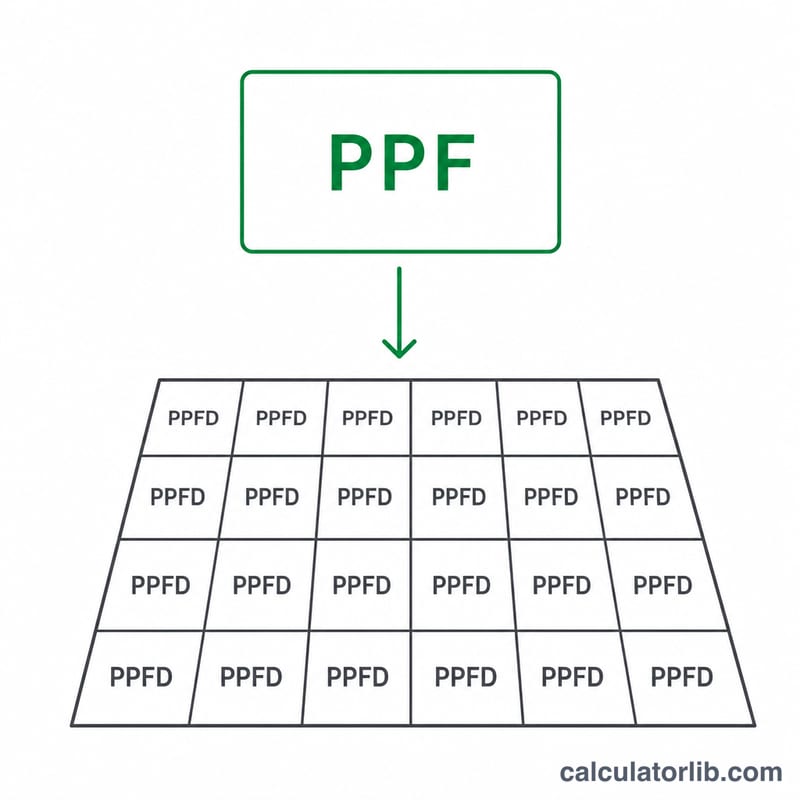
Worked example
A fixture rated at 1000 µmol/s, with a flowering target of 600 µmol/m²/s: $$\text{Area} = \frac{1000}{600 \times 0.0929} = \frac{1000}{55.74} \approx 17.94\ \text{ft}^2$$ (about a 4 ft × 4 ft footprint), or roughly 1.667 m².
Recommended PPFD Targets by Growth Stage
PPFD (photosynthetic photon flux density) is the light reaching the canopy, in µmol/m²/s. The ranges below are general horticultural guidelines for typical flowering and fruiting plants. Actual optima vary by species, cultivar, temperature, nutrition and CO2 level.
| Growth stage | Target PPFD (µmol/m²/s) | Assumed photoperiod | Approx. DLI (mol/m²/day) |
|---|---|---|---|
| Seedlings / clones | 100–300 | 18 h | 6.5–19.4 |
| Vegetative | 300–600 | 18 h | 19.4–38.9 |
| Flowering | 600–1000 | 12 h | 25.9–43.2 |
| High-light flowering (needs supplemental CO2) | 1000–1500 | 12 h | 43.2–64.8 |
The daily light integral is calculated as:
$$\text{DLI} = \frac{\text{PPFD} \times \text{hours of light} \times 3600}{10^{6}}$$
For example, \(600 \times 12 \times 3600 / 10^{6} = 25.9\) mol/m²/day. The DLI column above assumes the stated photoperiod. A different light schedule changes the DLI even at the same PPFD.
Intensities above about 1000 µmol/m²/s generally pay off only with elevated CO2 (often around 1000–1500 ppm), plus well-managed temperature, humidity and nutrients. Without those, the extra light can stress plants rather than boost growth.
Coverage Comparison for Common PPF and PPFD Combinations
Coverage is computed as \(\text{Area (ft}^2) = \dfrac{\text{PPF}}{\text{PPFD} \times 0.0929}\), where 0.0929 converts square feet to square metres. The calculation assumes the light is spread evenly, which real fixtures do not do, so treat the result as an upper bound. For example, 1000 µmol/s at 600 µmol/m²/s gives \(1000 / (600 \times 0.0929) = \) 17.94 ft².
| Light PPF (µmol/s) | At 300 µmol/m²/s | At 600 µmol/m²/s | At 900 µmol/m²/s |
|---|---|---|---|
| 300 | 10.76 ft² (≈ 3x3) | 5.38 ft² (≈ 2x2) | 3.59 ft² (≈ 2x2) |
| 600 | 21.53 ft² (≈ 4x4) | 10.76 ft² (≈ 3x3) | 7.18 ft² (between 2x2 and 2x4) |
| 1000 | 35.88 ft² (≈ 5x5, or 6x6 at the limit) | 17.94 ft² (≈ 4x4) | 11.96 ft² (≈ 3x3) |
| 1500 | 53.82 ft² (larger than 5x5; use several lights or a larger room) | 26.91 ft² (≈ 5x5) | 17.94 ft² (≈ 4x4) |
| 2000 | 71.76 ft² (larger than 5x5; use several lights) | 35.88 ft² (≈ 5x5 to 6x6) | 23.92 ft² (≈ 4x4 to 5x5) |
Reference tent footprints: 2x2 = 4 ft², 2x4 = 8 ft², 3x3 = 9 ft², 4x4 = 16 ft², 5x5 = 25 ft². Where a result falls between two sizes, the tent in the table is the smaller one or a range, because uniformity matters more than raw coverage.
Practical Tips for Sizing Your Grow Light
- Round to a standard tent, and go smaller when in between. Match the calculated area to the nearest standard footprint (2x2, 2x4, 3x3, 4x4, 5x5 ft). If the result falls between two sizes, choose the smaller tent so the light stays intense and even across the canopy.
- Allow for edge falloff. Light is brightest in the centre and weaker at the edges and corners, so the average PPFD over a full tent floor will be lower than the ideal formula suggests. Do not size a light right at the limit of the calculated area.
- Use reflective walls. Reflective tent walls bounce light back onto the canopy and can partly offset edge falloff. They help most in smaller tents and vary with the material.
- Check the manufacturer's PPFD map. Look for measured PPFD at specific hanging heights and footprints, such as the average and the corner values at 12, 18 or 24 inches. Real maps are more reliable than a PPF-based estimate.
- Dim for earlier stages. Seedlings and clones need far less light than flowering plants (see the table above). A dimmable light lets you run at low output early and raise intensity over time, or hang it higher instead.
- Plan for plant, not just tent, size. The canopy area you actually fill matters more than the tent floor. Re-run the calculation with the PPFD target for your current growth stage.
This is general horticultural information, not professional advice. Optimal light levels vary by crop and growing conditions.
FAQ
Is this exact? It's a theoretical even-distribution estimate. Real fixtures have hotspots and edge falloff, so usable coverage is usually slightly smaller. Mount height and reflectors also matter.
What if I only know wattage? Use the PPF from the spec sheet, not watts — efficacy varies widely between LED, HPS, and fluorescent lights.
Should I use peak or average PPFD? Use the average target you want across the canopy for the most representative footprint.