

What Is the Website Bandwidth Calculator?
Bandwidth is the total amount of data your website transfers to visitors over a billing period — usually one month. Web hosts measure it in gigabytes (GB) or terabytes (TB), and going over your plan's allowance can trigger overage fees or throttling. This calculator estimates your expected monthly transfer from three simple inputs so you can pick the right hosting plan or CDN tier.
How to Use It
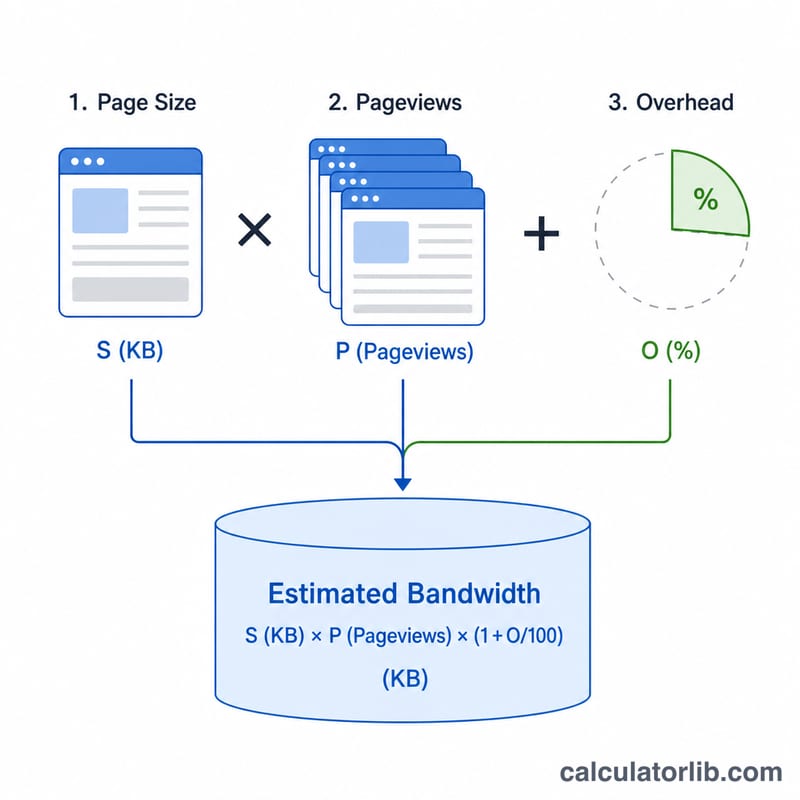
Enter the average page size in kilobytes (open your browser's network tab and look at the "transferred" total, or use a tool like PageSpeed Insights), your expected monthly pageviews, and a redundancy/overhead percentage. The overhead accounts for repeated asset downloads, API calls, retries, bots, and traffic spikes — 20–50% is a safe cushion for most sites.
The Formula Explained
The core calculation is:
$$\text{Bandwidth} = \text{Average Page Size} \times \text{Monthly Pageviews} \times \left(1 + \frac{\text{redundancy}}{100}\right)$$
The result is in kilobytes, which we convert to gigabytes by dividing by 1,048,576 (\(1024 \times 1024\)). We also report sustained average throughput in megabits per second (Mbps), which is useful for sizing network links.
Worked Example
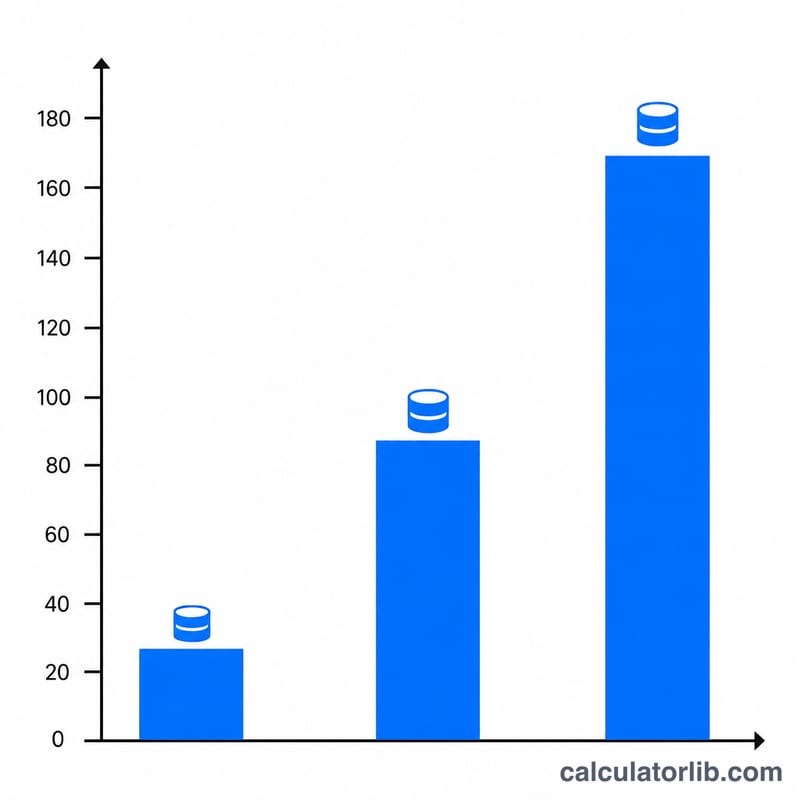
Suppose your pages average 2,048 KB (2 MB), you get 100,000 pageviews a month, and you add 50% overhead. The raw transfer is $$2{,}048 \times 100{,}000 \times 1.5 = 307{,}200{,}000 \text{ KB}.$$ Dividing by 1,048,576 gives roughly 293 GB per month — so a plan with at least 300–350 GB would be comfortable.
FAQ
Should I use KB or MB for page size? Use KB here. A 1.5 MB page = 1,536 KB.
What overhead should I pick? Start with 20–50%. Use higher values if you expect viral spikes, heavy bot traffic, or many returning visitors who re-download assets.
Does a CDN reduce bandwidth? A CDN doesn't reduce total transfer but offloads it from your origin server and often counts against the CDN's allowance instead. Plan both budgets separately.