
What This Calculator Does
The Video Bitrate & File Size Calculator estimates how large a video file will be based on its total bitrate and its duration. This is essential for planning storage space, choosing upload settings for YouTube or streaming platforms, sizing recordings for SD cards, or fitting a video onto a disc. The total bitrate should include both video and audio streams combined.
How to Use It
Enter the total bitrate in megabits per second (Mbps) — this is the value you set in your encoder, screen recorder, or export dialog. Then enter the clip length using the hours, minutes, and seconds fields. The calculator returns the estimated file size in megabytes (MB), gigabytes (GB), and mebibytes (MiB, the base-1024 unit that file managers often display).
The Formula Explained
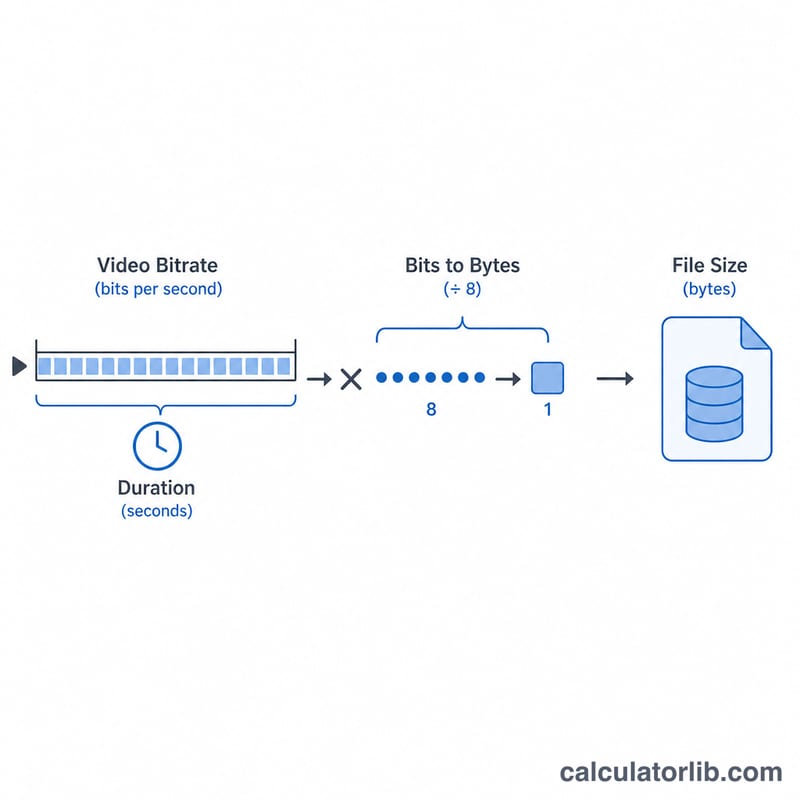
Bitrate measures how many bits of data are used per second of video. Since one byte equals eight bits, the math is straightforward:
$$\text{File Size (bytes)} = \frac{\text{Bitrate (bps)} \times \text{Duration (s)}}{8}$$
Because encoders specify Mbps, we first convert: \(1\,\text{Mbps} = 1{,}000{,}000\,\text{bps}\). We report MB and GB using the decimal convention (\(1\,\text{MB} = 1{,}000{,}000\,\text{bytes}\)), matching how manufacturers and platforms quote sizes, plus MiB for the binary convention used by many operating systems.
Worked Example
Suppose you record at 8 Mbps for 10 minutes. Duration = 600 seconds. Bitrate = \(8 \times 1{,}000{,}000 = 8{,}000{,}000\,\text{bps}\). $$\text{Size} = \frac{8{,}000{,}000 \times 600}{8} = 600{,}000{,}000\,\text{bytes} = 600\,\text{MB}$$ (≈ 0.6 GB, ≈ 572.2 MiB).
FAQ
Should I include audio in the bitrate? Yes. Use the combined video + audio bitrate for the most accurate result. For example, 8 Mbps video plus 0.192 Mbps audio is about 8.192 Mbps total.
Why does the actual file differ slightly? Variable bitrate (VBR) encoding, container overhead, and metadata can cause small differences. This calculator assumes a constant average bitrate.
What's the difference between MB and MiB? MB uses 1,000,000 bytes (decimal); MiB uses 1,048,576 bytes (binary). Windows often labels MiB as "MB," which can make files look smaller than the stated MB value.