
What is VSWR and Return Loss?
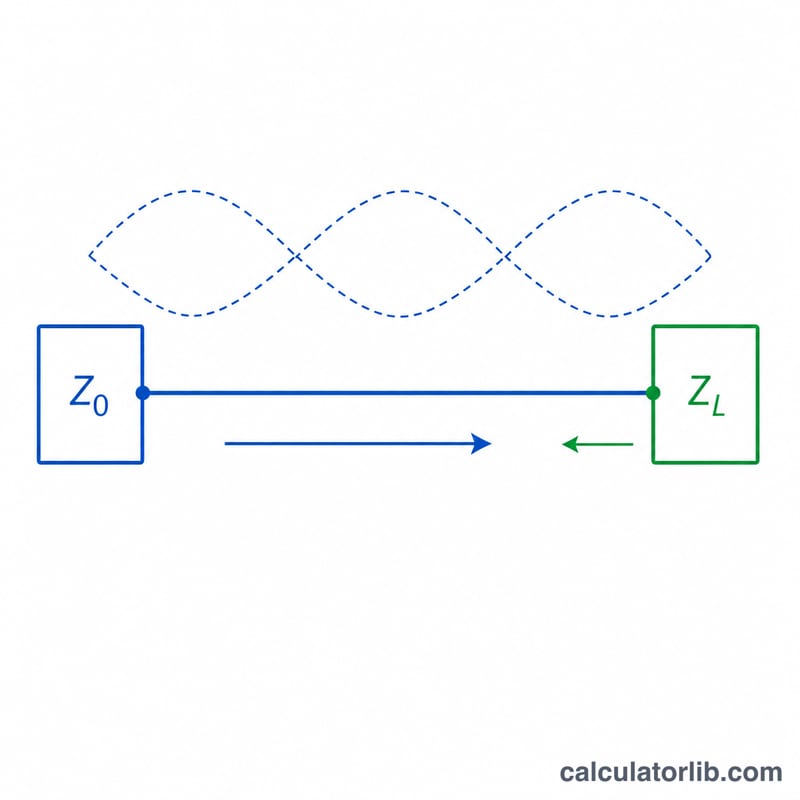
In RF and microwave engineering, the reflection coefficient \(\lvert\Gamma\rvert\) describes how much of a signal bounces back from a load (antenna, cable, amplifier) due to an impedance mismatch. From \(\lvert\Gamma\rvert\) you can derive two common figures of merit: the Voltage Standing Wave Ratio (VSWR) and the return loss in decibels. This calculator converts freely between them and also reports mismatch loss and reflected power.
How to use it
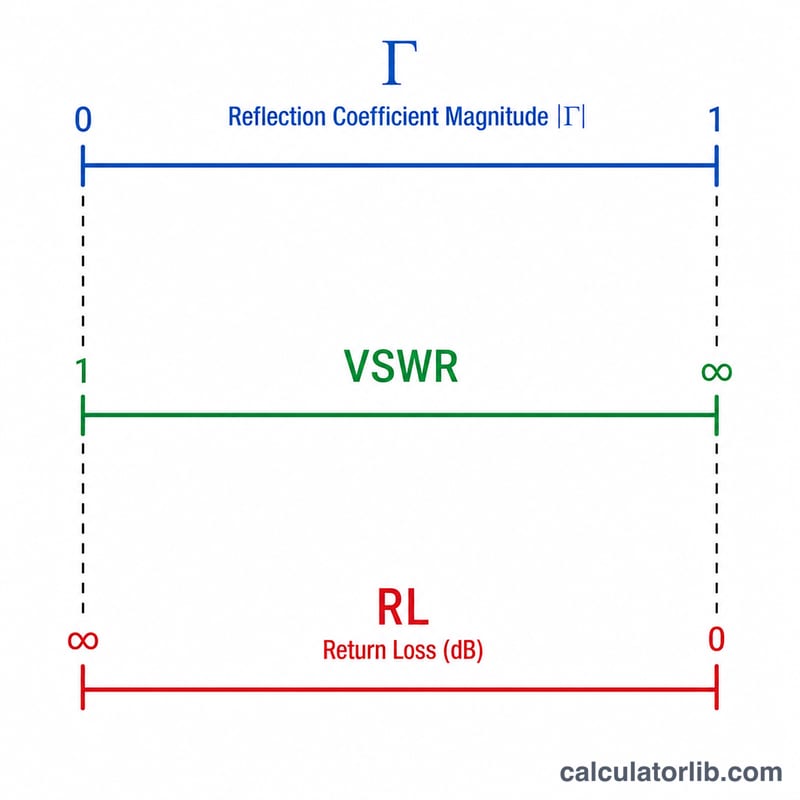
Pick what you know. Enter the reflection coefficient magnitude \(\lvert\Gamma\rvert\) (between 0 and 1), or enter the return loss in dB. The calculator computes the remaining quantities. A perfect match has \(\lvert\Gamma\rvert = 0\), VSWR = 1:1 and infinite return loss; a total reflection has \(\lvert\Gamma\rvert = 1\) and VSWR = ∞.
The formulas explained
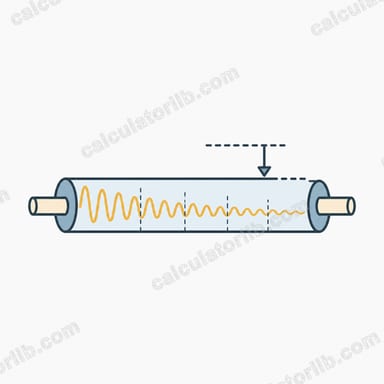
VSWR is defined as $$\text{VSWR} = \frac{1 + \lvert\Gamma\rvert}{1 - \lvert\Gamma\rvert}$$ the ratio of the peak to trough of the standing wave on the line. Return loss is \(\text{RL} = -20\,\log_{10}(\lvert\Gamma\rvert)\) dB — a larger positive number means less reflected power. Mismatch loss \(= -10\,\log_{10}(1 - \lvert\Gamma\rvert^{2})\) dB measures the power lost to reflection, and reflected power as a percentage equals \(\lvert\Gamma\rvert^{2} \times 100\).
Worked example
Suppose \(\lvert\Gamma\rvert = 0.2\). Then $$\text{VSWR} = \frac{1 + 0.2}{1 - 0.2} = \frac{1.2}{0.8} = 1.5:1.$$ Return loss \(= -20\,\log_{10}(0.2) \approx 13.98\) dB. Reflected power \(= 0.2^{2} \times 100 = 4\%\), and mismatch loss \(= -10\,\log_{10}(1 - 0.04) \approx 0.177\) dB.
FAQ
What VSWR is acceptable? Many antenna systems target VSWR ≤ 1.5:1 (return loss ≥ 14 dB). Below 2:1 is usually fine for general use.
Is higher return loss better? Yes — higher return loss (in dB) means less reflected power and a better match.
Does this depend on impedance? No. These conversions only need \(\lvert\Gamma\rvert\); the underlying impedance (e.g. 50 Ω) determines \(\lvert\Gamma\rvert\) but isn't needed here.