

What Is Cerebral Perfusion Pressure?
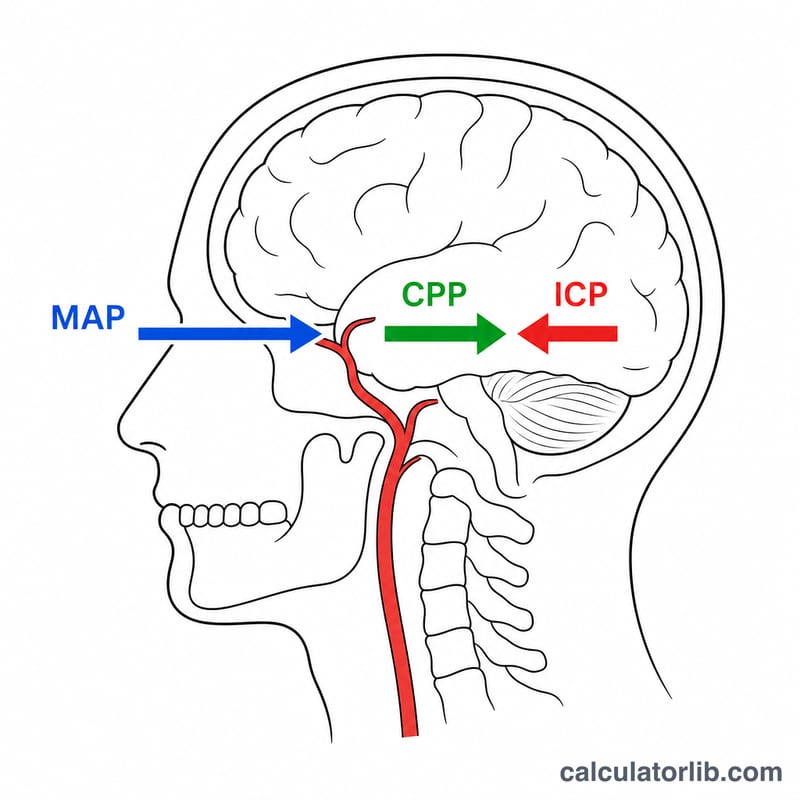
Cerebral perfusion pressure (CPP) is the net pressure gradient that drives blood flow — and therefore oxygen delivery — to the brain. It is defined as the difference between the mean arterial pressure (MAP) supplying the brain and the intracranial pressure (ICP) opposing that flow. Adequate CPP is essential to prevent cerebral ischemia, particularly in patients with traumatic brain injury, stroke, or raised intracranial pressure.
How to Use the Calculator
Enter the patient's systolic blood pressure (SBP), diastolic blood pressure (DBP), and measured intracranial pressure (ICP), all in mmHg. The calculator first estimates MAP, then subtracts ICP to give CPP. In adults, a target CPP of roughly 60–70 mmHg is commonly recommended after traumatic brain injury, though goals are individualized.
The Formula Explained
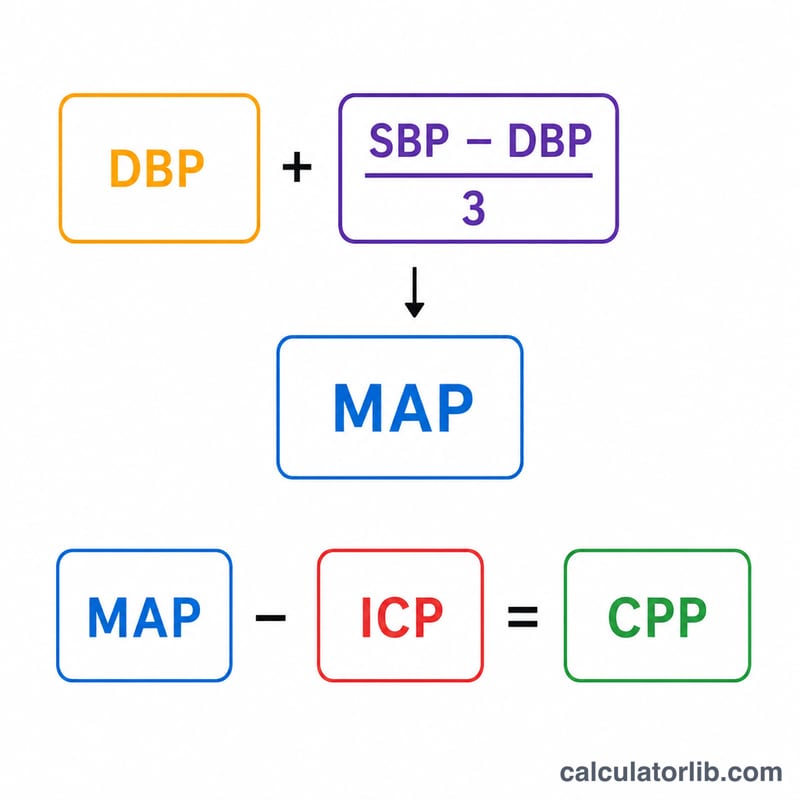
The tool uses two standard equations. Mean arterial pressure is estimated as $$\text{MAP} = \text{DBP} + \frac{\text{SBP} - \text{DBP}}{3}$$, which weights the diastolic pressure more heavily because the heart spends about two-thirds of the cardiac cycle in diastole. Cerebral perfusion pressure is then $$\text{CPP} = \text{MAP} - \text{ICP}$$.
Worked Example
Suppose a patient has SBP 120 mmHg, DBP 80 mmHg, and ICP 10 mmHg. $$\text{MAP} = 80 + \frac{120 - 80}{3} = 80 + 13.33 = 93.33 \text{ mmHg}$$ $$\text{CPP} = 93.33 - 10 = 83.33 \text{ mmHg}$$ which is within a healthy range.
FAQ
What is a normal CPP? A CPP of about 60–80 mmHg is generally considered adequate in adults; values below 50–60 mmHg risk cerebral ischemia.
Why estimate MAP instead of measuring it? An invasive arterial line gives a directly measured MAP, but the SBP/DBP estimate is convenient and widely used when only a cuff reading is available.
Is this a substitute for clinical judgment? No. This calculator is an educational aid; treatment targets must be set by qualified clinicians for each patient.