
What Is the EROA (PISA) Calculator?
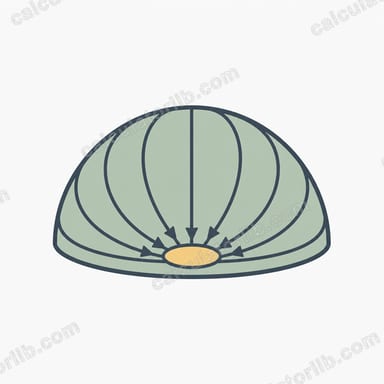
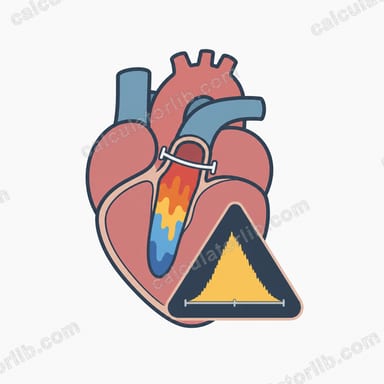
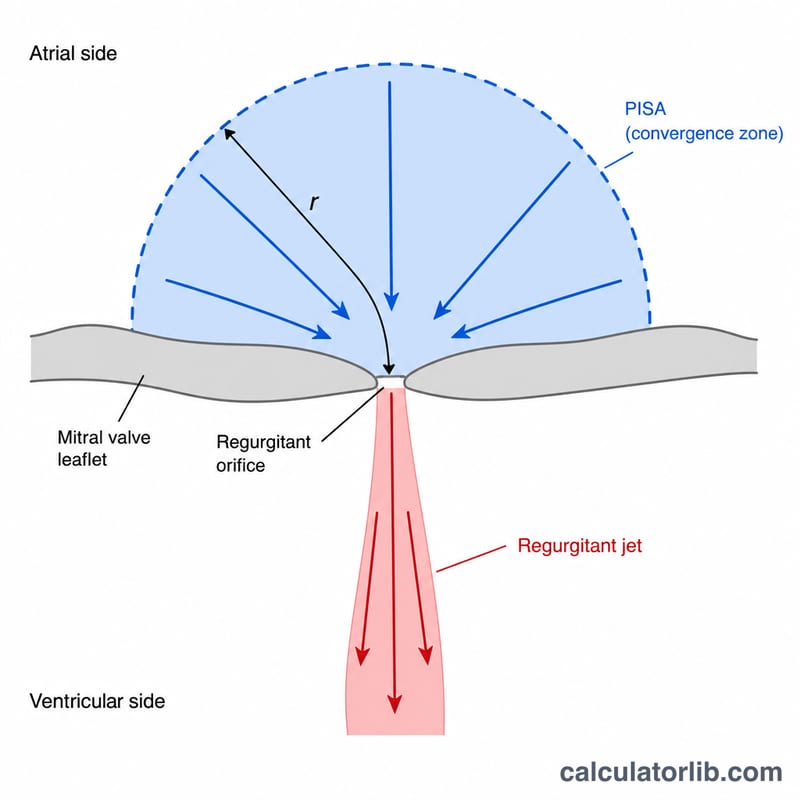
This tool estimates the Effective Regurgitant Orifice Area (EROA) in mitral regurgitation using the Proximal Isovelocity Surface Area (PISA) method, a standard echocardiographic technique. The PISA principle relies on the fact that blood converging toward a regurgitant orifice forms hemispheric shells of equal velocity. Measuring the radius of one such shell at a known aliasing velocity lets us quantify the regurgitant flow and orifice size. This is a clinical/educational tool and does not replace professional interpretation by a cardiologist or sonographer.
How to Use It
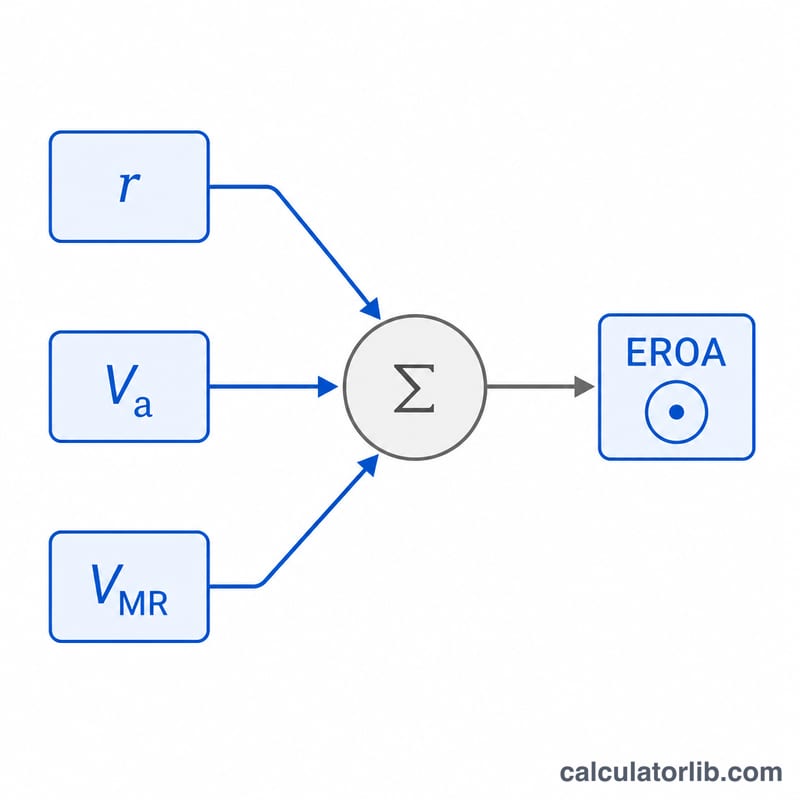
Enter three echocardiographic measurements: the PISA radius (the distance from the aliasing boundary to the orifice, in cm), the aliasing velocity (the Nyquist limit on color Doppler, in cm/s), and the peak MR velocity (the peak velocity of the mitral regurgitant jet on continuous-wave Doppler, in cm/s). The calculator returns the regurgitant flow rate (mL/s) and the EROA (cm²).
The Formula Explained
The surface area of a hemisphere is \(2\pi r^{2}\). Multiplying this by the aliasing velocity gives the instantaneous flow rate: $$Q = 2\pi r^{2} \times V_{\text{aliasing}}$$ By conservation of flow, the same volume passes through the orifice, so dividing flow rate by the peak MR jet velocity yields the orifice area: $$\text{EROA} = \frac{Q}{V_{\text{peak MR}}}$$
Worked Example
With a PISA radius of 0.9 cm, aliasing velocity 40 cm/s, and peak MR velocity 500 cm/s: $$Q = 2 \times \pi \times 0.9^{2} \times 40 \approx 203.6 \text{ mL/s}$$ $$\text{EROA} = \frac{203.6}{500} \approx 0.41 \text{ cm}^{2}$$ An EROA \(\geq 0.40\) cm² typically indicates severe mitral regurgitation.
FAQ
What EROA indicates severe MR? An EROA of 0.40 cm² or greater is generally considered severe primary mitral regurgitation, though thresholds vary by guideline and MR type.
Why use the aliasing velocity? It defines the velocity of the hemispheric shell you measure, so the flow through that shell equals shell area times aliasing velocity.
Are the units important? Yes — keep radius in cm and velocities in cm/s. This yields flow in mL/s (cm³/s) and EROA in cm².