
What Is the ABC/2 ICH Volume Calculator?
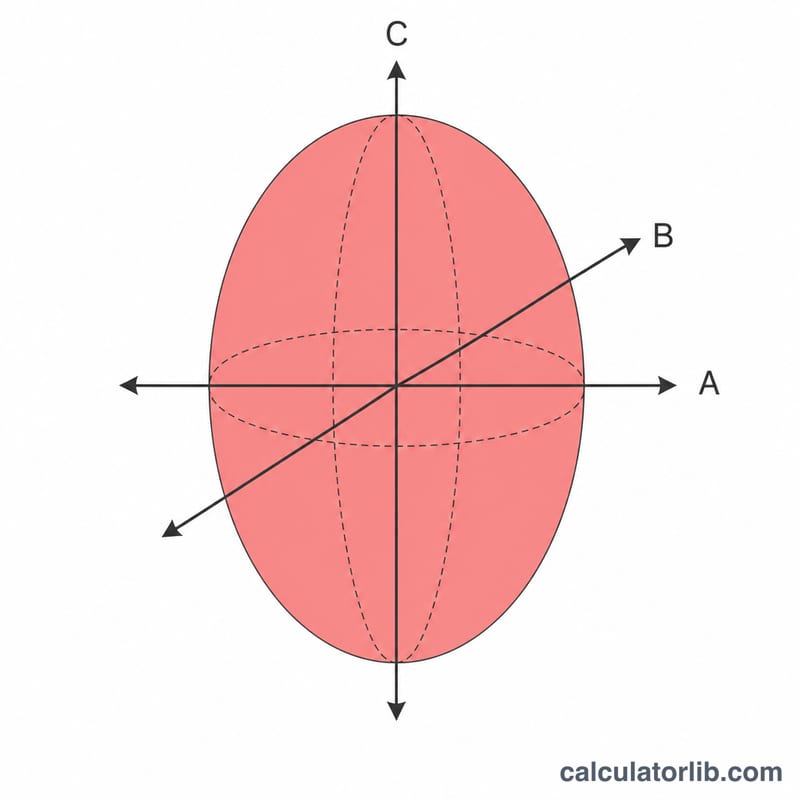
The ABC/2 method is a fast, widely used bedside formula for estimating the volume of an intracerebral hemorrhage (ICH) from CT imaging. It treats the hematoma as an ellipsoid and computes its approximate volume from three measured diameters. Clinicians use the estimate to gauge bleed severity, guide treatment decisions, and track expansion. This tool is intended for educational and clinical-support purposes and does not replace formal volumetric software or clinical judgment.
How to Use It
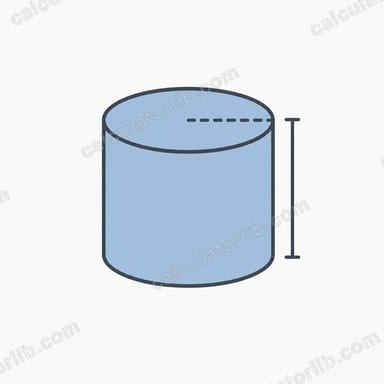
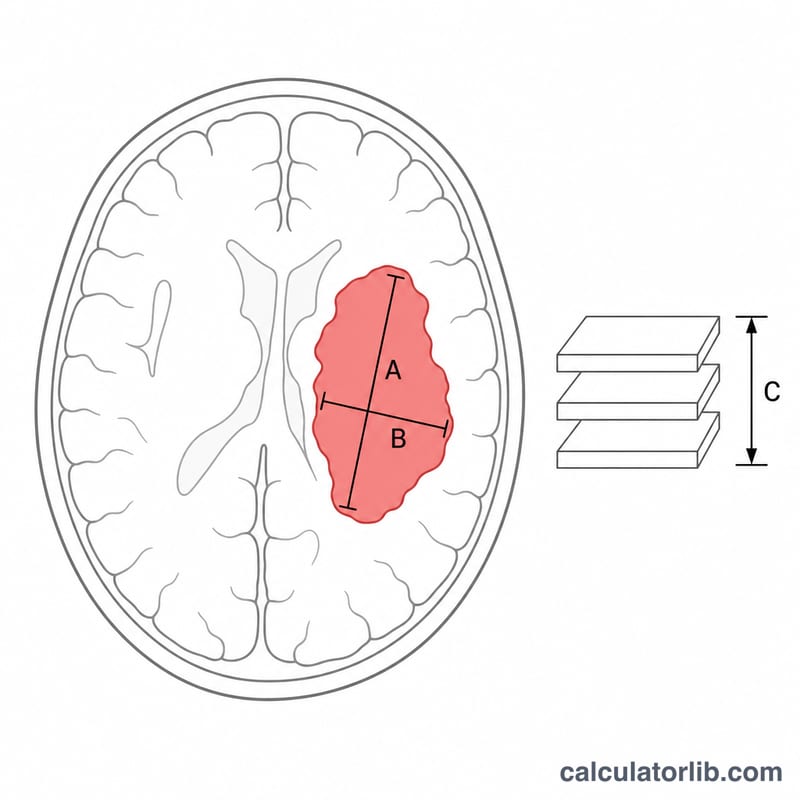
On the CT slice showing the largest area of hemorrhage, measure the greatest diameter (A) and the largest diameter perpendicular to A (B). Then measure C as the approximate vertical extent: count the number of slices the bleed appears on and multiply by the slice thickness. Enter A, B, and C in centimeters and read off the estimated volume in cubic centimeters, which is equivalent to milliliters.
The Formula Explained
The full ellipsoid volume is \(\frac{4}{3}\cdot\pi\cdot\frac{A}{2}\cdot\frac{B}{2}\cdot\frac{C}{2}\). Approximating \(\pi\) with 3 and simplifying yields \(\frac{A\cdot B\cdot C}{2}\). So the calculation reduces to multiplying the three diameters and dividing by two.
$$\text{Volume} = \frac{\text{Length A (cm)} \times \text{Width B (cm)} \times \text{Height C (cm)}}{2}$$
Worked Example
Suppose A = 5 cm, B = 4 cm, and C = 3 cm. $$\text{Volume} = \frac{5 \times 4 \times 3}{2} = \frac{60}{2} = 30 \text{ cm}^3$$ i.e. about 30 mL. A volume above 30 mL is often associated with poorer outcomes, though prognosis depends on many factors.
FAQ
Are the units always centimeters? Yes — enter all three diameters in cm and the result is in cm³, which equals mL.
How accurate is ABC/2? It is a good rapid estimate for roughly ellipsoidal bleeds but tends to overestimate irregular or lobulated hematomas. Use planimetric or software volumetry when precision matters.
Does it work for any shape? The approximation assumes an ellipsoid shape, so very irregular hemorrhages reduce its accuracy.