
What Is the PISA Flow Rate?
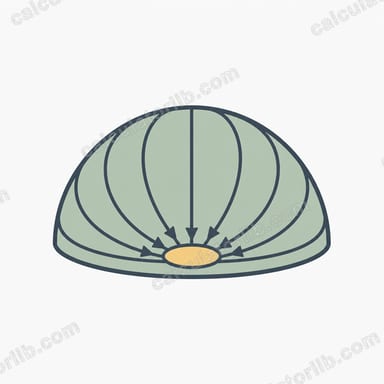
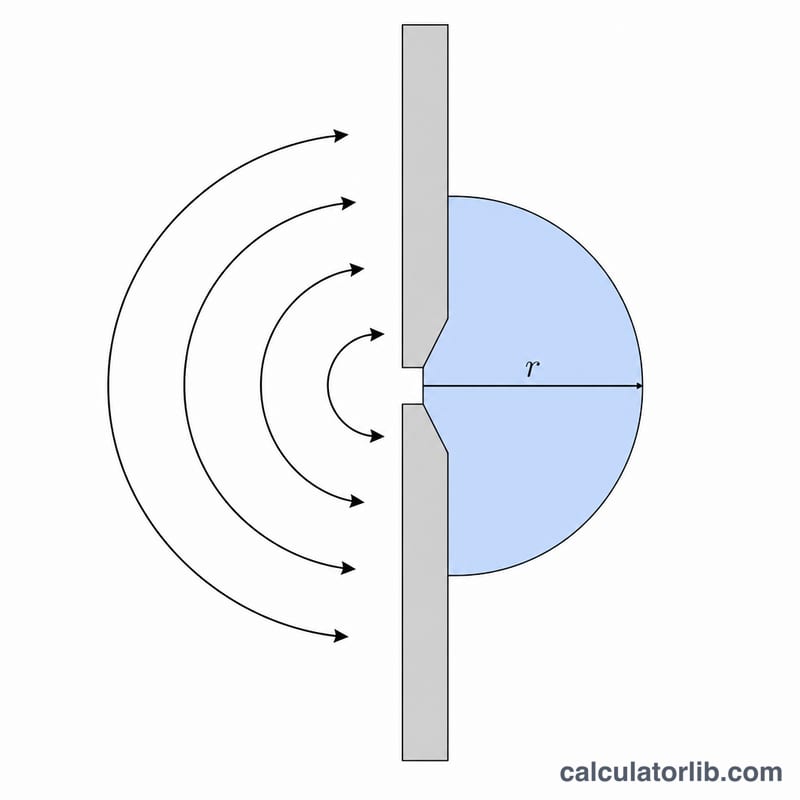
The Proximal Isovelocity Surface Area (PISA) method is used in echocardiography to quantify the severity of valvular regurgitation and shunt flow. As blood converges toward a regurgitant orifice, it forms hemispheric shells of equal velocity. At the radius where the color Doppler signal aliases, the flow can be computed by multiplying the surface area of that hemisphere by the aliasing velocity.
The Formula
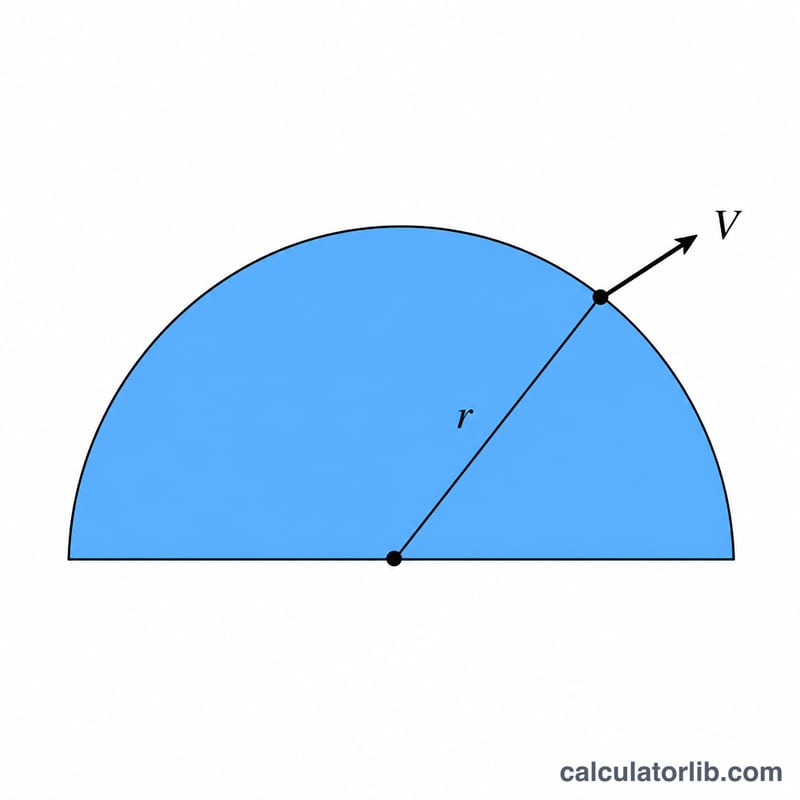
The surface area of a hemisphere is \(2\pi r^{2}\). Multiplying by the aliasing velocity gives the instantaneous flow rate:
$$\text{Flow Rate} = 2 \times \pi \times r^{2} \times V_{\text{aliasing}}$$
Here, \(r\) is the PISA radius in centimeters and \(V_{\text{aliasing}}\) is the Nyquist/aliasing velocity in cm/s. The result is expressed in cm³/s (equivalent to mL/s).
How to Use the Calculator
Measure the PISA radius from the color Doppler image at the point of color aliasing, and read the aliasing (Nyquist) velocity from the color scale. Enter both values and the calculator returns the peak flow rate across the converging hemisphere.
Worked Example
With a PISA radius of 0.9 cm and an aliasing velocity of 40 cm/s: $$\text{Flow} = 2 \times \pi \times (0.9)^{2} \times 40 = 2 \times 3.14159 \times 0.81 \times 40 \approx 203.58 \text{ mL/s}.$$ This peak flow rate can then be combined with the peak regurgitant velocity to estimate the effective regurgitant orifice area (EROA).
FAQ
Why a hemisphere and not a full sphere? Flow converges only from the chamber side of the orifice, so the isovelocity surface is approximated as a hemisphere \((2\pi r^{2})\) rather than a full sphere.
What units should I use? Use centimeters for radius and cm/s for velocity to obtain flow in mL/s. Keep units consistent for valid results.
Is this clinically validated? The PISA method is widely used but assumes a hemispheric flow convergence and a flat orifice. Anatomic deviations can introduce error, so interpret alongside other measurements.