What Is the NSFR?
The Net Stable Funding Ratio (NSFR) is a Basel III liquidity standard designed to promote longer-term resilience of banks. It requires institutions to maintain a stable funding profile relative to the composition of their assets and off-balance-sheet activities over a one-year horizon. The standard applies internationally to banks supervised under the Basel III framework (e.g., via national regulators implementing the rules, such as the EU CRR, UK PRA, or US federal banking agencies). The minimum requirement is an NSFR of at least 100%.
How to Use This Calculator
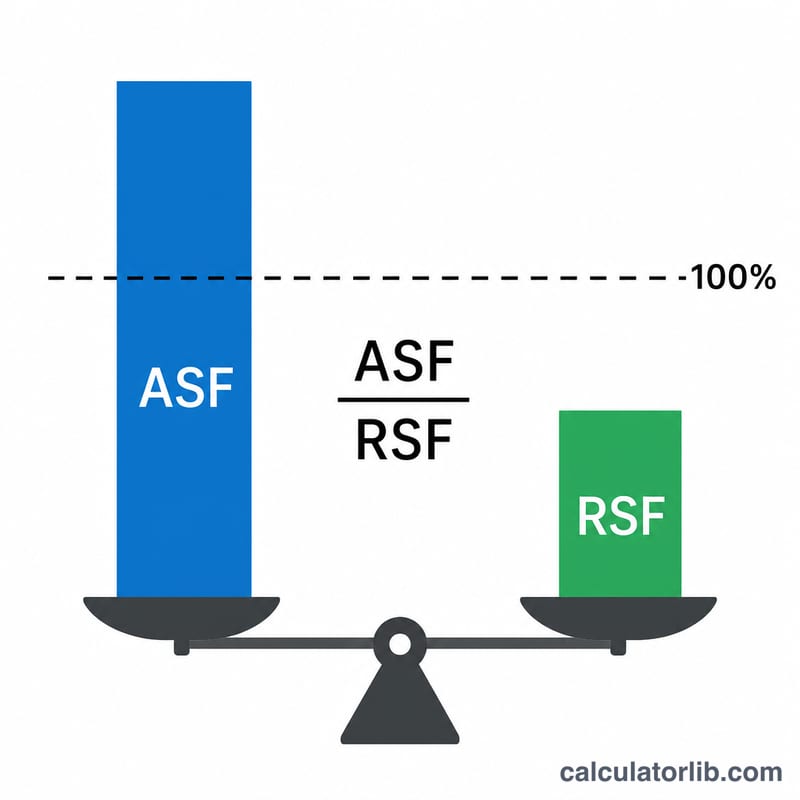
Enter your total Available Stable Funding (ASF) — the portion of capital and liabilities expected to be reliable over one year (weighted by ASF factors) — and your total Required Stable Funding (RSF) — the amount of stable funding your assets and exposures require (weighted by RSF factors). The calculator returns the NSFR as a percentage and flags whether you meet the 100% regulatory minimum.
The Formula Explained
$$\text{NSFR} = \frac{\text{Available Stable Funding}}{\text{Required Stable Funding}} \times 100\%$$ ASF is the weighted sum of equity, long-term liabilities and stable deposits; RSF is the weighted sum of assets according to their liquidity and remaining maturity. A ratio of 100% or more means a bank funds its assets with sufficiently stable sources.

Worked Example
Suppose a bank reports ASF of 1,200,000 and RSF of 1,000,000. $$\text{NSFR} = \frac{1{,}200{,}000}{1{,}000{,}000} \times 100\% = 120\%$$ Because 120% exceeds the 100% threshold, the bank is compliant with a comfortable buffer.
FAQ
What is the minimum NSFR? Under Basel III, banks must maintain an NSFR of at least 100% on an ongoing basis.
How does NSFR differ from LCR? The Liquidity Coverage Ratio (LCR) addresses short-term (30-day) liquidity stress, while NSFR targets structural funding stability over a one-year horizon.
What if my RSF is zero? The ratio is undefined when RSF is zero; this calculator returns 0 to avoid division by zero. In practice an active bank always has positive RSF.