
What Is the Korean Age Calculator?
This tool converts your birth year into your traditional Korean age. In the long-standing Korean counting system, a baby is considered 1 year old at birth, and everyone gains a year together on January 1st — not on their individual birthday. As a result, a person's Korean age is usually one or two years higher than their international (Western) age.
How to Use It
Enter your birth year and the current year (this defaults to the present year). The calculator returns your Korean age along with your Western age for comparison. No month or day is needed because the simplified yearly method only depends on the calendar year.
The Formula Explained
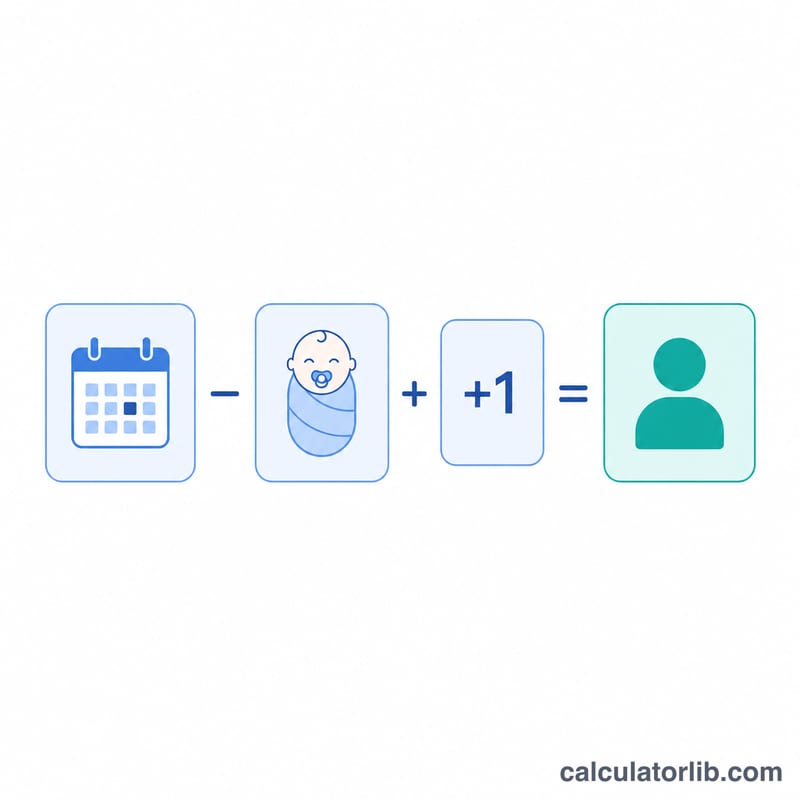
The core equation is simple:
$$\text{Korean age} = \text{current year} - \text{birth year} + 1$$
The "+ 1" accounts for the fact that you start life at age 1 rather than 0. The Western age is just \(\text{current year} - \text{birth year}\).
Worked Example
Suppose you were born in 1995 and the current year is 2024. Your Korean age is $$2024 - 1995 + 1 = 30,$$ while your Western age is \(2024 - 1995 = 29\). So in Korea you'd say you are 30 (서른 살).
Korean Age vs. International Age: Comparison by Birthday
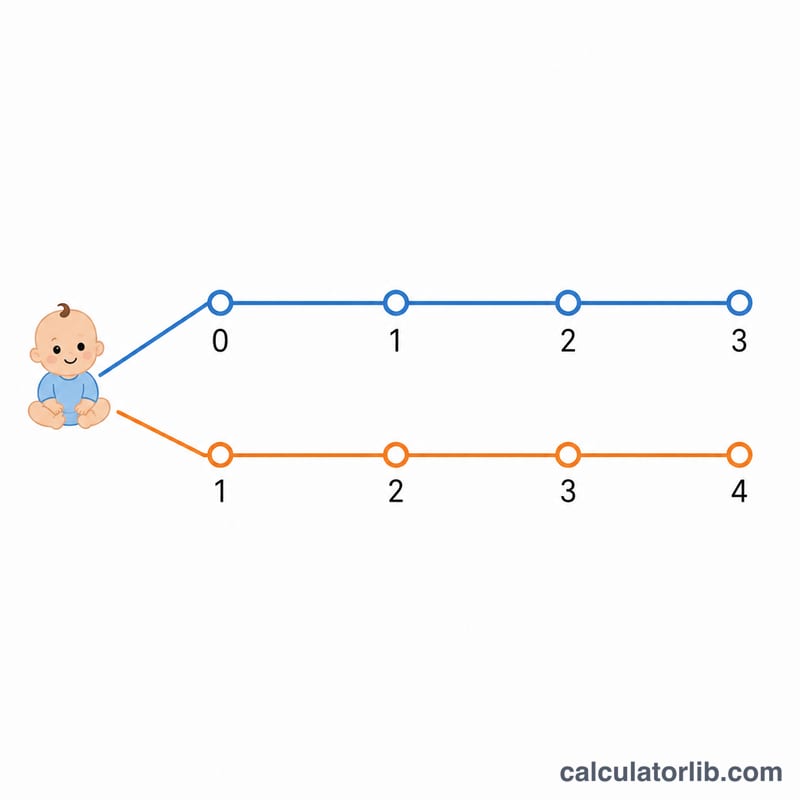
The table uses a fixed reference date of 15 June 2024. Korean age (세는 나이) is calculated as \(2024 - \text{birth year} + 1\). International age (만 나이) is the number of full years elapsed since birth, so it depends on whether the birthday has already passed in 2024.
| Birth date | Korean age | International age | Difference |
|---|---|---|---|
| 31 Dec 1994 | 2024 − 1994 + 1 = 31 | 29 (birthday not yet reached) | 2 |
| 1 Jan 1995 | 30 | 29 (birthday already passed) | 1 |
| 14 Jun 1995 | 2024 − 1995 + 1 = 30 | 29 (birthday passed yesterday) | 1 |
| 15 Jun 1995 | 30 | 29 (turns 29 today) | 1 |
| 16 Jun 1995 | 30 | 28 (birthday tomorrow) | 2 |
| 31 Dec 1995 | 30 | 28 (birthday not yet reached) | 2 |
| 1 Jan 1996 | 2024 − 1996 + 1 = 29 | 28 | 1 |
| 10 Jun 2024 (newborn) | 2024 − 2024 + 1 = 1 | 0 | 1 |
Note: in the same calendar year, the gap between Korean age and international age is 2 before the birthday and 1 after it (a birthday on 1 Jan is reached immediately, so the gap is 1 all year). Because the calculator uses only the birth year and the current year, everyone born in the same year gets the same Korean age, regardless of the month or day.
Korean Age Terms: Definitions
- 세는 나이 (seneun nai, Korean or traditional age): a person is age 1 at birth, and everyone's age increases by 1 on 1 January, not on their birthday. The formula is \(\text{Korean Age} = \text{Current Year} - \text{Birth Year} + 1\). This is what this calculator computes.
- 연 나이 (yeon nai, year age): the current year minus the birth year, with no +1. It is a year-based count that ignores the exact birthday. Some South Korean laws, for example certain military service and youth protection rules, have used this method.
- 만 나이 (man nai, international or Western age): the number of full years elapsed since birth, which increases on the birthday. South Korea adopted it as the standard for most legal and administrative purposes in June 2023, although a few laws still keep year-based age rules.
- Birth year vs. current year: in this calculator, birth year is the calendar year in which the person was born, and current year is the calendar year for which you want the age. Only these two years are used. Months and days are not considered, so the result is the traditional Korean age for that year and may be 1 or 2 higher than the international age.
FAQ
Why is my Korean age higher? Because Korean tradition counts the time in the womb as the first year, making you 1 at birth.
Did Korea change its age system? Yes — in June 2023, South Korea officially adopted the international age system for legal and administrative purposes. This calculator shows the traditional cultural age many people still use casually.
Does my birth month matter? In the simple yearly system shown here, no. Everyone's Korean age increases on January 1st regardless of birthday.