
What Is Lunar Age?
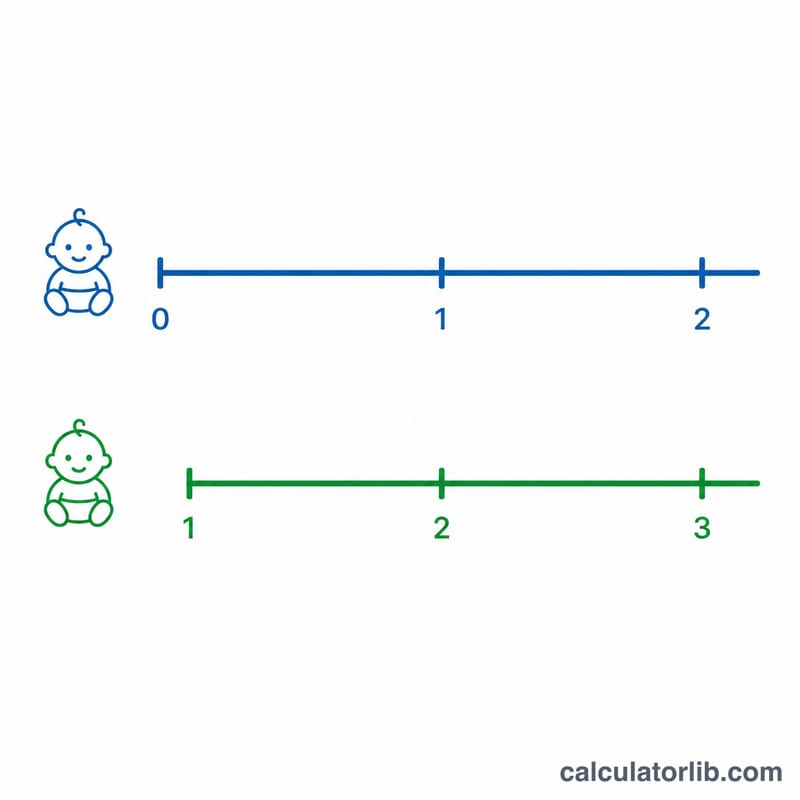
Lunar age — also called East Asian age reckoning or "nominal age" — is a traditional way of counting a person's age used in China, Korea, Vietnam and historically in Japan. Unlike the Western system, a baby is considered 1 year old at birth, and everyone gains a year together at the lunar new year rather than on their individual birthday. This means a person's lunar age is usually one or two years higher than their international age.
How to Use the Calculator
Enter your birth year and the current year. The calculator returns your lunar (nominal) age along with an approximate Western age for comparison. Because lunar age is based on the calendar year of birth, you do not need to enter your exact birth date for this nominal calculation.
The Formula Explained
The core formula is simply $$\text{Lunar Age} = \text{Current Year} - \text{Birth Year} + 1$$ The "+1" reflects the convention that life is counted from conception/birth as year one. For example, someone born in any month of 2000, evaluated in 2024, is \(2024 - 2000 + 1 = 25\) in lunar age, while their Western age is 23 or 24 depending on whether their birthday has passed.

Worked Example
Birth year 1990, current year 2024: Lunar age = $$2024 - 1990 + 1 = \mathbf{35}$$ Approximate Western age = \(2024 - 1990 = 34\).
Lunar Age vs Western Age Across Birth Years
Lunar age (East Asian nominal age) counts the calendar year you are living in, not the number of birthdays you have had. The rule this calculator uses is:
$$\text{Lunar Age} = \text{Current Year} - \text{Birth Year} + 1$$
Because the count changes at the turn of the year rather than on your birthday, your nominal age is always 1 year above your Western age once your birthday has passed, and 2 years above it before your birthday falls in the current year. The table below fixes the current year at 2026 and shows both cases.
| Birth Year | Current Year | Lunar / Nominal Age (Year − Birth + 1) | Western Age — birthday already passed | Western Age — birthday not yet passed | Gap |
|---|---|---|---|---|---|
| 1960 | 2026 | 67 | 66 | 65 | 1 or 2 |
| 1975 | 2026 | 52 | 51 | 50 | 1 or 2 |
| 1990 | 2026 | 37 | 36 | 35 | 1 or 2 |
| 2000 | 2026 | 27 | 26 | 25 | 1 or 2 |
| 2010 | 2026 | 17 | 16 | 15 | 1 or 2 |
| 2024 | 2026 | 3 | 2 | 1 | 1 or 2 |
| 2026 (born this year) | 2026 | 1 | 0 | 0 | 1 |
Worked example for the 1990 row: \(2026 - 1990 + 1 = 37\). Someone born in 1990 is nominally 37 throughout all of 2026. In international age they turn 36 on their birthday in 2026, so they are 35 in January and 36 in December — the same person, two valid answers, depending on which system is being used.
The last row is the clearest illustration of the difference: a baby born in 2026 is counted as 1 sui from the day of birth under nominal reckoning, but is 0 years old internationally until their first birthday. Under the strictest traditional practice, a baby born shortly before Lunar New Year becomes "2" within days of being born, because the year boundary — not the birthday — advances the count.
Age Reckoning Systems by Country
Three systems are in active use across East and Southeast Asia. They are not dialects of one another — they answer different questions, and the same person can legitimately hold three different ages on the same day. The status column below describes law and administrative practice in each named country; none of it applies outside those jurisdictions.
| System | Starting age at birth | When it increments | Where it is used | Current official status |
|---|---|---|---|---|
| International / Western age (만 나이 man-nai, 周岁 zhōusuì, tuổi tây) | 0 | On each birthday | Worldwide; the legal standard in China, Vietnam, Japan and (since 2023) South Korea | The default for all legal, medical and administrative purposes in these countries. |
| East Asian nominal age (虚岁 xūsuì / 세는나이 se-neun-nai / tuổi mụ, tuổi ta) | 1 | At the New Year — traditionally Lunar New Year in China and Vietnam; in modern Korean everyday use, at Gregorian 1 January | China, Vietnam, Korea, and historically Japan (数え年 kazoedoshi); common in conversation, fortune-telling, zodiac readings, funerals and traditional customs | Not a legal age anywhere today; entirely customary. Still widely spoken, especially among older generations and in rural areas. |
| Korean "year age" (연 나이 yeon-nai) — current year − birth year | 0 | At Gregorian 1 January | South Korea only | Retained in specific statutes: school entry, military conscription, and youth-protection rules on alcohol and tobacco sales. |
South Korea's 2023 change. South Korea passed an age-counting unification act in December 2022 that took effect on 28 June 2023. It makes international age (만 나이) the default interpretation of "age" in judicial and administrative documents unless a law explicitly says otherwise. This did not abolish nominal age — people still use 세는나이 in conversation — and it deliberately left year age in place where a whole cohort must be treated identically, such as a school class or a conscription year group.
Japan moved earlier: full-year reckoning (満年齢 man-nenrei) was fixed in law in 1902 and a 1950 law actively promoted its use over kazoedoshi, which is now rare outside a few ritual contexts. In China and Vietnam, official age has long been the international count, with 虚岁 and tuổi mụ surviving as cultural rather than legal figures.
Note the easily-missed distinction between the two calendar-year systems: nominal age and Korean year age both change on the same date, but nominal age is always exactly one greater than year age, because it starts the count at 1 instead of 0.
Key Terms and Definitions
- Lunar age / nominal age — The age produced by \(\text{Current Year} - \text{Birth Year} + 1\). "Lunar" is a loose popular label; the count does not depend on the lunar phase of your birth date, only on the calendar year you were born in and the year you are asking about. "Nominal age" or "East Asian age" is the more accurate term.
- East Asian age reckoning — The traditional system in which a newborn is counted as 1 and everyone advances together at the New Year, rather than each person advancing on their own birthday. It treats age as "which calendar year of life you are in", not "how much time has elapsed since birth".
- Sui (歲 / 岁) — The Chinese counter for years of age. 虚岁 (xūsuì, "empty age") is the nominal count starting at 1; 周岁 (zhōusuì, "full age") is the international count starting at 0. Saying someone is "30 sui" is ambiguous until you know which of the two is meant.
- 세는나이 (se-neun-nai) — Korean "counting age": the nominal system, starting at 1 and incrementing on 1 January in modern usage. It is the age most often meant in casual Korean conversation about seniority and school year.
- 연 나이 (yeon-nai) — Korean "year age": simply current year minus birth year, starting at 0. Used by specific South Korean statutes — school admission, conscription, and youth alcohol and tobacco rules — so that everyone born in the same year is treated as the same age.
- 만 나이 (man-nai) — Korean for international/full age, the legal default in South Korea since 28 June 2023.
- Tuổi mụ / tuổi ta — Vietnamese for nominal age (tuổi mụ literally refers to the midwife-goddess; tuổi ta means "our age"), contrasted with tuổi tây, "Western age", the international count. Tuổi ta is used for zodiac signs, ancestral rites and traditional fortune-telling.
- Lunar New Year (Seollal 설날 / Chunjie 春节 / Tết) — The first day of the lunisolar calendar year, and the traditional moment when nominal age advances in China and Vietnam. Because the lunisolar year is tied to the moon, this date moves against the Gregorian calendar, falling somewhere between roughly 21 January and 20 February. Anyone born in that January–February window can therefore have a nominal age that depends on whether the traditional or the 1-January convention is applied.
- International / Western age — Completed years since birth: 0 at birth, +1 on each birthday. The standard used in medicine, law, insurance and official documents in essentially every country, including the East Asian countries discussed here.
- Calendar-year-based vs birthday-based counting — The core distinction. Calendar-year counting (nominal age, Korean year age) changes for everyone on the same date and needs only your birth year; birthday-based counting (international age) changes on a different date for each person and needs your full birth date. This is why a nominal age can be computed from a year alone, and why it runs 1 or 2 years ahead of international age.
- Zodiac year — The 12-animal cycle assigned by lunisolar year. It aligns with nominal-age reckoning, which is one reason nominal age persists in cultural contexts even where it has no legal force.
This page describes cultural and legal conventions, and the calculator returns a customary count rather than an official age. For anything with legal, immigration, medical or benefits consequences, use the international age recorded on your official documents and check the rules of the specific country involved.
FAQ
Why is my lunar age higher? Because counting starts at 1 at birth and everyone ages at new year, so the gap is typically 1–2 years.
Does Korea still use this? In 2023 South Korea standardized official documents to international age, but lunar/Korean age is still common in daily conversation.
Do I need my exact birthday? No — nominal lunar age depends only on the birth year and current year.