
What is the Area Model of Multiplication?
The area model (also called the box method) is a visual way to multiply numbers by splitting each factor into place-value parts — tens and ones — and arranging the partial products in a rectangle grid. The total area of the rectangle equals the product of the two numbers. It builds a strong conceptual understanding of how multi-digit multiplication actually works and connects directly to the distributive property.
How to Use This Calculator
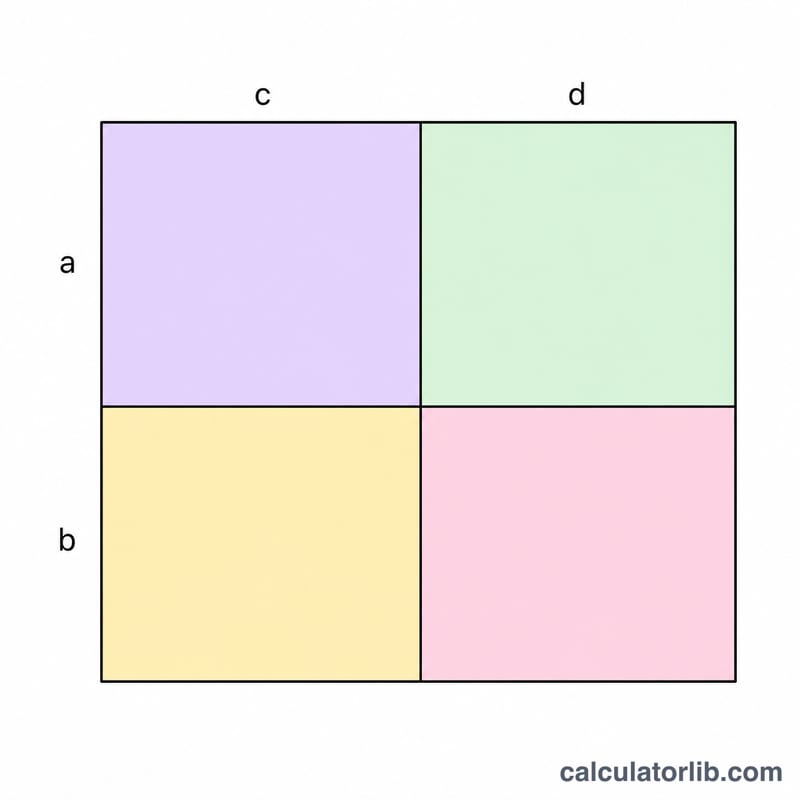
Enter your two numbers and the calculator splits each into a tens part and a ones part. It fills a 2×2 grid: the column headers are the parts of the second number and the row headers are the parts of the first number. Each cell is the product of its row and column header, and adding all four cells gives the final answer.
The Formula Explained
If the first number is a + b (tens + ones) and the second is c + d, then by the distributive property:
$$\text{First} \times \text{Second} = (a+b)(c+d) = ac + ad + bc + bd$$
Here a is the tens portion of the first number and b its ones, while c is the tens of the second and d its ones.
$$\left\{ \begin{aligned} a &= 10\left\lfloor \tfrac{\text{First}}{10} \right\rfloor, \quad b = \text{First} - a \\ c &= 10\left\lfloor \tfrac{\text{Second}}{10} \right\rfloor, \quad d = \text{Second} - c \end{aligned} \right.$$
Worked Example: 12 × 13
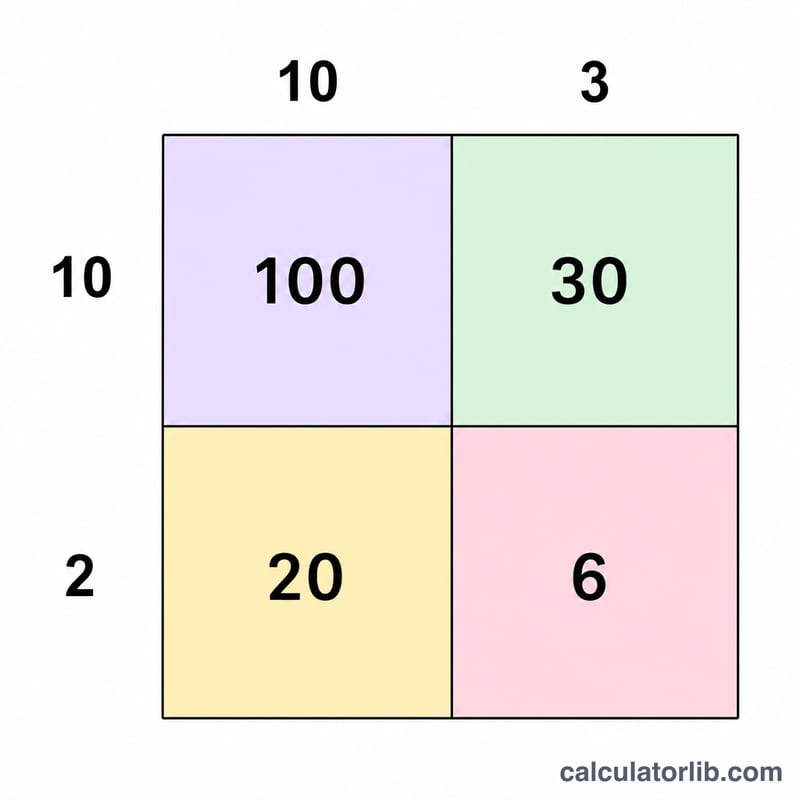
Split 12 into \(a = 10\), \(b = 2\), and 13 into \(c = 10\), \(d = 3\). The four boxes are: \(ac = 10 \times 10 = 100\), \(ad = 10 \times 3 = 30\), \(bc = 2 \times 10 = 20\), \(bd = 2 \times 3 = 6\). Sum: $$100 + 30 + 20 + 6 = 156.$$ So \(12 \times 13 = 156\).
More Worked Examples
Each example splits both factors into tens and ones (\(a,b\) for the first number and \(c,d\) for the second), fills a \(2\times2\) grid with the four partial products \(ac, ad, bc, bd\), then adds them for the final answer.
Example 1 — 7 × 8 (single digits)
With single-digit numbers there are no tens, so \(a=0,\ b=7\) and \(c=0,\ d=8\). The grid collapses to a single non-zero cell:
| × | c = 0 | d = 8 |
|---|---|---|
| a = 0 | 0×0 = 0 | 0×8 = 0 |
| b = 7 | 7×0 = 0 | 7×8 = 56 |
Sum of partial products: \(0+0+0+56 = \) 56. So \(7\times8 = 56\).
Example 2 — 23 × 45
Split the factors: \(a=20,\ b=3\) and \(c=40,\ d=5\).
| × | c = 40 | d = 5 |
|---|---|---|
| a = 20 | 20×40 = 800 | 20×5 = 100 |
| b = 3 | 3×40 = 120 | 3×5 = 15 |
Add the four partial products:
$$800 + 100 + 120 + 15 = 1035$$So \(23\times45 = \) 1035.
Example 3 — 9 × 26
Here \(a=0,\ b=9\) (a single-digit first factor) and \(c=20,\ d=6\).
| × | c = 20 | d = 6 |
|---|---|---|
| a = 0 | 0×20 = 0 | 0×6 = 0 |
| b = 9 | 9×20 = 180 | 9×6 = 54 |
Add the partial products:
$$0 + 0 + 180 + 54 = 234$$So \(9\times26 = \) 234. The same expansion can be checked with the distributive property: \(9(20+6)=9\cdot20+9\cdot6\), giving 234.
How to Do the Area Model by Hand
- Split the first factor into tens and ones. Write it as \(a+b\), where \(a\) is the tens part (e.g. for 23, \(a=20\)) and \(b\) is the ones part (\(b=3\)).
- Split the second factor the same way. Write it as \(c+d\), where \(c\) is the tens part and \(d\) is the ones part (e.g. for 45, \(c=40,\ d=5\)).
- Draw a 2×2 grid. Make a box with two rows and two columns — four cells in total.
- Label the rows and columns. Put \(a\) and \(b\) on the left to label the two rows; put \(c\) and \(d\) across the top to label the two columns.
- Multiply each cell. Fill in the four partial products: top-left \(=ac\), top-right \(=ad\), bottom-left \(=bc\), bottom-right \(=bd\). Each cell is the row label times the column label.
- Add the four partial products. Compute \(ac+ad+bc+bd\). Their sum is the final product of the two original numbers.
- Check your work. The grid area equals \((a+b)(c+d)\), the product you started with, so the sum of the parts must match the whole.
For larger numbers (hundreds or more) you can use the same idea with a bigger grid — split each factor into hundreds, tens and ones and use a 3×3 grid, multiplying every row part by every column part.
Key Terms
- Area model (box method)
- A visual multiplication strategy that represents a product as the area of a rectangle. Each factor is broken into place-value parts, forming a grid whose cell areas (partial products) add up to the total.
- Partial product
- The result of multiplying one place-value part of the first factor by one place-value part of the second — one cell of the grid (\(ac\), \(ad\), \(bc\), or \(bd\)). Summing all partial products gives the final answer.
- Distributive property
- The rule that \((a+b)(c+d)=ac+ad+bc+bd\). The area model is a picture of this property: distributing each part of one factor over each part of the other.
- Place value
- The value a digit holds based on its position — ones, tens, hundreds, and so on. Splitting a number by place value (e.g. \(23=20+3\)) is what creates the grid's row and column labels.
- Factor
- A number being multiplied. In \(23\times45\), both 23 and 45 are factors; their product is 1035.
- \(a\) and \(b\)
- The tens part and ones part of the first factor, so that first factor \(=a+b\). For 23: \(a=20,\ b=3\).
- \(c\) and \(d\)
- The tens part and ones part of the second factor, so that second factor \(=c+d\). For 45: \(c=40,\ d=5\).
FAQ
Does this work for any two whole numbers? It splits each number into a tens part and a ones part, so it works cleanly for one- and two-digit numbers; larger numbers still produce a correct total but only a 2×2 grid.
What does each box mean? Each box is one partial product — the area of a smaller rectangle. Adding the four areas gives the whole rectangle's area, which is the product.
Why teach the box method? It makes place value explicit and links multiplication to the distributive law, helping students before they learn the standard column algorithm.