
What This Calculator Does
This tool converts between a foreign currency (such as USD) and the Vietnamese Dong (VND) using an exchange rate you supply — for example a rate published by ACB (Asia Commercial Bank, Vietnam). It works in both directions: turn a foreign amount into VND, or work backwards to find how much foreign currency a VND amount is worth. The rate is always expressed as VND per 1 foreign unit, which is how Vietnamese banks quote their buy/sell boards.
How to Use It
Pick the conversion direction. For Foreign → VND, enter the foreign amount (e.g. 100 USD) and the rate (e.g. 25,400). For VND → Foreign, enter the VND amount and the same rate to get the foreign equivalent. Use the bank's buy rate when you are selling foreign cash to the bank and the sell rate when you are buying foreign currency.
The Formula Explained
The math is direct multiplication or division:
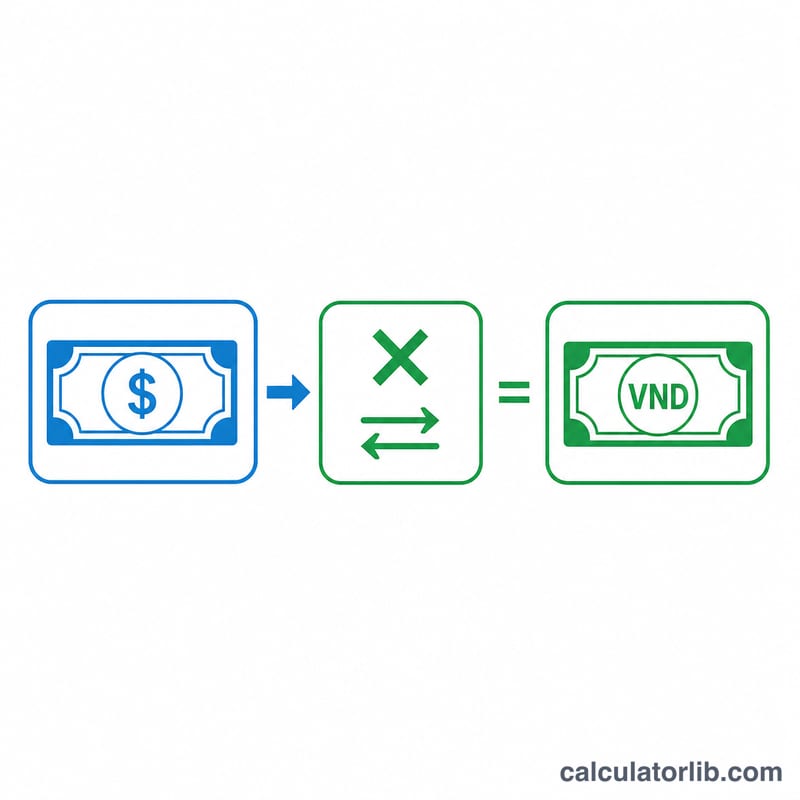
$$\text{VND} = \text{Amount} \times \text{Rate}$$ when converting to Dong, and $$\text{Amount} = \frac{\text{VND}}{\text{Rate}}$$ when converting from Dong. Because the rate represents how many Dong one foreign unit is worth, multiplying scales a small foreign number up to a large VND number, and dividing reverses it.
Worked Example
Suppose you have 100 USD and the ACB sell rate is 25,400 VND/USD. Then $$\text{VND} = 100 \times 25{,}400 = 2{,}540{,}000 \text{ VND}.$$ Going the other way, if you hold 2,540,000 VND at the same rate, you have $$2{,}540{,}000 \div 25{,}400 = 100 \text{ USD}.$$
Definitions & Glossary
When you read an ACB (Asia Commercial Bank) exchange rate board or use a USD/VND converter, the figures rely on a small set of standard foreign-exchange terms. The definitions below explain exactly what each value means and how it enters the conversion formula \(\text{VND} = \text{Amount} \times \text{Rate}\).
- Exchange rate (VND per foreign unit): The number of Vietnamese Dong you receive for one unit of foreign currency. For example, a rate of 25,400 means 1 USD is worth 25,400 VND. In USD/VND quotes the rate is always expressed as VND per 1 USD.
- Base currency: The first currency in a pair, whose value is fixed at 1 unit. In USD/VND, the base currency is USD — the rate tells you how much of the quote currency one unit of the base is worth.
- Quote (counter) currency: The second currency in the pair, in which the price is expressed. In USD/VND, VND is the quote currency, so the rate is stated in Dong.
- Buy rate: The rate at which the bank buys foreign currency from you (you are selling USD, receiving VND). This is the lower VND figure on the board, because the bank pays you slightly less than the market value.
- Sell rate: The rate at which the bank sells foreign currency to you (you are buying USD, paying VND). This is the higher VND figure, since the bank charges slightly more than the market value.
- Mid-rate (mid-market rate): The midpoint between the buy and sell rates, \(\text{Mid} = \tfrac{\text{Buy} + \text{Sell}}{2}\). It approximates the “true” market rate before the bank’s margin is applied and is useful for measuring how far an offered rate sits from fair value.
- Spread: The difference between the sell rate and the buy rate, \(\text{Spread} = \text{Sell} - \text{Buy}\). It represents the bank’s margin on the transaction; a wider spread means a more expensive exchange for the customer.
For ACB cash transactions, note that banknotes (cash) and telegraphic-transfer rates can differ slightly, and the buy/sell columns on the board correspond directly to the buy and sell definitions above.
Scenario Comparison
The table below converts several USD amounts to VND at three illustrative ACB-style rates using \(\text{VND} = \text{Amount} \times \text{Rate}\). These rates are examples for comparison only — always use the live ACB board figure for an actual transaction.
| USD Amount | Rate 25,200 | Rate 25,400 | Rate 25,600 |
|---|---|---|---|
| 50 | 1,260,000 | 1,270,000 | 1,280,000 |
| 100 | 2,520,000 | 2,540,000 | 2,560,000 |
| 500 | 12,600,000 | 12,700,000 | 12,800,000 |
| 1,000 | 25,200,000 | 25,400,000 | 25,600,000 |
Buy vs. sell rate on the same amount
Banks quote a lower buy rate and a higher sell rate. Suppose ACB lists a buy rate of 25,200 and a sell rate of 25,600 for USD/VND. Converting 1,000 USD:
- You sell 1,000 USD (bank’s buy rate 25,200): you receive \(1{,}000 \times 25{,}200 = 25{,}200{,}000\) VND.
- You buy 1,000 USD (bank’s sell rate 25,600): you pay \(1{,}000 \times 25{,}600 = 25{,}600{,}000\) VND.
The spread of \(25{,}600 - 25{,}200 = 400\) VND per dollar means that, on 1,000 USD, the round-trip difference is 400,000 VND — the cost of buying and immediately selling back. This gap is how the bank earns its margin on each exchange.
FAQ
Why use VND per foreign unit? Vietnamese bank boards quote rates this way, so entering them directly avoids mistakes.
Does it include fees or spread? No — it converts at the exact rate you enter. Banks use different buy and sell rates, so plug in the relevant one.
Can I use it for EUR, JPY or other currencies? Yes. Any currency works as long as the rate is the VND value of one unit of that currency.