What Is Negative Marking?
Negative marking is a scoring scheme used in many competitive and standardized exams where wrong answers reduce your total score. Instead of simply counting correct answers, the exam deducts a fixed penalty for each incorrect response. This discourages random guessing and rewards genuine knowledge. This calculator turns your raw answer counts into a final scaled score so you can see exactly how guessing affects your result.
How to Use This Calculator
Enter the number of questions you answered correctly and incorrectly, then set the marks awarded per correct answer and the penalty deducted per wrong answer. Questions you leave unattempted are ignored, since most negative-marking schemes only penalize wrong answers, not blanks. Click calculate to see your final marks, the gross marks from correct answers, the total penalty, and your accuracy.
The Formula Explained
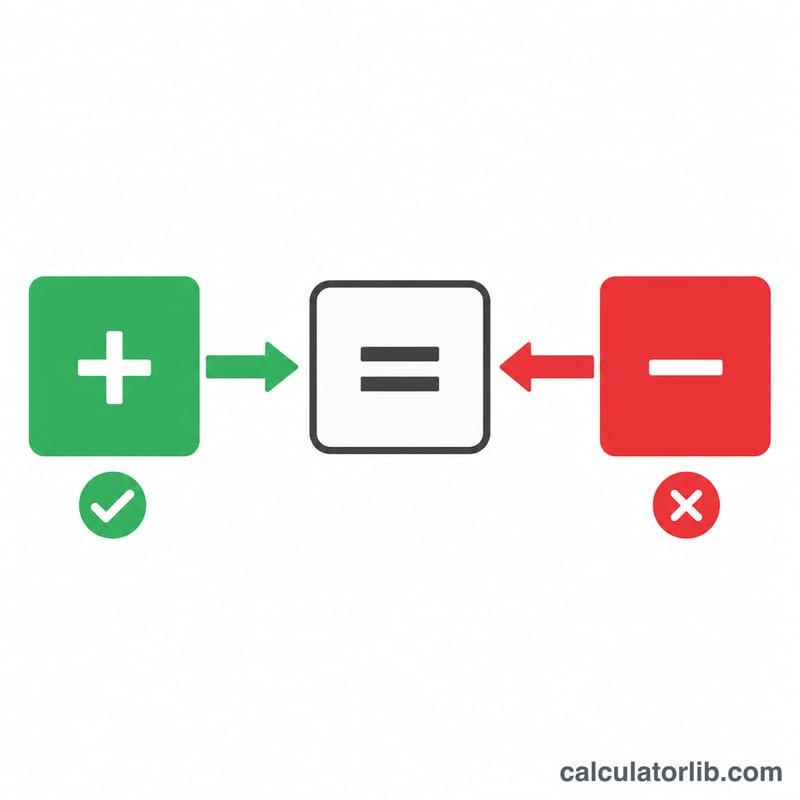
The score is computed as $$\text{Marks} = (\text{Correct} \times \text{PosMark}) - (\text{Wrong} \times \text{NegMark})$$ The first term is the reward for correct answers, and the second term is the penalty subtracted for mistakes. A common pattern is \(+1\) per correct and \(-0.25\) per wrong, meaning four wrong answers cancel out one correct answer.
Worked Example
Suppose you answered 40 questions correctly and 12 incorrectly, with \(+1\) mark per correct and \(-0.25\) per wrong. Gross marks $$= 40 \times 1 = 40$$ Penalty $$= 12 \times 0.25 = 3$$ Final score $$= 40 - 3 = 37 \text{ marks}$$ Your accuracy over attempted questions is \(40 \div 52 \approx 76.9\%\).
Common Negative Marking Schemes and Break-Even Guess Rates
Negative marking subtracts a penalty for each wrong answer. A question is worth attempting on expected value only if your chance of being right is above the break-even accuracy, which is the penalty divided by the sum of the reward and the penalty:
$$p_{\text{break-even}} = \frac{ n }{ r + n }$$
Here \(r\) is the marks per correct answer and \(n\) is the penalty per wrong answer. At exactly this accuracy, the expected gain from answering is zero.
| Scheme (correct / wrong) | Typical options | Marks per correct | Penalty per wrong | Penalty-to-reward ratio | Wrong answers that cancel one correct | Break-even accuracy |
|---|---|---|---|---|---|---|
| +1 / −0.25 | 4 | 1 | 0.25 | 0.25 | 4 | 0.25/1.25 = 20% |
| +1 / −1/3 | 4 | 1 | 0.333 | 0.333 | 3 | (1/3)/(4/3) = 25% |
| +1 / −0.5 | 3 | 1 | 0.5 | 0.5 | 2 | 0.5/1.5 = 33.3% |
| +4 / −1 | 5 | 4 | 1 | 0.25 | 4 | 1/5 = 20% |
| +2 / −0.5 | varies | 2 | 0.5 | 0.25 | 4 | 0.5/2.5 = 20% |
| +3 / −1 | varies | 3 | 1 | 0.333 | 3 | 1/4 = 25% |
Only the ratio matters for break-even: schemes with the same penalty-to-reward ratio have the same break-even accuracy. A 4-option question with +1/−1/3 is exactly fair for pure random guessing, because a 25% chance of being right equals the 25% break-even. With +1/−0.25 and 4 options, random guessing has a small positive expected value.
Note: exact rules vary by exam and even by year, section or question type (some questions may carry no penalty). Always check the official exam notice or instructions for the scheme that applies to you.
Score Comparison Across Different Attempt Strategies
The table below uses a 100-question paper with +1 for each correct answer and −0.25 for each wrong answer. The final score is:
$$\text{Score} = \text{Correct} \times 1 - \text{Wrong} \times 0.25$$
| Scenario | Correct | Wrong | Unattempted | Gross marks | Penalty | Final score | Accuracy over attempted |
|---|---|---|---|---|---|---|---|
| A | 60 | 0 | 40 | 60 | 0 | 60 | 100% |
| B | 60 | 20 | 20 | 60 | 5 | 55 | 75% |
| C | 70 | 30 | 0 | 70 | 7.5 | 62.5 | 70% |
| D | 50 | 10 | 40 | 50 | 2.5 | 47.5 | 83.3% |
| E | 40 | 40 | 20 | 40 | 10 | 30 | 50% |
Worked check for scenario C: \(70 \times 1 - 30 \times 0.25 = 70 - 7.5 = 62.5\).
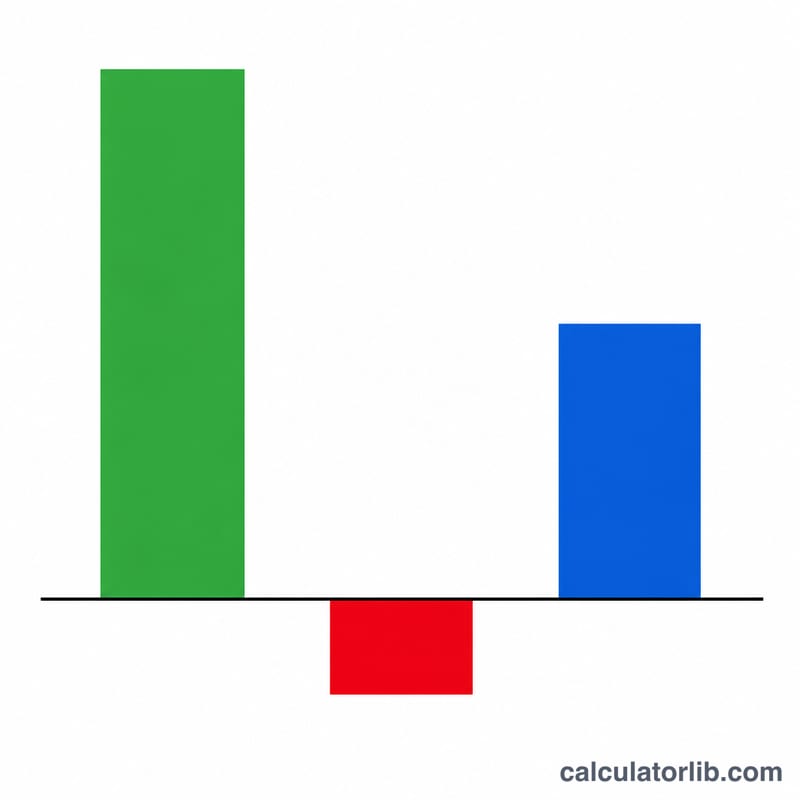
Takeaways: in scenario B, attempting 20 extra questions at 0% accuracy would cost 5 marks, so those wrong answers cancel the benefit of the extra attempts. In scenario C, the candidate attempted every question at 70% accuracy and still scored higher than A, because 70% is well above the 20% break-even. Scenario E shows that accuracy of 50% still yields a modest score when many answers are wrong.
FAQ
Are unattempted questions penalized? Not in this calculator — only wrong answers reduce your score, which matches the most common exam rules.
Can the final score be negative? Yes. If your penalty exceeds your gross marks, the result can be negative, which is possible in heavily guessed sections.
Can I change the penalty ratio? Absolutely. Set any positive value for the negative mark per wrong answer to match your specific exam's rules (e.g. \(1/3 \approx 0.33\) or \(0.5\)).