
What Is the AP® Psychology Score Calculator?
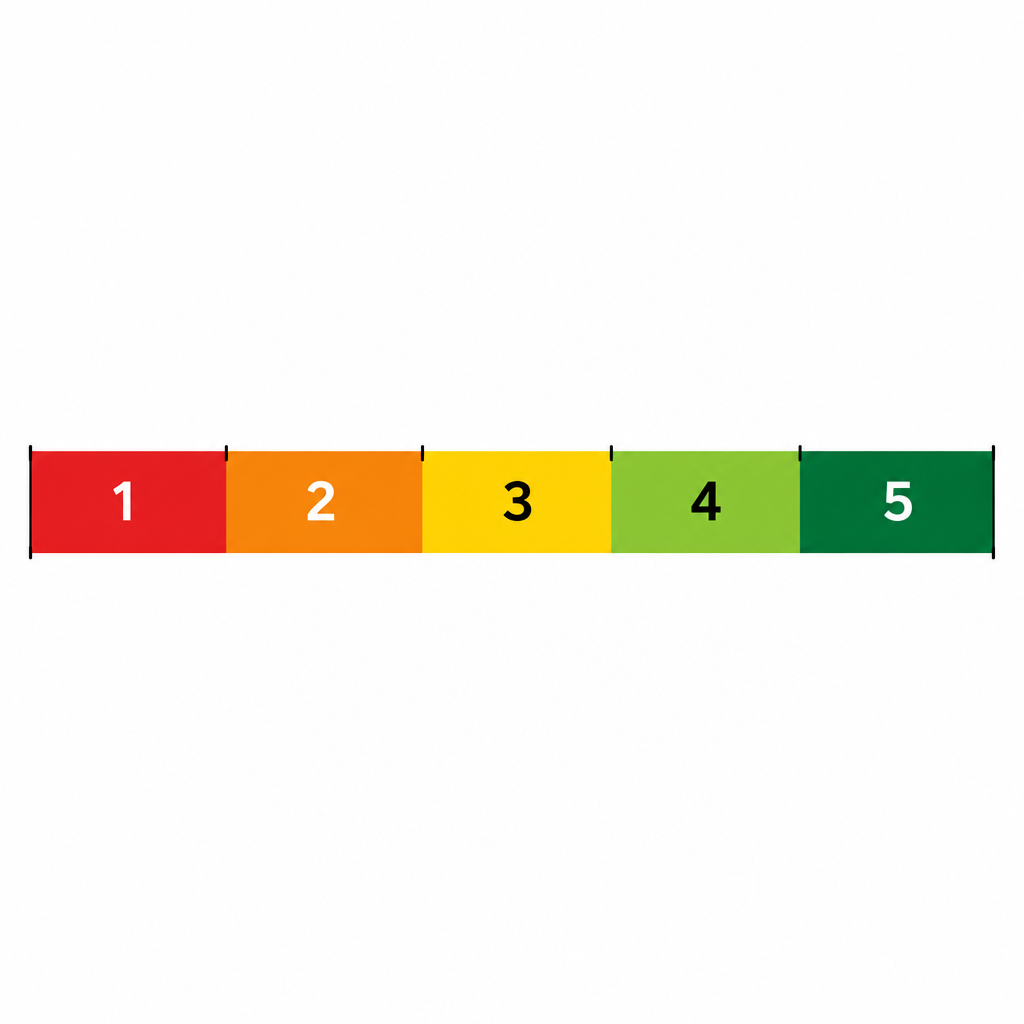
This tool estimates your AP® Psychology exam score on the 1–5 scale used by the US College Board. It combines your multiple-choice (MC) results with your free-response question (FRQ) points to produce a composite score, then maps that composite onto a predicted final grade. The cut scores used here are approximate and based on commonly published score distributions — the College Board does not release exact curves, so treat the result as a study guide, not a guarantee.
How to Use It
Enter how many of the 75 multiple-choice questions you answered correctly, then enter your raw points for each of the two free-response questions (each scored out of 7). Click calculate to see your scaled MC points, FRQ points, total composite, and the predicted 1–5 score.
The Formula Explained
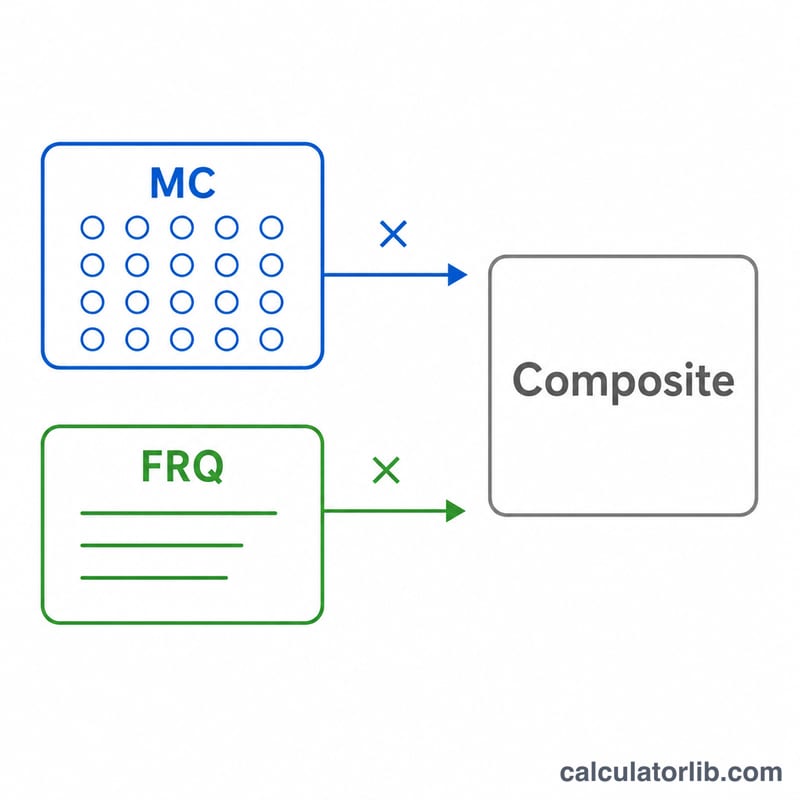
The exam has two sections weighted roughly two-thirds MC and one-third FRQ. We scale the 75 MC questions so each correct answer is worth about 0.8889 composite points (≈100 points total), and each FRQ point is worth about 3.5714 composite points (≈50 points across both questions). The composite (out of ~150) is then matched to cut scores: 113+ = 5, 93+ = 4, 77+ = 3, 65+ = 2, otherwise 1.
$$\text{Composite} = 0.8889 \times \text{MC Correct} + 3.5714 \times \left( \text{FRQ 1} + \text{FRQ 2} \right)$$
$$\text{Score} = \begin{cases} 5 & \text{Composite} \ge 113 \\ 4 & 93 \le \text{Composite} < 113 \\ 3 & 77 \le \text{Composite} < 93 \\ 2 & 65 \le \text{Composite} < 77 \\ 1 & \text{Composite} < 65 \end{cases}$$
Worked Example
Suppose you get 60 MC correct, 6 on FRQ 1, and 5 on FRQ 2. MC points = \(60 \times 0.8889 = 53.33\). FRQ points = \((6 + 5) \times 3.5714 = 39.29\). Composite = \(53.33 + 39.29 = 92.62\), which falls in the 77–92 band, predicting a score of 3 (just shy of a 4).
What Your Predicted Score Means
AP® scores are reported on a 1–5 scale. The College Board describes the levels as follows:
- 5 — Extremely well qualified
- 4 — Well qualified
- 3 — Qualified
- 2 — Possibly qualified
- 1 — No recommendation
A score of 3 is generally considered passing and is often the minimum many colleges look for. Many institutions grant course credit or placement for scores of 3, 4, or 5, while some more selective schools require a 4 or 5. A score of 5 ("extremely well qualified") represents the strongest outcome and is the most widely accepted for credit.
Whether a given score earns you credit, advanced placement, or a waived requirement depends entirely on the policy of the college you attend, your intended major, and the specific course. Always check the official AP credit policy of each institution you are considering.
This tool provides an estimate only. It is not an official College Board score. Actual cut points are set each year after the exam is administered and can shift from one administration to the next, so your real score may differ from the prediction shown here.
FAQ
Are these the official cut scores? No. The College Board keeps exact curves private; these are widely used approximations.
What score do I need to pass? A 3 is generally considered passing, and many colleges grant credit for a 3, 4, or 5.
Does the calculator work for older exam formats? It assumes the current 75-question MC and two 7-point FRQ format. Older exams differ.