What This Calculator Does
The Hiking Water Intake Calculator estimates how much water you should carry for a hike. Dehydration is one of the most common (and avoidable) problems on the trail, while carrying too much water adds unnecessary weight. This tool helps you strike the right balance using your hike duration, a base drinking rate, and the day's conditions.
How to Use It
Enter the expected duration of your hike in hours, a base water rate in liters per hour (a typical resting-to-moderate value is about 0.5 L/hr), and select the weather and terrain conditions. The calculator returns total water needed in liters, milliliters, fluid ounces, and the equivalent number of standard 500 ml bottles so you can plan your pack.
The Formula Explained
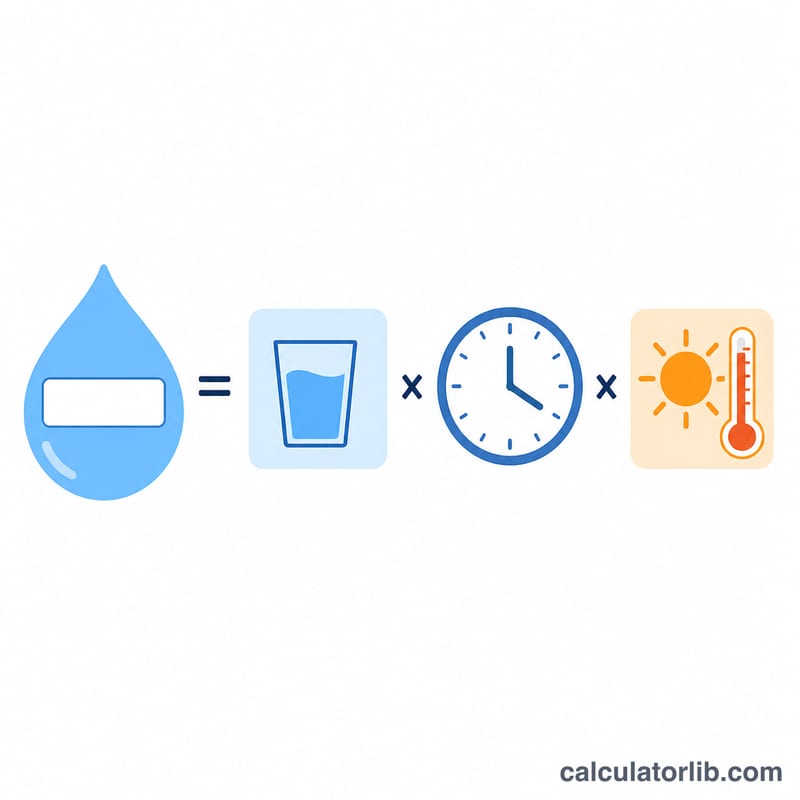
The estimate uses a simple model:
$$\text{Liters} = \text{Base Rate} \times \text{Hours} \times \text{Heat Factor}$$
The base rate captures your typical sweat and breathing losses per hour of activity. The heat factor scales that up or down: cool, easy hiking lowers it (\(\approx 0.9\)), while hot weather or steep climbing pushes it higher (\(\approx 1.2\text{–}1.5\)) because you sweat far more. This is a planning guide, not a medical prescription — drink to thirst and adjust for altitude, illness, and individual needs.
Worked Example
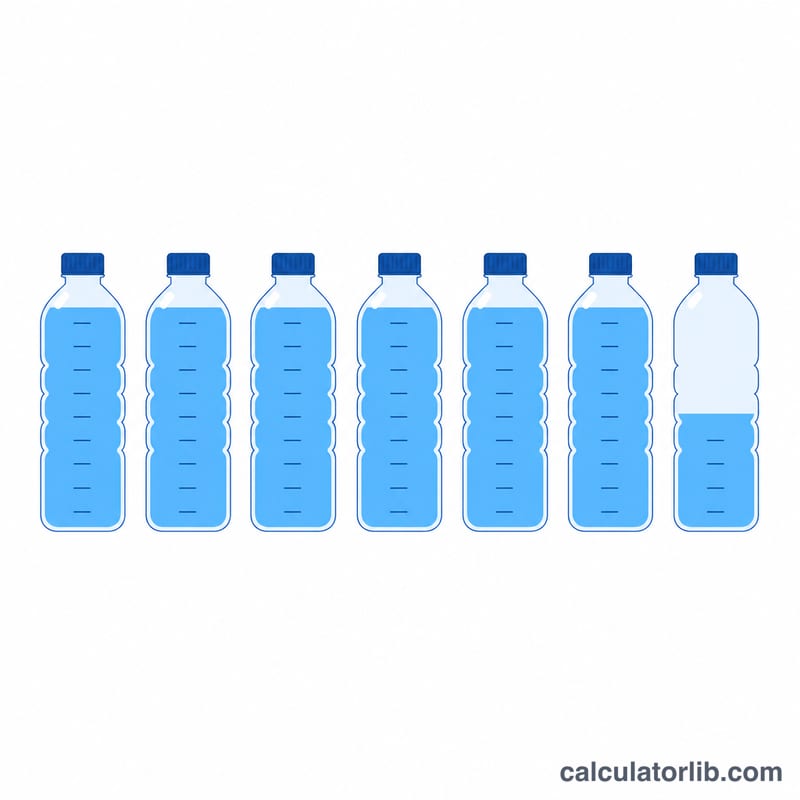
Suppose you hike for 6 hours at a base rate of 0.5 L/hr on a warm, strenuous day (heat factor 1.2). The calculation is $$0.5 \times 6 \times 1.2 = 3.6 \text{ liters},$$ which is 3,600 ml, about 121.7 fluid ounces, or roughly 7.2 standard 500 ml bottles.
Heat and Terrain Factor Lookup Table
The calculator multiplies your base rate (L/hr) by the hours hiked and by a condition factor. Pick the row below that best matches your day. The four values are the ones in the calculator's condition selector.
| Conditions | Typical situation | Condition factor |
|---|---|---|
| Cool / easy | Cool temperatures, flat or gentle trail, low effort | 0.9 |
| Mild / moderate | Comfortable temperatures, rolling terrain, steady pace | 1.0 |
| Warm / strenuous | Warm weather or sustained climbing, noticeable sweating | 1.2 |
| Hot / steep | Hot weather, steep or exposed terrain, heavy sweating | 1.5 |
Note: these factors are rough planning estimates, not measured physiological values. Real fluid loss varies with body size, fitness, acclimatization, pack weight, humidity, altitude and wind. Treat the result as a starting point and carry a margin, especially where refill sources are unreliable.
Water Needs Across Hike Scenarios
All scenarios use a base rate of 0.5 L/hr and the formula Water (L) = base rate × hours × condition factor. Ounces are US fluid ounces (1 L = 33.814 fl oz), and bottles are 500 ml bottles rounded up to a whole bottle.
| Scenario | Hours | Factor | Calculation | Liters | Fluid ounces | 500 ml bottles |
|---|---|---|---|---|---|---|
| Cool, easy | 2 | 0.9 | 0.5 × 2 × 0.9 | 0.9 | 30.4 | 2 |
| Mild, moderate | 4 | 1.0 | 0.5 × 4 × 1.0 | 2.0 | 67.6 | 4 |
| Warm, strenuous | 6 | 1.2 | 0.5 × 6 × 1.2 | 3.6 | 121.7 | 8 (7.2 rounded up) |
| Hot, steep | 8 | 1.5 | 0.5 × 8 × 1.5 | 6.0 | 202.9 | 12 |
The same 0.5 L/hr base rate produces a more than sixfold difference between a short cool outing and a long hot day. At 6 L, the water alone weighs about 6 kg, so on long hot hikes plan refill points instead of carrying everything.
Water Volume Conversion Table
Use this table to convert a result into the units on your bottles or reservoir. Fluid ounces are US fluid ounces (1 L = 33.814 fl oz), rounded to one decimal place.
| Liters | Milliliters | US fluid ounces | 500 ml bottles | Approx. weight of water |
|---|---|---|---|---|
| 0.5 | 500 | 16.9 | 1 | 0.5 kg |
| 1 | 1,000 | 33.8 | 2 | 1 kg |
| 2 | 2,000 | 67.6 | 4 | 2 kg |
| 3 | 3,000 | 101.4 | 6 | 3 kg |
| 4 | 4,000 | 135.3 | 8 | 4 kg |
| 5 | 5,000 | 169.1 | 10 | 5 kg |
Water weighs about 1 kg per liter (roughly 2.2 lb), not counting the container. Hydration reservoirs commonly come in 1.5 L, 2 L and 3 L sizes. Combine a reservoir with a bottle if your total is larger than one container holds.
This is general information, not medical advice. Individual hydration needs vary, so adjust for your own body, the conditions, and the advice of a healthcare professional if you have a medical condition.
FAQ
How much water does the average hiker need? A common rule of thumb is about 0.5 liters per hour of moderate hiking, increasing significantly in heat or on tough terrain.
Should I carry all my water? If reliable, treated water sources exist on your route you may carry less and refill, but always pack a buffer and a filter or purification method.
Does this account for electrolytes? No. On long or hot hikes, replace electrolytes (sodium, potassium) too, as drinking only plain water can dilute them.