What is a layover / connection time calculator?
A layover (or connection time) is the gap between when your first flight lands and when your next flight departs at the same airport. This calculator works out that gap in minutes and hours, then tells you whether it is long enough to clear the airport's minimum connection time (MCT) — the shortest interval an airport considers safe to change planes.
How to use it
Enter your scheduled arrival time and your next departure time using a 24-hour clock (hours 0–23, minutes 0–59). Then enter the minimum connection time you want to compare against. If your departure is on the next calendar day, just enter its clock time — the calculator automatically adds 24 hours when the departure appears earlier than the arrival.
The formula explained
Both times are converted to minutes past midnight: \(\text{arr} = \text{arr\_h} \times 60 + \text{arr\_m}\) and \(\text{dep} = \text{dep\_h} \times 60 + \text{dep\_m}\). The layover is \(\text{dep} - \text{arr}\); if that is negative, 1440 minutes (24 hours) is added. The connection is marked sufficient when \(\text{layover} \ge \text{MCT}\), and the buffer is \(\text{layover} - \text{MCT}\).
$$\text{Layover} = \big(D - A\big) \;(+\,1440 \text{ if } < 0)$$ $$\text{where}\quad \left\{ \begin{aligned} A &= 60\cdot\text{Arr. Hour} + \text{Arr. Min} \\ D &= 60\cdot\text{Dep. Hour} + \text{Dep. Min} \\ \text{Buffer} &= \text{Layover} - \text{Min. Conn. (min)} \end{aligned} \right.$$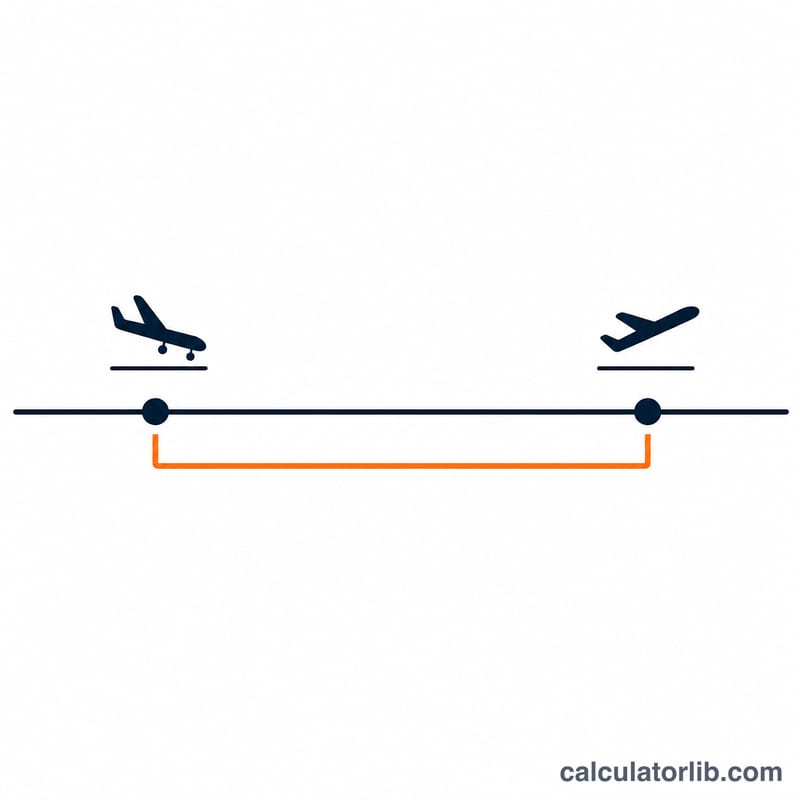
Worked example
Arrival 14:30, next departure 16:15, minimum connection time 60 minutes. Arrival = 870 min, departure = 975 min, so layover = 105 minutes (1h 45m). Since 105 ≥ 60, the connection is sufficient with a 45-minute buffer.
$$A = 14 \times 60 + 30 = 870 \text{ min}$$ $$D = 16 \times 60 + 15 = 975 \text{ min}$$ $$\text{Layover} = 975 - 870 = 105 \text{ min} = 1\text{h } 45\text{m}$$ $$\text{Buffer} = 105 - 60 = 45 \text{ min} \;\;(105 \ge 60)$$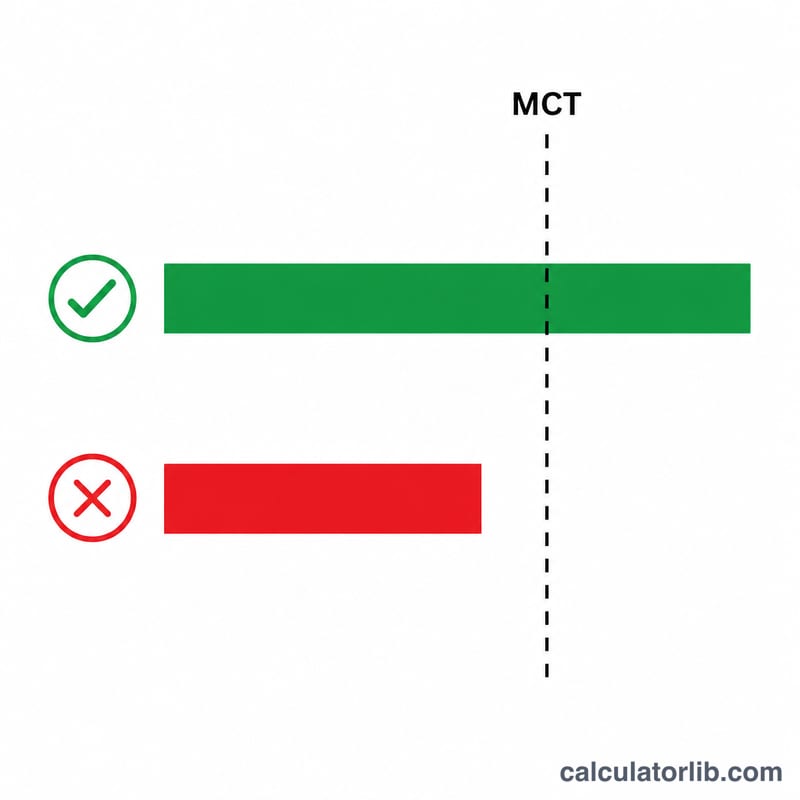
Typical Minimum Connection Times by Connection Type
A minimum connection time (MCT) is the shortest time an airline or airport system allows between an arriving flight and the next departure for the connection to be sold as a single itinerary. The ranges below are rough, indicative figures only. They are not guaranteed and not universal.
| Connection type | Typical MCT range (indicative) | Notes |
|---|---|---|
| Domestic → domestic, same terminal | about 30–60 min | Shortest MCTs, usually at small or compact airports |
| Domestic → international or international → domestic | about 60–120 min | Often includes immigration, customs or security re-screening |
| International → international | about 60–120+ min | Can be longer at large hubs or where passport control or security is required |
| Same-terminal connection | toward the lower end of the range | No transfer between buildings |
| Terminal change (shuttle, train or walking) | toward the higher end, sometimes more | Transfer time and possible re-screening are added |
Exact MCTs are set per airport, per airline pair, and sometimes per terminal or flight type. Always check the airline's or airport's published MCT for your specific itinerary and enter it in the calculator's Min. Conn. field.
Interpreting Your Layover Result
The calculator gives the layover in minutes (arrival to next departure, adding 1440 minutes if the departure clock time is earlier than the arrival clock time). The buffer is the layover minus the minimum connection time.
- Negative buffer: the connection is shorter than the MCT. It is likely to be flagged, or unbookable as a single ticket.
- Zero buffer: the connection exactly meets the MCT. It is technically valid but leaves no margin.
- Small buffer (under about 30 minutes): valid, but any arrival delay, gate change or long walk can cause a missed connection.
- Comfortable buffer (about 30 minutes or more above the MCT): room for modest delays, a terminal transfer, meals or rest rooms. Longer is not always better, since it means more waiting time.
Scheduled times only: the result uses scheduled clock times. It does not account for delays, time-zone differences between airports or date changes. Enter local times consistently, and make sure both times are given in the same time zone (usually the layover airport's local time).
Long layovers: layovers of about 6 hours or more, or overnight, are often a different type of trip. Many airlines and fare rules treat a stopover (commonly a stay of more than 24 hours, though the threshold varies by route and carrier) differently from a connection, and fares, baggage handling and visa or transit rules can differ. Long layovers may also require a hotel and, in some countries, entry formalities.
Single ticket vs. separate tickets: on a single ticket (a protected connection), the airline normally rebooks you if a delay makes you miss the onward flight and usually transfers the bags. On separate tickets, each flight is independent. A missed connection may mean buying a new ticket, and you may have to collect and re-check your bags. Allow a much larger buffer for separate tickets.
Layover Scenarios Compared
Each row applies the formula Layover = (D − A), plus 1440 if the result is negative, where A and D are minutes after midnight. Buffer = Layover − MCT.
| Arrival | Departure | MCT (min) | Layover (min) | Buffer (min) | Verdict |
|---|---|---|---|---|---|
| 10:00 (600) | 10:45 (645) | 60 | 45 | −15 | Insufficient: below the MCT |
| 14:30 (870) | 16:15 (975) | 60 | 105 | +45 | Sufficient, with a comfortable margin |
| 08:00 (480) | 09:00 (540) | 60 | 60 | 0 | Just meets the MCT, with no margin |
| 23:00 (1380) | 06:30 (390) | 90 | 450 | +360 | Sufficient: an overnight layover (390 − 1380 = −990, + 1440 = 450) |
| 18:20 (1100) | 18:05 (1085) | 60 | 1425 | +1365 | Meets the MCT, but it is a next-day departure (1085 − 1100 = −15, + 1440 = 1425, about 23 h 45 min) |
The MCT values here are examples only. Use the published MCT for your airport and airline.
FAQ
What minimum connection time should I use? It varies by airport and whether it's domestic or international (often 30–90+ minutes). Check your airport's published MCT or your airline's guidance.
Does this handle overnight connections? Yes — if the departure time is earlier than the arrival time, 24 hours are added automatically.
Does it account for terminal changes or customs? No. It only computes the scheduled time gap; add extra margin for immigration, baggage re-check, and terminal transfers.