
What Is the Octagon Calculator?
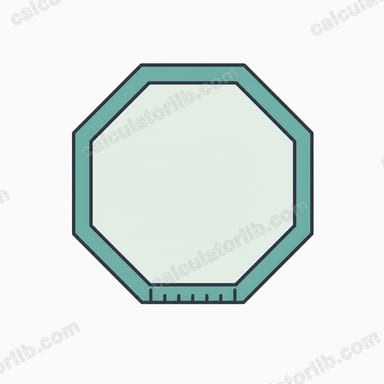
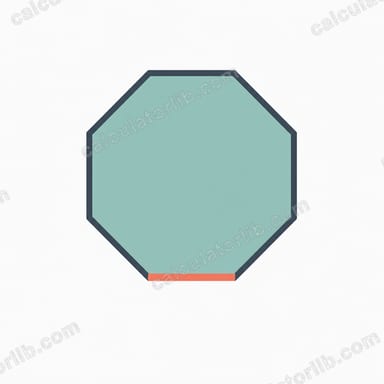
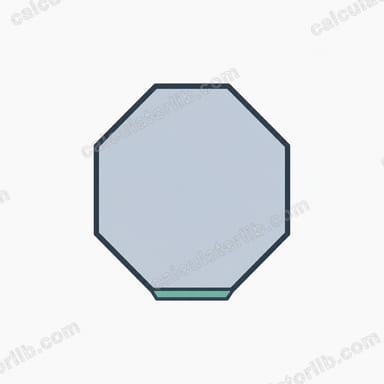
A regular octagon is an eight-sided polygon where every side has the same length and every interior angle equals 135°. This calculator takes a single input — the side length s — and instantly returns the octagon's area, perimeter, apothem (inradius), circumradius, and longest diagonal. It is useful for tessellation design, stop-sign geometry, tiling layouts, gazebo and deck construction, and math homework.
How to Use It
Enter the length of one side in any unit you like (cm, inches, metres). The results are returned in the matching unit: lengths share your unit, and the area is in those units squared. There is no need to specify a unit — the geometry is identical regardless.
The Formulas Explained
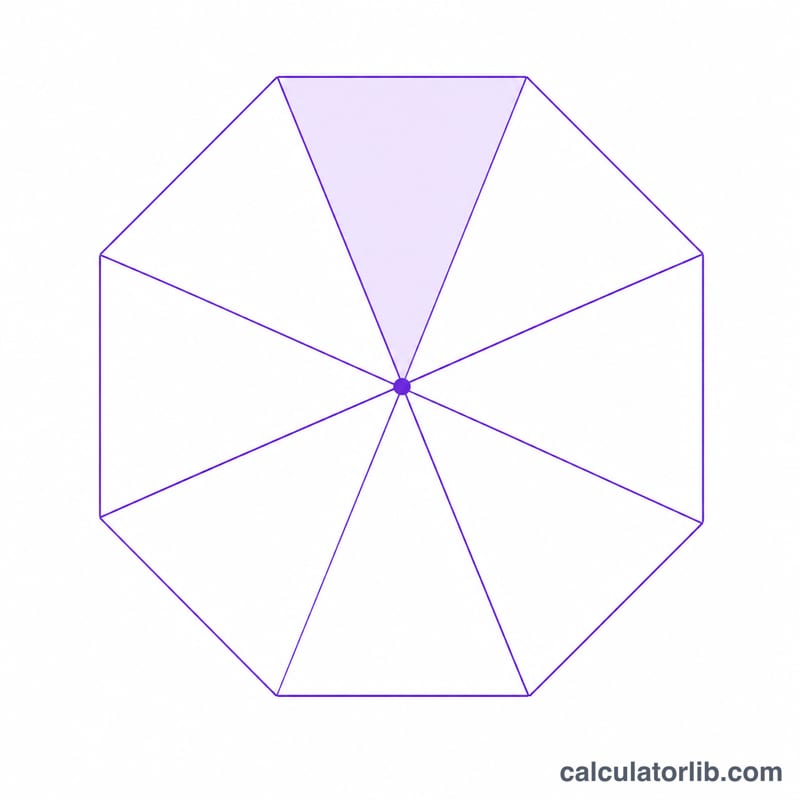
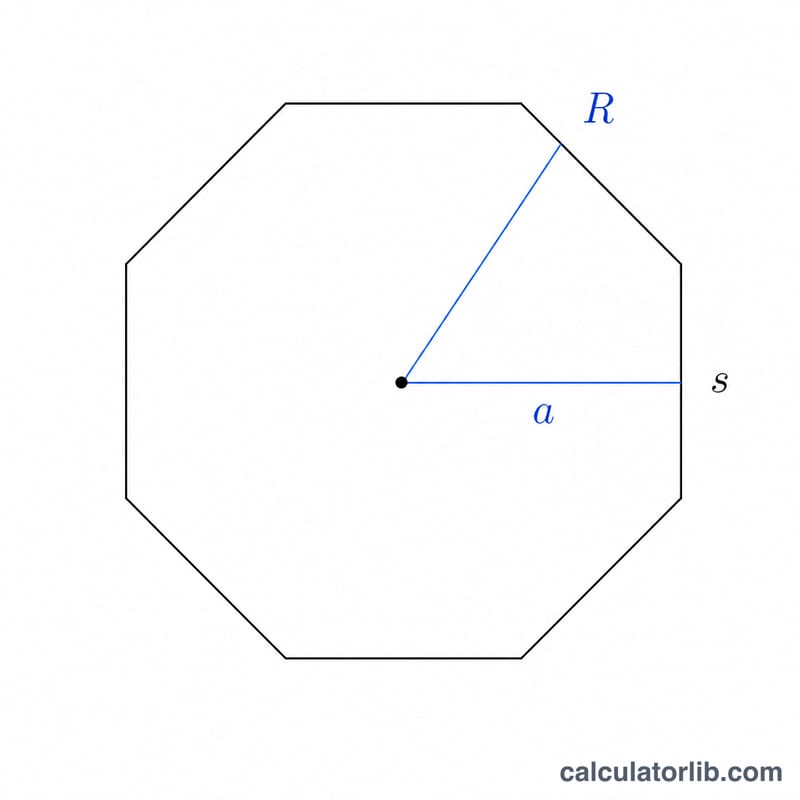
The area of a regular octagon is $$A = 2\left(1+\sqrt{2}\right)\cdot s^{2}$$, which comes from dividing the octagon into a central square plus four rectangles and four corner triangles. The perimeter is simply \(P = 8s\) because all eight sides are equal. The apothem — the perpendicular distance from the centre to the midpoint of a side — is \(a = \frac{s\left(1+\sqrt{2}\right)}{2}\). The circumradius (centre to a vertex) is \(R = \frac{s\sqrt{4+2\sqrt{2}}}{2}\), and the longest diagonal across the octagon is \(d = s\sqrt{4+2\sqrt{2}}\).
Worked Example
For a side length of \(s = 5\): $$\text{Area} = 2(1+1.41421)\cdot 25 = 2 \times 2.41421 \times 25 \approx 120.71$$ square units. $$\text{Perimeter} = 8 \times 5 = 40$$ $$\text{Apothem} = \frac{5 \times 2.41421}{2} \approx 6.0355$$ Circumradius \(\approx 6.5328\) and longest diagonal \(\approx 13.0656\).
FAQ
Does this work for irregular octagons? No — these formulas assume a regular octagon with equal sides and angles. Irregular octagons require coordinate-based methods.
What is the apothem used for? The apothem times half the perimeter gives the area (\(A = \tfrac{1}{2}\cdot P\cdot a\)), and it equals the radius of the inscribed circle.
What are the interior angles? Each interior angle of a regular octagon is 135°, and they sum to 1080°.