
What is cross-sectional area?
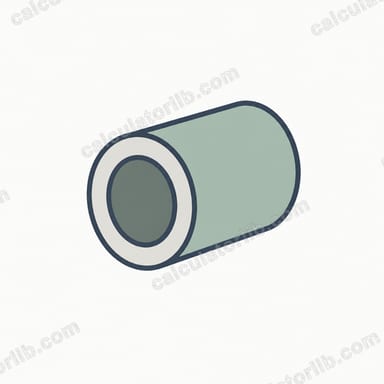
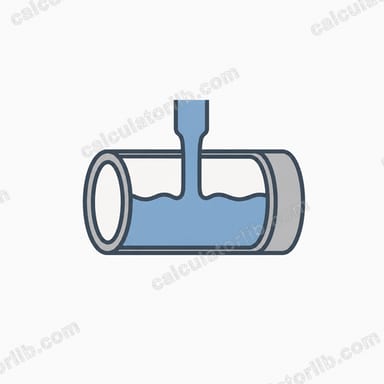
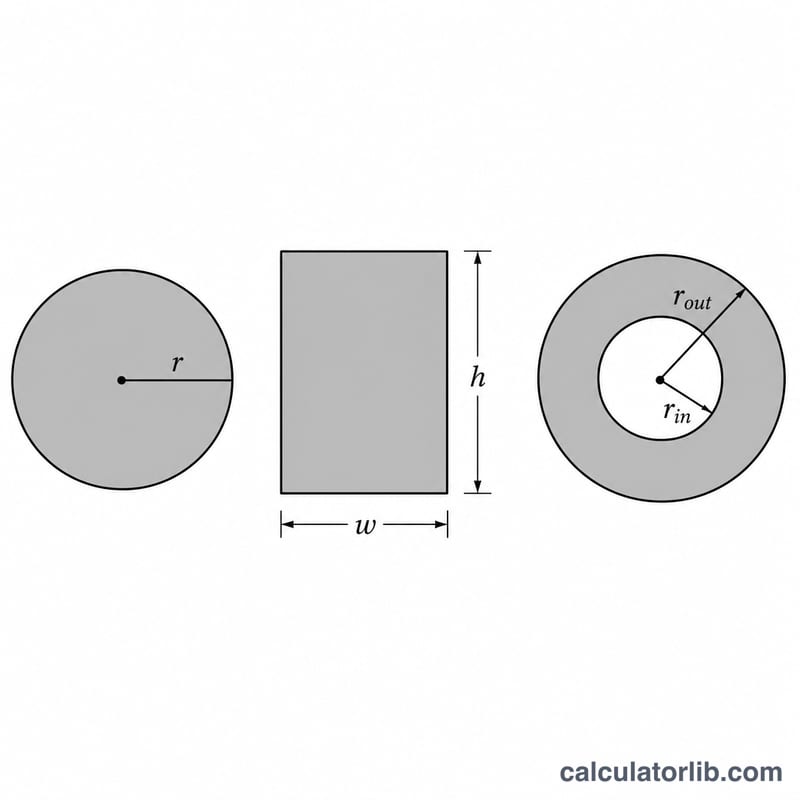
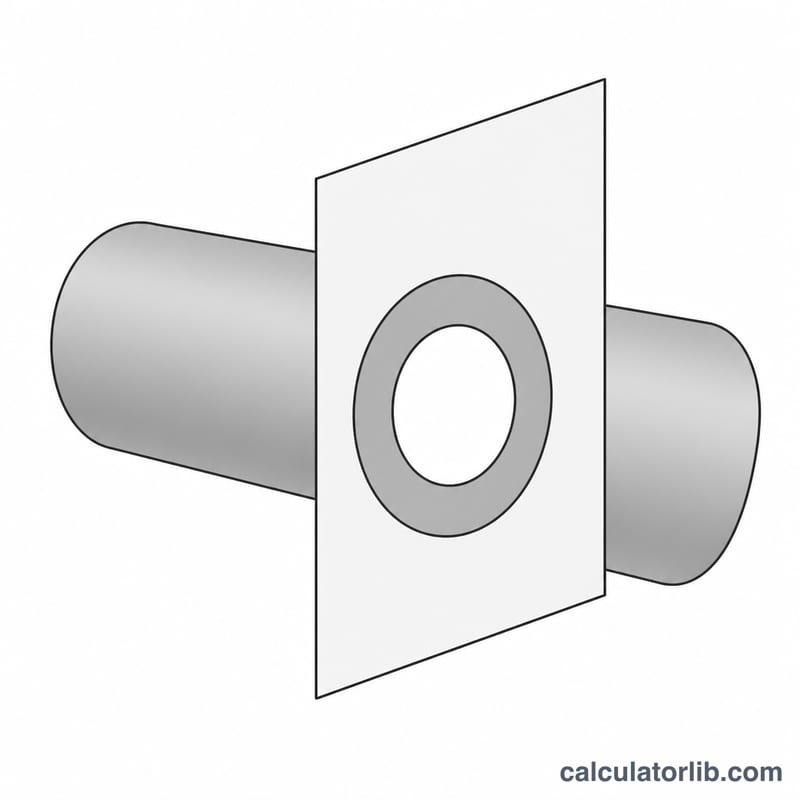
The cross-sectional area is the area of the two-dimensional shape you get when you slice an object perpendicular to its length. It is essential in engineering, fluid flow, structural design, and physics — for example, to compute stress (force ÷ area), flow rate, or the material in a pipe wall. This calculator handles three common cross-sections: a solid circle, a rectangle, and a hollow pipe (annulus).
How to use it
Select a shape, then enter the matching dimensions. For a circle, enter the radius. For a rectangle, enter the width and height. For a pipe, enter the outer and inner radii. The result is given in square units — whatever length unit you input (mm, cm, m, in), the area comes out in that unit squared.
The formulas explained
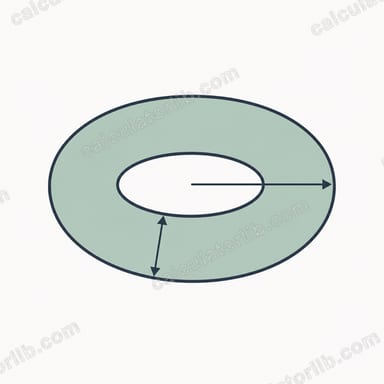
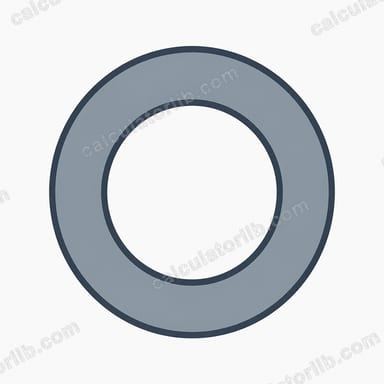
A circle's area is \(A = \pi r^{2}\), where \(r\) is the radius. A rectangle is simply \(A = \text{width} \times \text{height}\). A pipe's cross-section is a ring (annulus): take the full outer disc area and subtract the hollow inner disc, giving \(A = \pi(r_{out}^{2} - r_{in}^{2})\). The inner radius must be smaller than the outer radius for a physically valid pipe.
Worked example
A pipe has an outer radius of 6 and an inner radius of 4. Then $$A = \pi(6^{2} - 4^{2}) = \pi(36 - 16) = \pi \times 20 \approx 62.83 \text{ square units}.$$ That is the area of the metal in the pipe wall — useful for weight and material estimates.
FAQ
What units does it use? Any consistent length unit; the answer is in that unit squared.
Can I find area from a diameter? Divide the diameter by 2 to get the radius first.
Why subtract for a pipe? A pipe is hollow, so its cross-section is only the ring of material, not the empty bore.