
What is volumetric weight?
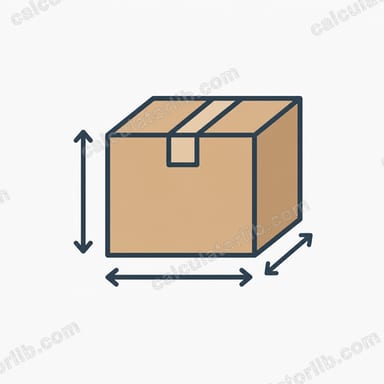
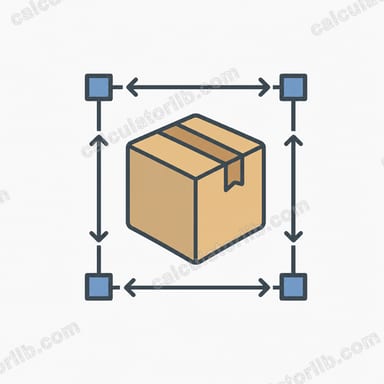
Carriers charge for parcels based on whichever is greater: the actual (scale) weight or the volumetric weight — also called dimensional or "DIM" weight. Light but bulky packages take up space that could carry heavier freight, so the volumetric weight ensures the price reflects the room the box occupies. This calculator works out the volumetric weight and total volume of any shipping box from its three dimensions.
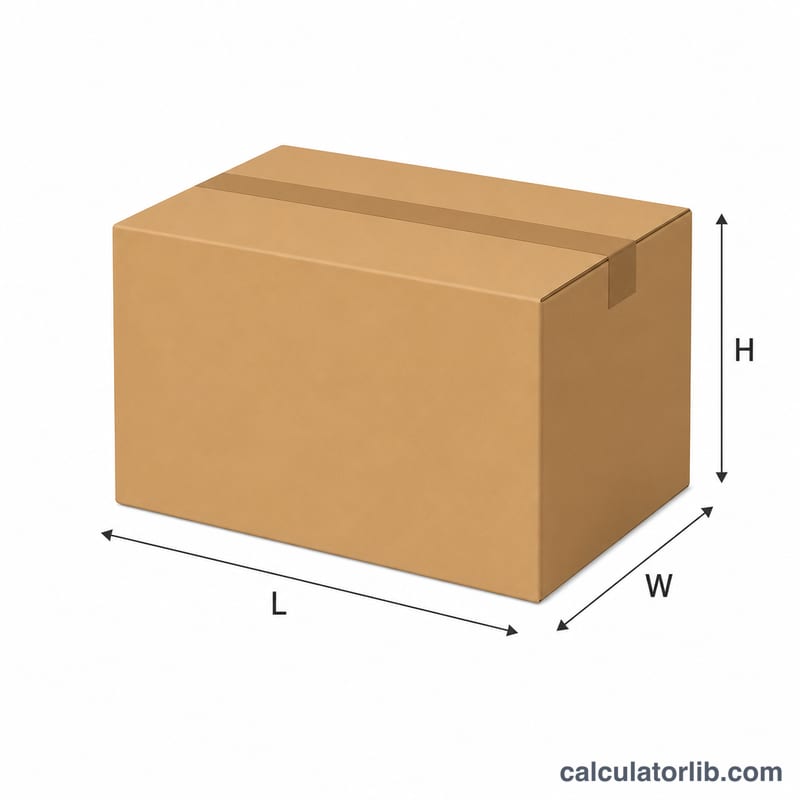
How to use it
Enter the box's length, width and height in centimetres, then choose the dimensional divisor your carrier uses. Common divisors are 5000 for air/express services, 6000 for the IATA standard, and 4000 for some road or courier rates. The calculator instantly returns the volumetric weight in kilograms plus the box volume in cm³ and m³.
The formula explained
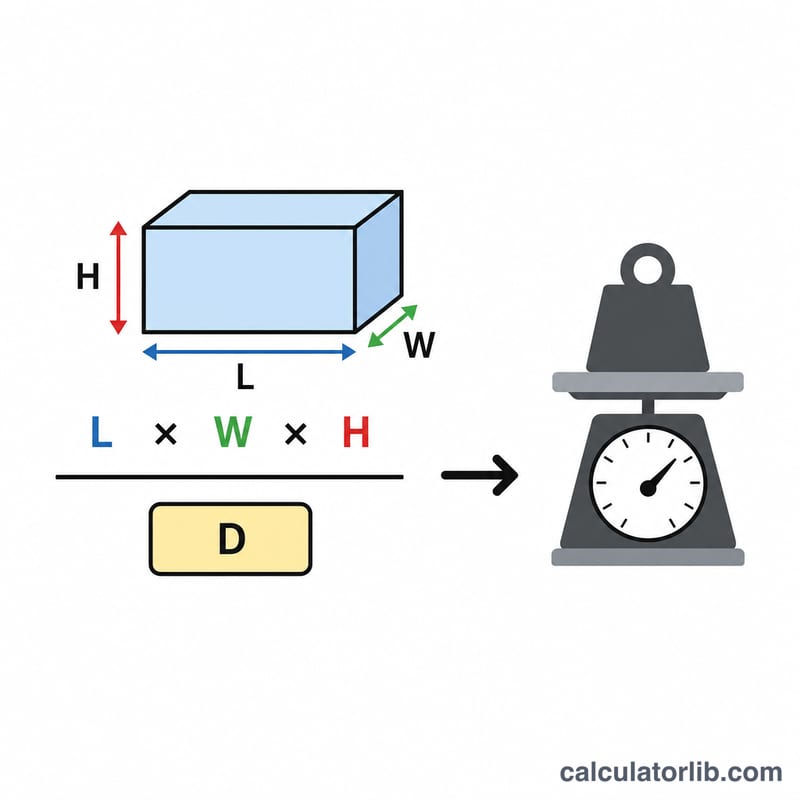
Volume is simply \(L \times W \times H\). To convert that cubic volume into a billable weight, you divide by the carrier's dimensional divisor:
$$\text{Volumetric Weight (kg)} = \frac{\text{Length} \times \text{Width} \times \text{Height}}{\text{Divisor}}$$
A larger divisor produces a lower volumetric weight, which is why the chosen factor matters. Always compare this figure to the parcel's real weight — you are charged on the larger value.
Worked example
A box measuring 40 × 30 × 20 cm shipped with a divisor of 5000: $$\text{volume} = 40 \times 30 \times 20 = 24{,}000 \text{ cm}^3 \ (0.024 \text{ m}^3)$$ $$\text{Volumetric weight} = \frac{24{,}000}{5000} = \mathbf{4.8 \text{ kg}}$$ If the actual weight were only 3 kg, the carrier would still bill 4.8 kg.
FAQ
Which divisor should I use? Check your carrier's rate card — express/air services often use 5000 or the IATA 6000, while domestic road services may use 4000.
Can I use inches? This tool assumes centimetres. For inches and pounds, a different divisor (e.g. 139 or 166) applies, so convert dimensions to cm first.
Will I be charged the volumetric weight? You are charged on the greater of actual weight and volumetric weight, known as the chargeable weight.