
What this calculator does
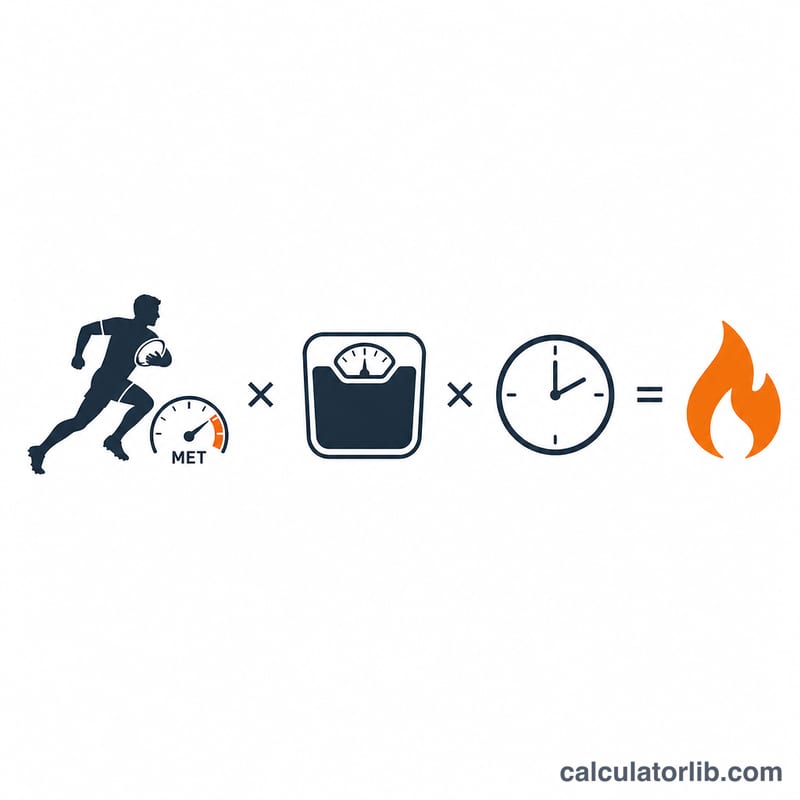
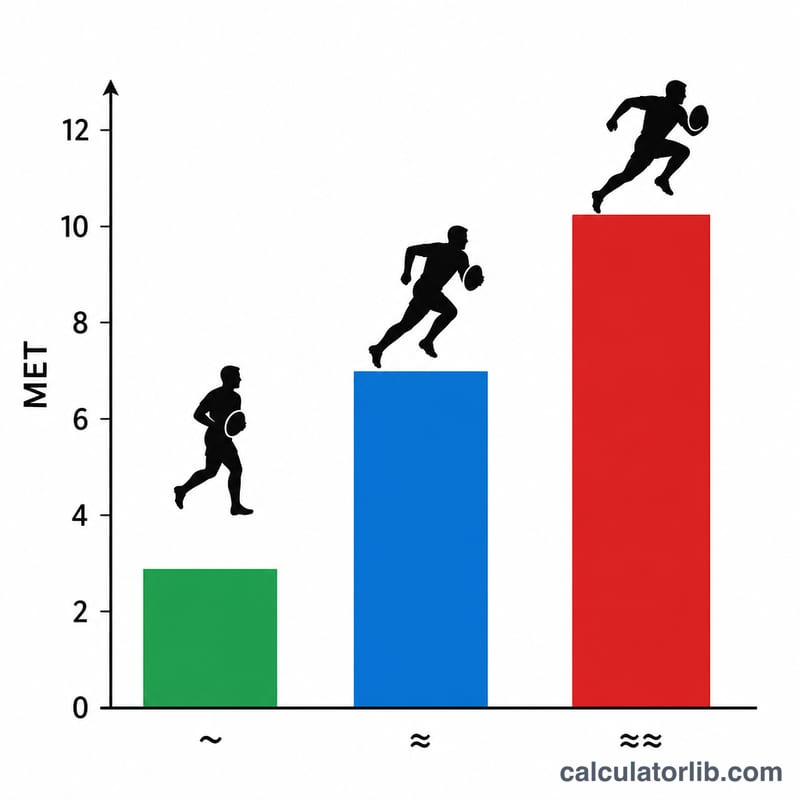
The Rugby Calories Burned Calculator estimates how much energy you expend playing rugby. It uses the internationally standard METs (metabolic equivalent of task) method, where the MET value for the activity is multiplied by your body weight, the time spent and a constant conversion factor. The MET values shown here come from the revised "METs of Physical Activity" table published by Japan's National Institute of Health and Nutrition, but the underlying physiology is universal, so the estimate applies anywhere.
How to use it
Pick your rugby intensity: Touch rugby / non-match play (6.3 METs) for lighter, casual play, or Union, team practice or match (8.3 METs) for full-contact training and games. Enter your session length in minutes and your body weight in kilograms, then read off the calories burned and the MET intensity used.
The formula explained
The calculation is:
$$\text{Calories (kcal)} = \text{MET} \times \text{body weight (kg)} \times \text{time (hours)} \times 1.05$$Time is first converted from minutes to hours by dividing by 60. The 1.05 factor represents kilocalories burned per kilogram of body weight per hour for each MET, which is the standard coefficient used in the METs-based energy expenditure method.
Worked example
Suppose you play a 60-minute union match (8.3 METs) and weigh 70 kg. First convert time: \(60 / 60 = 1.0\) hour. Then: $$8.3 \times 70 \times 1.0 \times 1.05 = 610.05 \text{ kcal}$$ A 90-minute touch session (6.3 METs) at 60 kg gives $$6.3 \times 60 \times 1.5 \times 1.05 = 595.35 \text{ kcal}$$
FAQ
Is this total or net calories? It estimates total energy expenditure during the activity, not the amount above your resting metabolism.
Why does heavier weight burn more? Energy cost scales with body mass, so a heavier player moving at the same intensity expends more calories.
How accurate is it? It is a useful approximation. Real expenditure varies with fitness, playing position, effort and rest periods, so treat the number as a guide.