
What is the Z-Score to Probability Calculator?
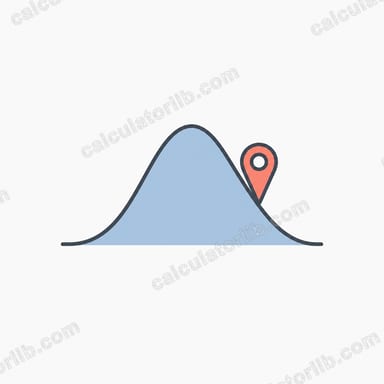
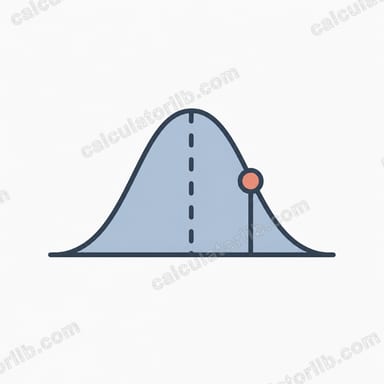
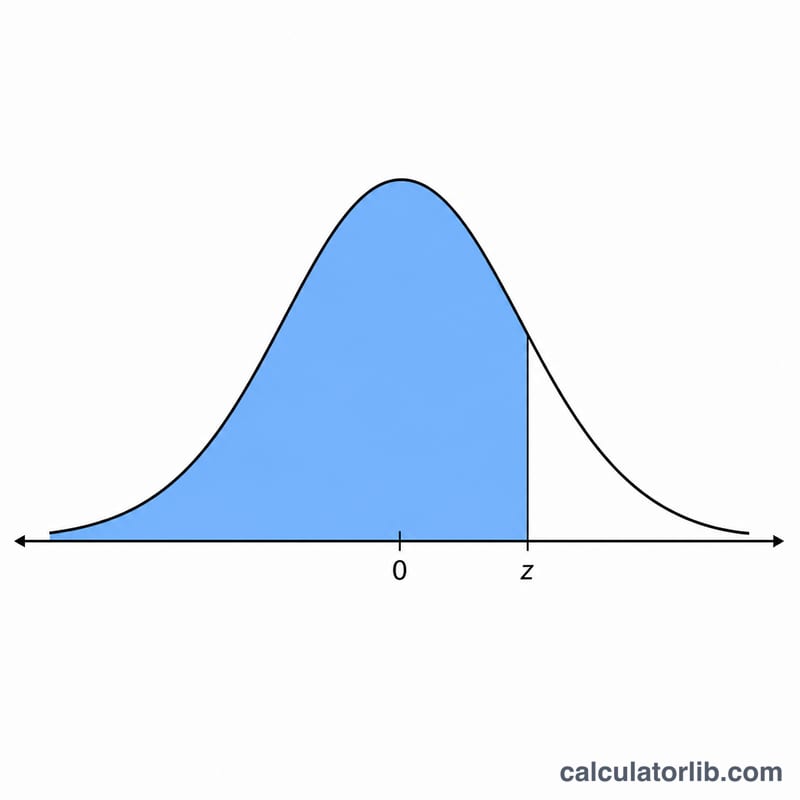
This tool converts a z-score (the number of standard deviations a value lies from the mean) into a probability using the standard normal cumulative distribution function (CDF), denoted \(\Phi(z)\). Probabilities are the foundation of hypothesis testing, confidence intervals, and percentile rankings, so turning a z into a probability is one of the most common tasks in statistics.
How to use it
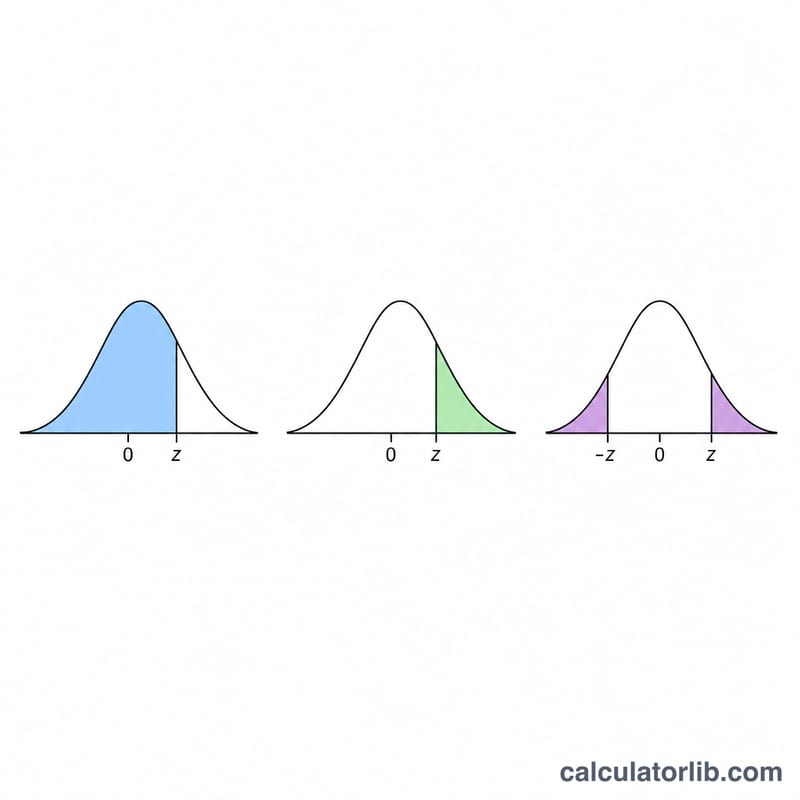
Enter your z-score and choose the probability type. Left tail gives \(P(Z < z)\) — the area to the left of z, which is the percentile. Right tail gives \(P(Z > z)\), useful for one-sided significance tests. Two-tailed gives \(P(|Z| > |z|)\), the combined area in both tails, used for two-sided tests. The result also shows all three values so you can pick whichever you need.
The formula explained
The standard normal distribution has mean 0 and standard deviation 1. Its CDF is written using the error function:
$$\Phi(z) = \frac{1}{2}\left[1 + \operatorname{erf}\!\left(\frac{z}{\sqrt{2}}\right)\right]$$
Because erf has no closed form, this calculator uses the Abramowitz & Stegun rational approximation (7.1.26), accurate to about \(1.5\times10^{-7}\) — more than enough for practical statistics.
Worked example
For \(z = 1.96\), the left-tail probability \(\Phi(1.96) \approx 0.975\). That means 97.5% of the distribution lies below 1.96. The right tail is $$1 - 0.975 = 0.025,$$ and the two-tailed value is $$2 \times 0.025 = 0.05$$ — which is exactly the familiar 5% significance threshold.
FAQ
What does a z-score of 0 give? \(\Phi(0) = 0.5\), since exactly half the distribution lies below the mean.
Can z be negative? Yes. A negative z gives a left-tail probability below 0.5; the symmetry \(\Phi(-z) = 1 - \Phi(z)\) holds.
Which probability is the p-value? For a one-sided test use the appropriate tail; for a two-sided test use the two-tailed value.