
What is the Solar Noon & Equation of Time Calculator?
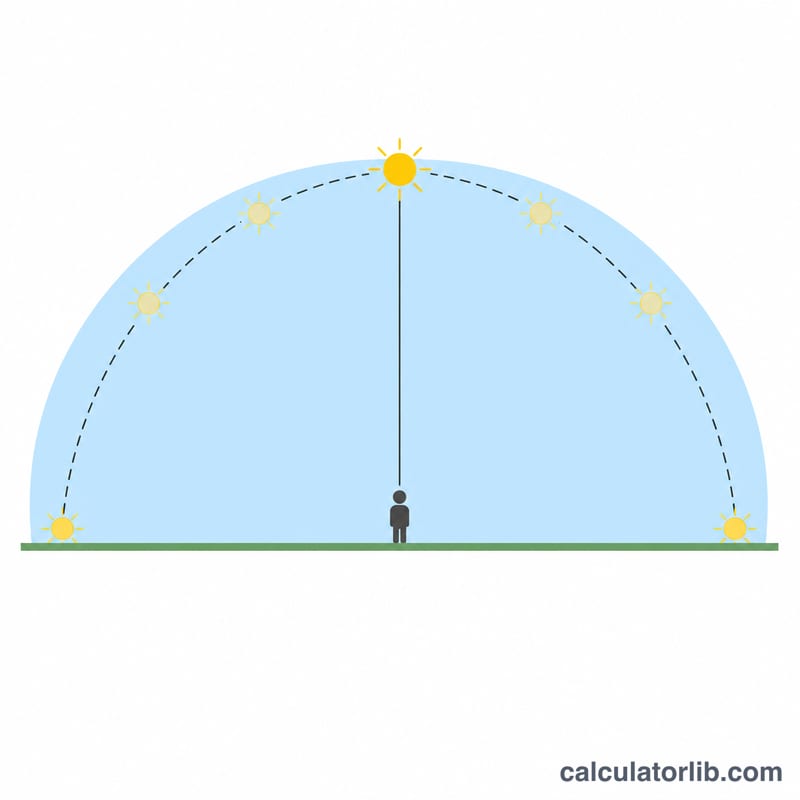
This universal astronomy tool computes, for any Gregorian year and any observer longitude and standard-time zone offset, two related quantities for each day of the year: the equation of time (the difference between mean and apparent solar time) and the solar noon — the clock time at which the real Sun crosses the local meridian. It also plots the yearly analemma-like curve of the equation of time. The defaults (longitude 135 degrees East, time zone +9 hours) correspond to Japan Standard Time, but you may enter any location worldwide.
How to use it
Enter the year (this sets 365 or 366 days), pick a sampling interval for the table and graph, then enter your longitude in decimal degrees (East positive, West negative) and your standard-time offset from UTC in hours (East positive). The headline shows the result for the sampled day nearest day-of-year 36 (early February); the full series is plotted below.
The formula explained
For day-of-year \(n\) with \(N\) days in the year, the fractional-year angle is \(\gamma = \frac{2\pi}{N}\,(n - 1)\) radians. The NOAA low-precision equation of time in minutes is
$$E = 229.18\,(0.000075 + 0.001868\cos\gamma - 0.032077\sin\gamma - 0.014615\cos 2\gamma - 0.040849\sin 2\gamma)$$where positive means the apparent Sun is ahead of the mean Sun. Solar noon on the standard clock is
$$\text{Solar Noon} = 12 + \left( \text{timeZone} - \frac{\text{longitude}}{15} \right) + \frac{E}{60}$$since the standard-time zone meridian sits at \(15 \times \text{timeZone}\) degrees and 15 degrees of longitude equals one hour.
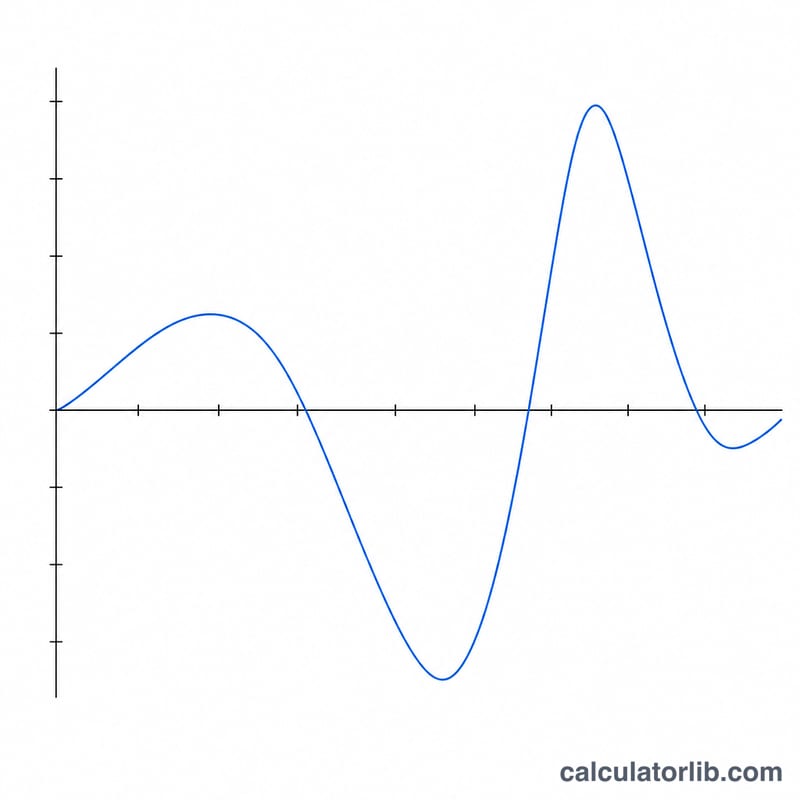
Worked example
For year 2024 (leap, \(N = 366\)), longitude 135 degrees East, time zone +9, day \(n = 36\) (Feb 5): \(\gamma = \frac{2\pi}{366} \times 35 = 0.60099\) rad, giving \(E \approx -13.73\) min (apparent behind mean). Solar noon
$$= 12 + \left( 9 - \frac{135}{15} \right) + \frac{-13.73}{60} = 12 + 0 - 0.2288 = 11.7712 \text{ h}$$about 11:46:16 standard time — roughly 14 minutes before clock noon.
FAQ
Why is the earliest sunset not on the winter solstice? Because the equation of time shifts solar noon day by day, the earliest sunset (e.g. in Tokyo around December 5) occurs before the solstice.
How accurate is this? The NOAA approximation is good to about plus or minus 0.5 minute — fine for the yearly graph, not for second-level precision.
What sign convention is used? The displayed equation of time is apparent minus mean (the usual analemma plot); the negative of this is the mean-minus-apparent convention.